What is a flexible denture and what is it made of?
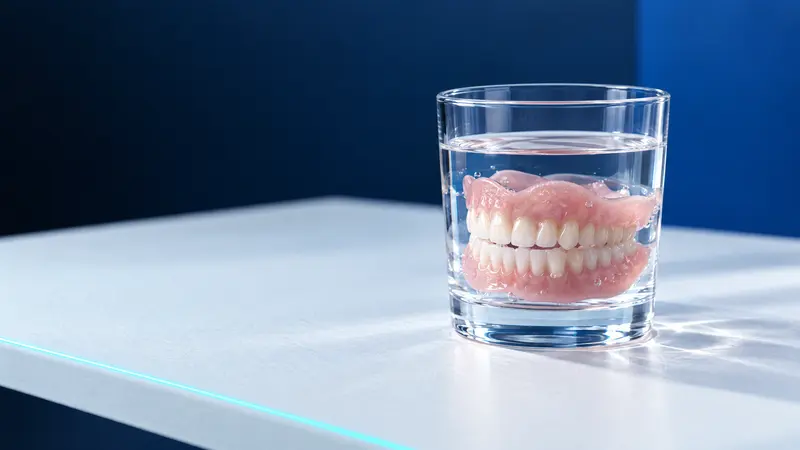
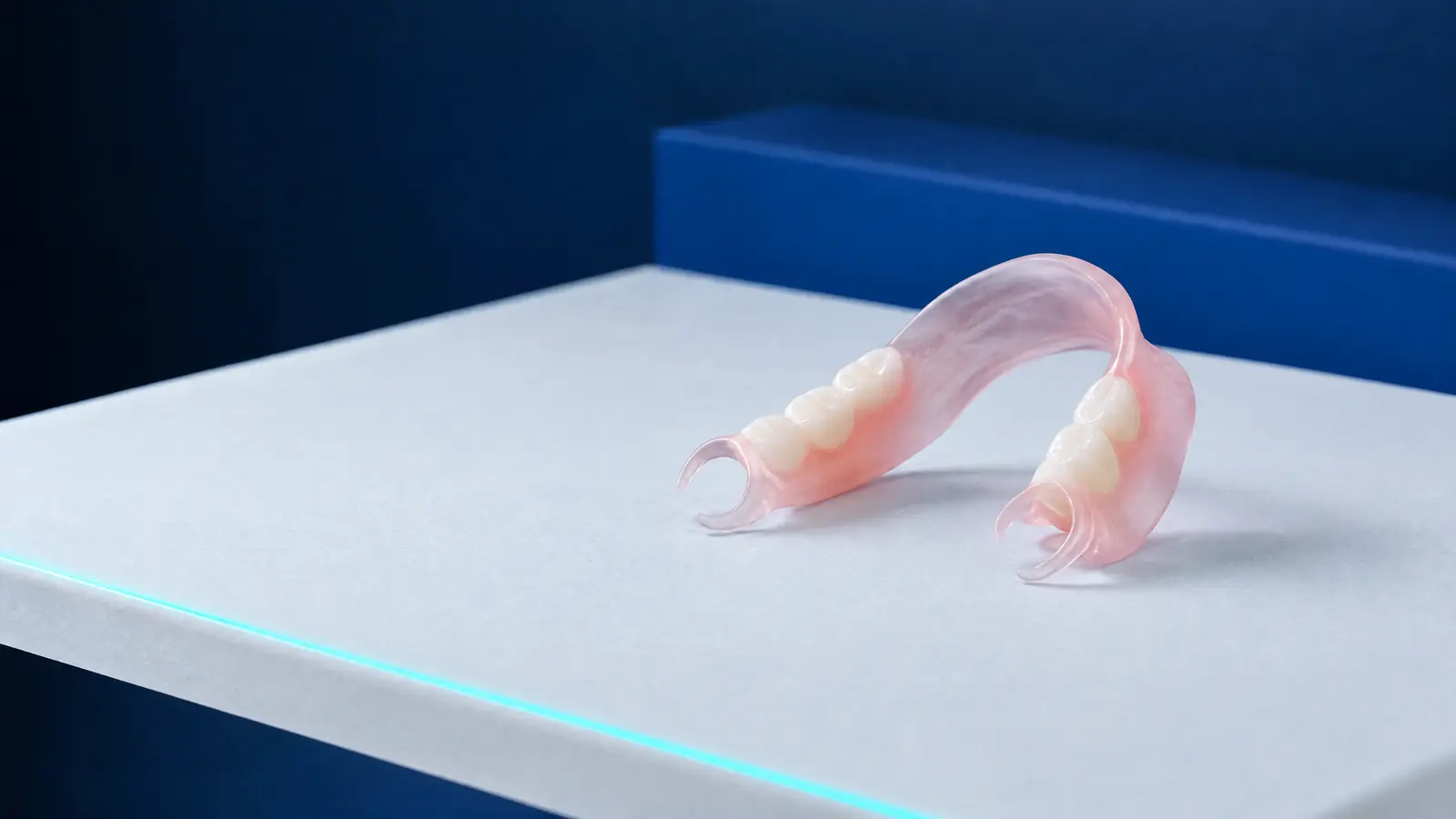
A flexible denture is a removable denture made of thermoplastic resin, which is melted in the laboratory and injected into a mould under pressure. A review by authors from Wroclaw Medical University includes nylons (polyamides), acetals, acrylic polymers and acrons in this group (Bogucki and Kownacka, 2018).
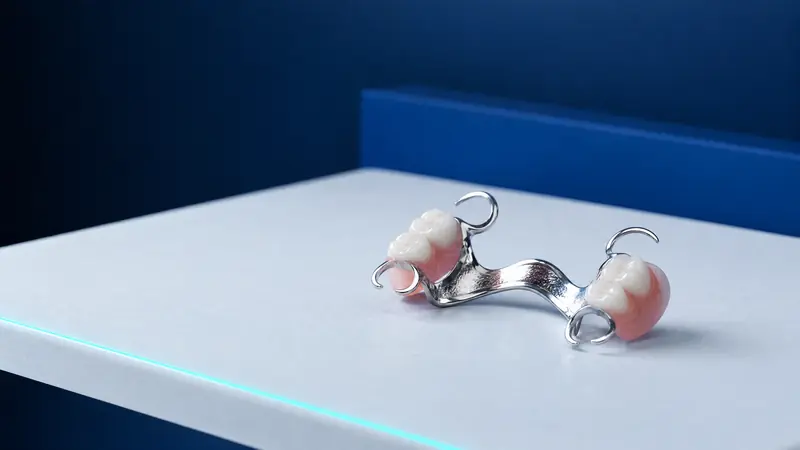
The Japan Prosthodontic Society calls these constructions non-metal clasp dentures and divides them into two types: flexible ones without a metal framework, and rigid ones combining resin clasps with a metal framework (Fueki et al., 2014). In everyday use, “flexible denture” usually means the first type.
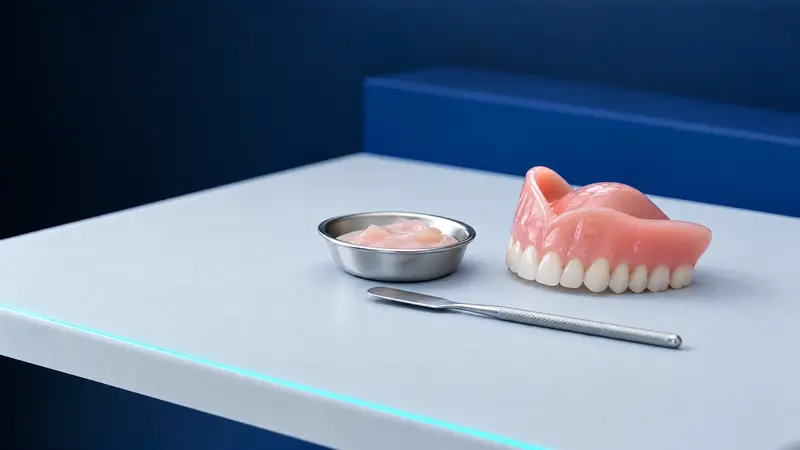
Appointments for a flexible denture follow a similar pattern to those for an acrylic denture: examination, impressions, bite registration and a try-in. Bogucki and Kownacka (2018) write that the main difference is in the laboratory stage, and that selecting patients appropriately for a particular material is essential.
Nylon, acetal or acron: how do the materials differ?
Flexible denture materials differ in elasticity, rigidity and the constructions they suit. According to the review by Bogucki and Kownacka (2018), nylons are used mainly for partial dentures, acetals for tooth-supported dentures and clasps, and acron, combining acrylic’s gloss with polyamide’s fracture resistance, for partial and complete dentures.
The table compares these materials with conventional acrylic and a metal framework. It describes material groups, as individual products have very different properties, a point made in the Japanese position statement (Fueki et al., 2014).
| Material | Properties | Typical use | Limitations |
|---|---|---|---|
| Acrylic (PMMA) | Rigid base, easy to adjust, repair and add a tooth to | Partial and complete dentures, including publicly funded ones | Wire clasps; acrylic allergy in some people |
| Nylon (polyamide) | Very flexible, gum-coloured clasps | Mainly partial dentures | Difficult to adjust and polish; yeasts adhere to it more readily |
| Acetal | Elastic, wear-resistant, available in many colours | Tooth-supported dentures, clasps | Clasps thicker than metal ones, which may make the tooth look bulkier |
| Acron | Acrylic’s gloss and polyamide’s fracture resistance | Partial and complete dentures | Does not bond chemically to acrylic teeth |
| Metal framework | Thin and rigid, transfers pressure to teeth | Metal partial and combination dentures | Visible clasps; unsuitable with metal allergy |
When does a metal-free denture make sense?
A metal-free denture makes sense mainly when a metal framework or clasps are not an option. The Japan Prosthodontic Society does not recommend flexible dentures without a framework as definitive dentures, except in limited situations such as metal allergy. When patients reject metal clasps for aesthetic reasons, it recommends a rigid construction with a metal framework (Fueki et al., 2014).
The review by Mendoza-Carrasco et al. (2020) concludes that non-metal clasp dentures should be recommended cautiously if they are intended for more than temporary use. In practice, flexible dentures may be considered in several situations:
- Confirmed allergy to a metal, such as chromium, cobalt or nickel, ruling out a metal partial denture.
- Allergy to acrylic that rules out a conventional acrylic base.
- A pronounced gag reflex; the Wrocław authors write that flexible dentures are less troublesome for these patients.
- A temporary denture during healing or while awaiting definitive treatment.
- A patient’s refusal of a visible metal clasp, although the Japanese position statement favours a rigid denture with a metal framework and resin clasps in this situation.
What are the drawbacks of flexible dentures?
Flexible dentures have several documented limitations, mainly related to the material and its processing. The Japan Prosthodontic Society’s position statement says thermoplastic resins generally have poorer colour stability and a greater risk of fracture than acrylic, and their surfaces become rough more easily (Fueki et al., 2014).
The review by Mendoza-Carrasco et al. (2020) adds that these dentures need laboratory relining, grinding and polishing, become rough and discoloured over time, and may compress the supporting tissues. Design criteria and long-term clinical studies are lacking.
Bogucki and Kownacka (2018) note that the yeast Candida albicans and the bacterium Staphylococcus aureus adhere more strongly to nylon than to acrylic, and mild inflammatory reactions have been described at sites of contact with the mucosa. Nylon dentures therefore need particularly careful hygiene.
Can a flexible denture be repaired or relined?
Flexible dentures can be adjusted and relined, but this is harder than with acrylic dentures because it requires laboratory work and special tools. According to Bogucki and Kownacka’s review (2018), thermoplastics should not be cut and heated again, as this causes brittleness, greater water absorption and discolouration.
The same authors write that thermoplastic dentures offer limited scope for modification once made, for example extending the base after another tooth is extracted. Polishing at too high a temperature may soften nylon, while unsuitable tools leave microscopic scratches that encourage discolouration.
If further teeth may be extracted over the next few years, the dentist takes this into account when choosing the material, as it is easier to add another tooth to an acrylic denture (Jagger, 2017).
Flexible dentures: patient opinions and research findings
Research on flexible dentures suggests better ratings for appearance, but not advantages in every respect. A November 2025 review by the Canadian health technology assessment agency CDA-AMC included 7 randomised studies and 1 non-randomised study: flexible dentures may improve ratings of appearance and satisfaction and perform similarly for speech, pain when eating, fractures and staining, whereas differences in retention and other assessed outcomes depended on the study and the measurement method.
Confidence in these conclusions is low. In one study, objectively measured retention of a flexible complete denture was significantly poorer than that of an acrylic denture; in another, artificial teeth fell out of flexible dentures more often after a year. The reviewers found no guidelines meeting the review’s inclusion criteria and no cost-effectiveness analyses applicable to the Canadian setting; they also note that thermoplastic dentures may be more expensive.
The Wrocław review’s authors write that most patients consider flexible dentures comfortable and attractive. This is an opinion rather than a comparative study result, so it should be considered alongside clinical research data.
How should you care for a flexible denture?
A flexible denture needs the same daily hygiene as any denture. The Wrocław reviewers stress that hygiene guidance and check-up schedules must be followed closely with these materials. Basic NHS advice for denture wearers includes:
- Wash the denture morning and evening with mild soap or washing-up liquid, without toothpaste, which may damage it.
- Rinse it in cold water after meals.
- Brush the remaining teeth, gums and tongue with fluoride toothpaste.
- Remove it at night unless your dentist advises otherwise.
- Store a nylon denture in a moist environment, as the Wrocław authors recommend for some nylons.
- See a dentist if it presses on tissues, becomes loose or is damaged.
How much do flexible dentures cost and what affects the price?
The price of a flexible denture depends on the resin, the number of missing teeth and clasps, and any treatment needed before it is made. The CDA-AMC review (2025) notes that thermoplastic dentures may cost more than conventional ones, and the NFZ, Poland’s National Health Fund, does not fund them.
Part of the cost comes from the technology. Bogucki and Kownacka (2018) describe injection-moulding the denture on a duplicated model in a special machine, with strict control of melting temperature, injection time, pressure and cooling; errors at this stage cause air bubbles, teeth coming out and poor base adaptation.
For comparison, the clinic’s price list gives “Proteza acetalowa” (acetal denture) at 3 500 zł, “Proteza akronowa” (acron denture) at 3 000 zł, “Proteza szkieletowa” (metal partial denture) at 3 500 zł, and “Proteza akrylowa całkowita/częściowa” (complete/partial acrylic denture) at 2 500 zł or 2 000 zł. The dentist sets the final cost at the consultation, and prices may change.
How it works at DentalBlue
At DentalBlue in Białystok, prosthodontics is one of five specialist teams at one address. The dentist selects the material and denture design at a prosthodontic consultation (300 zł in the clinic’s price list) after examining the teeth and gums; the clinic’s own radiology unit takes panoramic X-rays. “Klamra acetalowa” (acetal clasp) is a separate price-list item (700 zł). The dentist sets the final scope and cost, and prices may change. A consultation can be booked by phone.
Frequently asked questions
Does the NFZ fund flexible dentures?
No. The regulation on guaranteed dental services provides adults only with acrylic dentures: partial dentures when at least 5 teeth are missing in an arch, and complete dentures, once every 5 years. Nylon, acetal and acron dentures are paid for privately (legal status as of 24 October 2026).
How long do flexible dentures last?
There is no reliable figure. The Japanese position statement stresses that studies of effectiveness and long-term follow-up are insufficient, while some results in the 2025 CDA-AMC review cover only a year. Lifespan is affected by the resin, design, hygiene and changes in the supporting tissues.
Is a flexible denture suitable for someone with no teeth?
Rarely. The Wrocław reviewers write that acetal and nylon dentures are not used for people with no teeth, whose dentures rely mainly on adhesion of the base; they also list acron as a material for complete dentures. In one study, a flexible complete denture had poorer retention than an acrylic one (CDA-AMC, 2025).
Is an acetal denture flexible?
Acetal is one of the thermoplastics used to make flexible dentures. The Wrocław review describes it as elastic and wear-resistant, yet sufficiently rigid, which is why it is used for tooth-supported dentures and clasps.
Can you sleep with a flexible denture in?
Usually not. The NHS advises removing dentures at night unless your dentist recommends otherwise. With a nylon denture, ask the dentist how to store it, as some nylons need a moist environment.
Sources
- Journal of Prosthodontic Research: Fueki K et al., non-metal clasp dentures, part I: definition and indications (2014)
- Journal of Prosthodontic Research: Fueki K et al., non-metal clasp dentures, part II: material properties (2014)
- CDA-AMC (Canada’s Drug Agency): Flexible Dentures for Edentulism, rapid review (2025)
- Advances in Clinical and Experimental Medicine: Bogucki ZA, Kownacka M, flexible dentures, literature review (2018)
- Journal of Indian Prosthodontic Society: Mendoza-Carrasco I et al., non-metal clasp dentures, evidence review (2020)
- NHS: Dentures (2025)
- NHS Scotland: Jagger R, Successful partial dentures, training materials (2017)
- ELI: Rozporządzenie MZ w sprawie świadczeń gwarantowanych z zakresu leczenia stomatologicznego, t.j. Dz.U. 2025 poz. 615
An informational article. It does not replace a consultation, and treatment decisions are made during a visit.