Does an upper denture have to cover the palate?
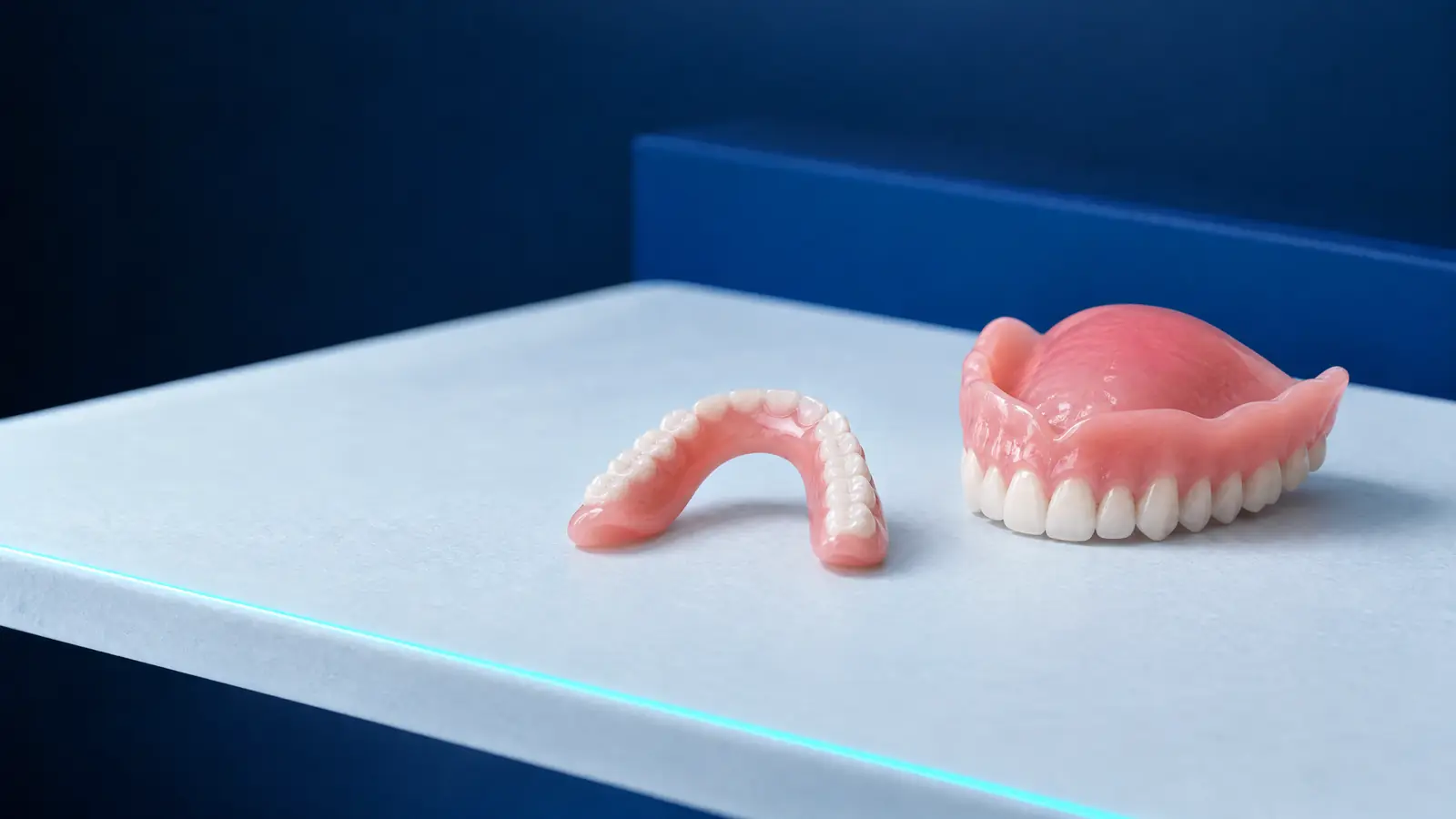
An upper complete denture supported only by the gum usually has to cover the palate, as this is its main supporting surface. Cleveland Clinic explains that complete dentures rest on the palate and, in the lower jaw, on the bony ridge.
The situation differs when natural teeth remain in the arch or implants have been placed. Teeth or implants then provide some support and retention, allowing the palatal plate to be reduced or replaced with a narrow connector. The number and distribution of teeth or implants determine how much of the palate can be left uncovered.
Why does a palatal plate help retain a complete denture?
The palatal plate gives an upper complete denture support and a large area of contact with the mucosa; a denture without abutment teeth has no other components to replace this. A conventional gum-supported complete denture therefore covers the palate, and the dentist determines the position of its back edge.
A small Norwegian study in 1986 investigated how much retention the palate alone provides. Fløystrand et al. reduced upper denture plates in 20 people to a U-shape, with the edge about 10 mm from the dental arch: resistance to tilting forces did not change significantly, and patients rated retention during eating as unchanged.
Several people did, however, report poorer retention between meals. This is an old study with a small group, so it cannot determine an individual’s outcome, but it shows that a horseshoe denture without tooth or implant support is a compromise rather than a full substitute for a palatal plate.
When is a denture without full palatal coverage possible with natural teeth?
A denture without full palatal coverage is possible mainly as a tooth-supported partial denture, usually with a metal framework. NHS Scotland training materials describe tooth-supported dentures as supported by rests on both sides of the saddles rather than by the connector, with better support and retention than mucosa-supported dentures (Jagger, 2017).
The upper major connector can then be an anterior, middle or posterior plate, or a frame-shaped connector leaving the centre of the palate uncovered. The same materials recommend keeping the connector away from gum margins wherever possible.
An acrylic partial denture, supported mainly by mucosa, is different. According to Jagger, it needs broad support, so it usually covers much of the palate; the article on metal partial dentures explains framework designs in more detail.
Palateless implant dentures: how many implants are needed?
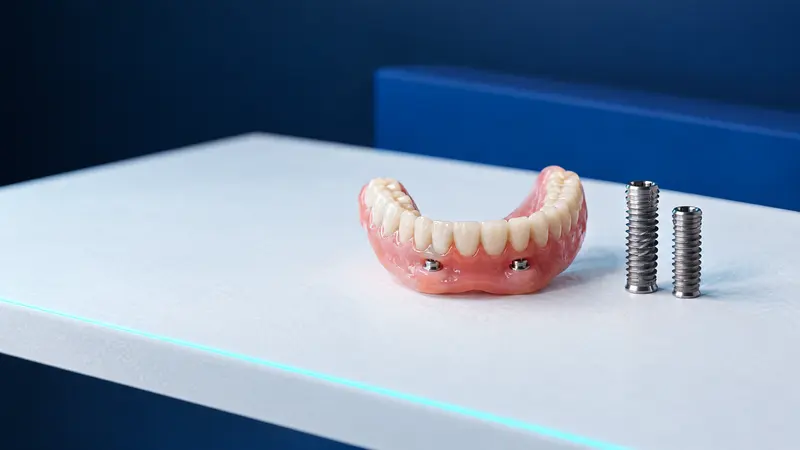
A palateless implant denture in the upper jaw usually needs at least 4 implants. The systematic review by Raghoebar et al. (2014) notes that there is no consensus for upper implant dentures and that all included studies used at least 4 implants. With bar-connected implants, annual implant and denture survival exceeded 95%, while 4 or fewer implants with individual attachments carried a greater risk of implant loss.
The review by Sadowsky and Zitzmann (2016) describes successful use in some studies of a palateless design on 4 to 6 implants widely spaced from front to back of the arch. The authors add that individual attachments need more frequent maintenance, while inflammation is more common under bars.
Fewer implants have been investigated in small studies. In Zembic et al. (2015), 21 people wore dentures on 2 implants for 2 months with a palatal plate, then for 2 months with a reduced plate. Quality of life did not differ, while patients rated appearance and taste more highly without palatal coverage. The dentist determines implant number and positions using cone-beam computed tomography (CBCT).
What does treatment with a palateless upper implant denture involve?
Treatment starts with an examination and a CBCT scan, and sometimes with making a new conventional complete denture. This was the sequence in the 5-year study by Sude et al. (2025): participants first received a new conventional denture, then had 4 implants placed, and finally received a palateless denture clipped onto the implants.
In Zembic et al. (2015), patients initially wore an implant denture with a full plate, which was reduced only after 2 months. This approach makes it possible to compare how the denture functions before and after the palatal plate is reduced. The typical stages are:
- Examination, panoramic X-ray and CBCT scan showing the height and width of bone in the upper jaw.
- Planning the number and positions of implants; palateless denture studies usually used 4 to 6 implants.
- Implant placement and a healing period during which the patient wears their existing or a new denture.
- Making a denture with individual attachments or a bar, and fitting it with instructions on cleaning the implants.
- Check-ups at which the dentist assesses the implants and replaces worn attachment inserts.
Are fixed implant teeth a palateless option?
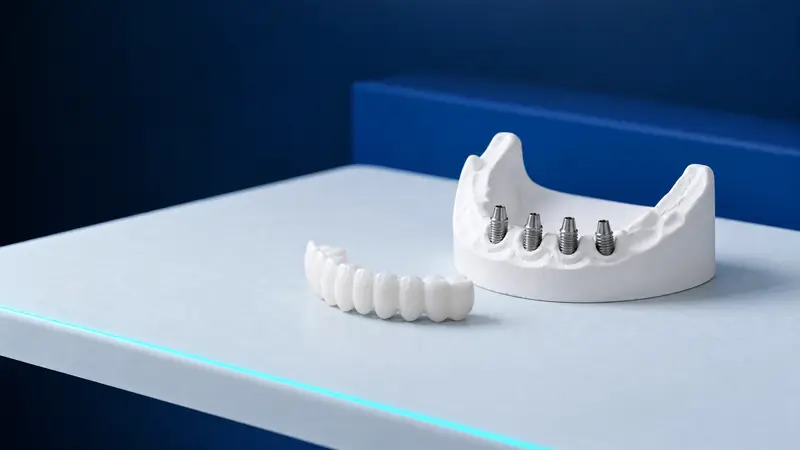
Fixed implant teeth, meaning a full-arch bridge screwed or cemented onto implants, do not cover the palate at all. Only a dentist removes this construction, and the patient cleans it in the mouth, much like a bridge on natural teeth.
A full-arch bridge requires enough implants and bone, so the decision follows an examination and scan. Separate articles on all-on-4 and implant dentures discuss the differences between fixed implant teeth and an overdenture, including costs and maintenance.
What do you gain and give up without palatal coverage?
A palateless denture primarily gives more freedom in the mouth. In Zembic et al. (2015), patients rated taste and appearance more highly without a palatal plate; in Fløystrand et al. (1986), three reported improved taste and one reported that an intermittent gag reflex had stopped.
The trade-off is usually implants and their maintenance. In a 5-year study of 9 people with palateless upper dentures on 4 implants, all implants survived. The most common issue was replacing nylon attachment inserts, on average about 4 times per person over 5 years (Sude et al., 2025).
The table summarises when palatal coverage can be reduced and how.
| Situation | Can palatal coverage be reduced? | How it is done |
|---|---|---|
| Gum-supported complete denture | Usually not; the palate provides support | Full plate; a horseshoe denture is a compromise |
| Acrylic partial denture | Usually not, as it rests on mucosa | Broad palatal coverage |
| Metal partial denture on natural teeth | Yes, if abutment teeth provide support; the connector still covers part of the palate | Rigid connector: anterior, middle or posterior plate, or frame-shaped connector |
| Upper denture on 2 implants | Evidence only from small, short studies | Plate reduced after a period with full coverage |
| Denture on 4 to 6 implants | Yes, with good outcomes in some studies | Implants widely spaced across the arch, with a bar or individual attachments |
| Fixed implant bridge | Yes; the construction does not cover the palate | Screw-retained or cemented bridge, removed by the dentist |
How much does a palateless upper denture cost?
The cost depends on what takes over the plate’s role: natural teeth, implants with an overdenture, or a fixed implant bridge. A metal partial denture on natural teeth has the fewest components; implant options add implant placement, scans and later attachment maintenance to the denture price.
In the clinic’s price list, “Proteza szkieletowa” (metal partial denture) costs 3 500 zł and “Proteza na 4 implantach” (denture on 4 implants) 16 000 zł; “Wszczepienie implantu” (implant placement, 3 500 zł) and “Konsultacja implantologiczna” (implant consultation, 300 zł) are separate items. The NFZ, Poland’s National Health Fund, does not fund implants or implant dentures and funds only acrylic dentures for adults (legal status as of 24 October 2026). The dentist sets the final scope and cost at the consultation, and prices may change.
How it works at DentalBlue
At DentalBlue, implants are planned using CBCT images from the clinic’s own radiology unit, with prosthodontics, surgery and implantology at one address. The dentist determines whether the palate can be left uncovered and which construction is possible after an examination and scan. “Wizyta bez bólu” (visit without pain, 300 zł) includes a panoramic X-ray, consultation, examination and written treatment plan. Prices may change. A consultation can be booked by phone.
Frequently asked questions
Does a palateless denture change the taste of food?
It may improve taste perception, although the evidence comes from small studies. In Zembic et al. (2015), people with implant dentures rated taste more highly after reduction of the palatal plate; in Fløystrand et al. (1986), 3 of 20 people with complete dentures reported better taste.
Does a palateless denture help with a gag reflex?
Sometimes, but the evidence is sparse. In Fløystrand et al. (1986), an intermittent gag reflex stopped in one of 20 people after plate reduction. With a strong gag reflex, the dentist may consider a tooth- or implant-supported construction that allows a smaller plate.
Can an old denture be converted to a palateless one?
Sometimes. Studies have reduced palatal plates in existing dentures, both conventional and implant-retained. Without abutment teeth or implants, however, retention may be poorer between meals, so the dentist decides after assessing the fit and supporting tissues.
Can a palateless denture fall out?
A complete denture without palatal coverage or implants may have poorer retention: several people in Fløystrand et al. reported worse retention between meals. Implant dentures are retained by attachments or a bar, but attachment inserts wear out and need periodic replacement (Sude et al., 2025).
Sources
- Cleveland Clinic: Dentures (2023)
- Acta Odontologica Scandinavica: Fløystrand F et al., reduced palatal coverage in upper complete dentures (1986)
- NHS Scotland: Jagger R, Successful partial dentures, training materials (2017)
- European Journal of Oral Implantology: Raghoebar GM et al., upper implant dentures and implant numbers, systematic review (2014)
- International Journal of Oral and Maxillofacial Implants: Sadowsky SJ, Zitzmann NU, upper implant dentures, systematic review (2016)
- Clinical Implant Dentistry and Related Research: Zembic A et al., upper implant dentures with and without palatal coverage (2015)
- Journal of Oral Rehabilitation: Sude A et al., palateless upper denture on 4 implants, 5-year outcomes (2025)
- ELI: Rozporządzenie MZ w sprawie świadczeń gwarantowanych z zakresu leczenia stomatologicznego, t.j. Dz.U. 2025 poz. 615
An informational article. It does not replace a consultation, and treatment decisions are made during a visit.