What does ‘occlusal disease’ mean?
Occlusion is how your upper and lower teeth meet. If you hear the term ‘occlusal disease’, ask whether it refers to muscle or joint pain, restricted jaw movement or damage to the teeth. These problems can occur together, but they each need to be assessed separately.
The name suggests that a bad bite is the cause, but current research does not support this. The 2014 international DC/TMD diagnostic criteria list 12 common temporomandibular disorders (TMD), including pain in the chewing muscles, joint pain, disc displacement, degenerative changes in the joint and headache attributed to TMD. ‘Occlusal disease’ is not on the list.
After an examination, ask what the dentist has found: muscle pain, a joint problem, tooth wear or several of these together. The plan depends on the diagnosis because muscle pain and a cracked tooth need different care.
What symptoms are described as ‘occlusal disease’?
The term can refer to different symptoms affecting the teeth, chewing muscles, joints or temples. According to the US National Institute of Dental and Craniofacial Research (NIDCR), the most common symptom of temporomandibular disorders is pain in the chewing muscles or jaw joint. The DC/TMD criteria also distinguish headache around the temples that changes with jaw movement.
According to the NIDCR, painless joint clicking is common and does not need treatment. Fever with facial swelling needs urgent assessment. If facial or neck swelling increases rapidly, or you have difficulty breathing or swallowing, call 112 or go to a hospital emergency department (SOR). If your jaw locks after a facial injury, get an urgent examination.
| Area | Typical symptoms | What it usually means |
|---|---|---|
| Teeth | Worn, chipped or cracked teeth and fillings that are breaking down | Excessive force is one possible cause of the damage. The dentist checks for other causes too. |
| Chewing muscles | Pain or fatigue in the cheek and temple muscles, and a stiff jaw | Pain in the chewing muscles, a common form of TMD |
| Temporomandibular joints | Pain in front of the ear, painful clicking, locking of the jaw and restricted mouth opening | Joint pain, disc displacement or, less often, degenerative changes |
| Head and ears | Pain around the temples that gets worse with chewing, ringing in the ears and dizziness | Pain around the temples that worsens with jaw movement may be linked to TMD. Ringing in the ears and dizziness need separate assessment. |
| Bite | A feeling that the teeth fit together differently | Can result from changes in the joint rather than causing them |
Can a bad bite cause jaw joint pain and headaches?
Current research suggests that the bite plays a small role in TMD. The NIDCR says research does not support the idea that a bad bite or treatment with braces causes TMD.
A 2017 systematic review by Manfredini et al. covered 25 studies in adults and nearly 40 features of the bite. Only two were associated with TMD in most simple analyses: a slide of the lower jaw into full tooth contact and an interfering contact on the side opposite the direction of jaw movement. Only the latter remained associated in analyses accounting for several factors. The authors stress that an association does not establish a cause, because interfering contacts can result from the disorder. They encourage clinicians to move away from the older view that the bite is the main cause of TMD.
The DC/TMD criteria reach a similar conclusion. Bite tests did not improve the accuracy of any diagnosis, although the bite is recorded at the first examination because disc displacement or degenerative joint changes can alter it. A headache alone does not establish a bite problem. The criteria link it to TMD if it affects the temples, varies with jaw movement and can be reproduced during the examination.
Do teeth need to be ground down to ‘even out the bite’?
Treatment for pain in the chewing muscles or temporomandibular joint does not start with permanently changing the bite. The NIDCR advises against grinding down teeth, crowns or orthodontic treatment for this purpose because the benefits are poorly documented and symptoms may worsen.
A 2024 Cochrane review set out to assess splints and grinding down teeth, but all 57 included studies looked at splints. The review did not establish whether grinding down teeth relieves pain. The procedure permanently removes enamel, so before you decide, ask about the expected benefits, risks and available reversible options.
‘Filling adjustment’ is a separate procedure for a new filling that is too high and hurts when you bite. It restores the previous contact on one tooth without changing the bite as a whole. DentalBlue lists it at 100 zł.
How does treatment for these symptoms start?
Treatment starts with simple, reversible measures. The NIDCR says that TMD symptoms go away without treatment in many people and recommends the steps below as a starting point.
If those steps are insufficient, the NIDCR lists physiotherapy, including manual therapy that may improve jaw movement and reduce pain. It also lists cognitive behavioural therapy and biofeedback, usually provided by a psychologist. The NIDCR says evidence for choosing the most effective medicine is limited. Some medicines can be habit-forming, so take them as directed by a clinician.
- Eat soft foods.
- Apply a warm or cold compress and combine it with gentle jaw muscle exercises.
- Notice when you clench your teeth, and cut down on chewing gum and biting your nails.
- Make time to unwind and practise relaxation techniques.
- Choose a painkiller with a pharmacist or clinician.
Can an occlusal splint help with these symptoms?
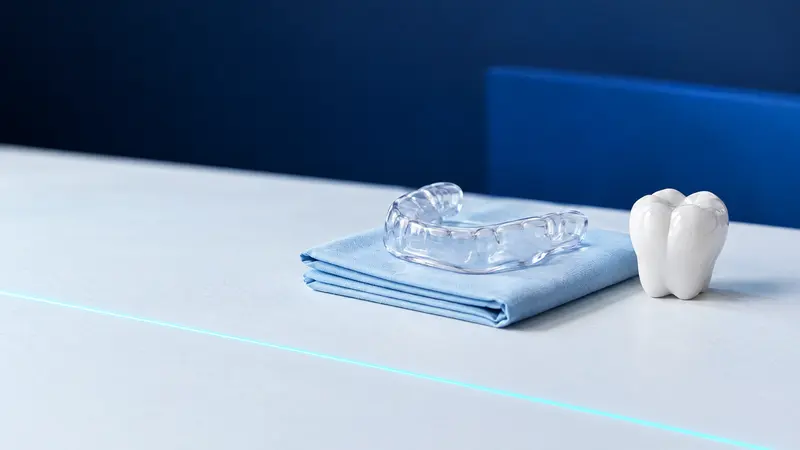
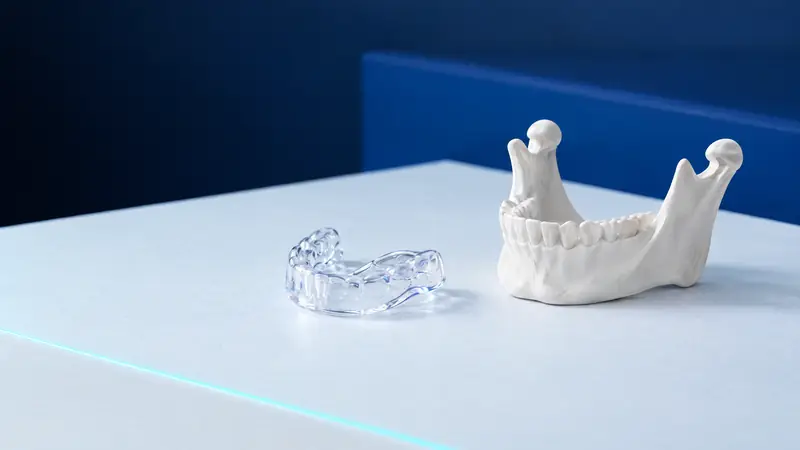
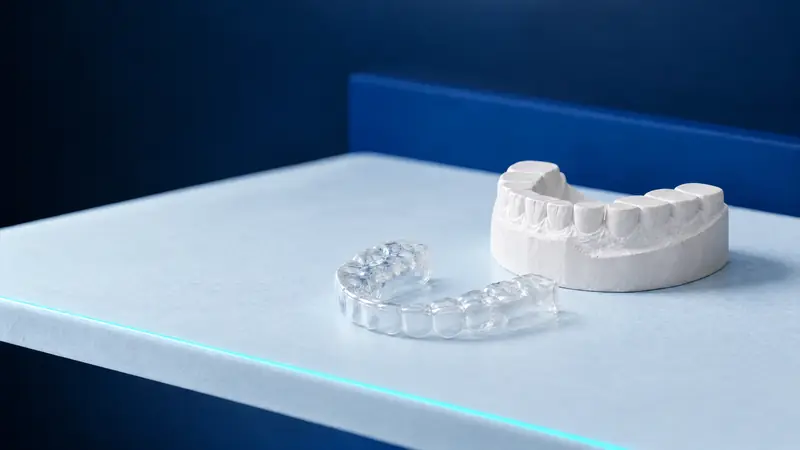
A relaxation or occlusal splint fits over the teeth and is often worn at night. A dentist may fit one to protect the teeth from clenching or grinding. It remains uncertain whether splints relieve TMD pain.
A 2024 Cochrane review included 57 studies with 2,846 participants. In one comparison, a hard stabilisation splint may have reduced muscle pain when chewing compared with no treatment, but the certainty of the evidence was very low. The data did not establish who benefits from splints or by how much.
A splint used for TMD should not be designed to change your bite permanently. If it makes the pain worse, stop using it and contact your dentist. The NIDCR also considers the evidence for botulinum toxin in TMD inconclusive.
When does restoring teeth require bite planning?
A dentist may suggest restoration if wear, a crack or missing teeth make biting difficult or put a tooth at risk of further damage. Crowns can restore teeth, but the NIDCR does not recommend them to treat TMD pain.
Before restoring a tooth, the dentist assesses what caused the damage and plans how to limit further wear or excessive forces. For extensive restorations or replacement of missing teeth, the dentist also checks how the upper and lower teeth meet. You can discuss the scope of treatment at a prosthetic consultation.
What does the dentist check when these symptoms suggest an occlusal problem?
The DC/TMD criteria describe the patient history and clinical examination as the basis for diagnosis. The NIDCR adds that there is no single standard test for TMD, and pain around the jaw can have another source that the clinician needs to rule out.
Imaging is used when the result could affect diagnosis or treatment. MRI can show the position of the joint disc, and CT helps assess changes in the bones of the joint. Painless clicking alone, without restricted movement, usually does not need imaging.
- History: where and when it hurts, whether you have headaches, whether you clench or grind your teeth, how you sleep and what medicines you take.
- Pressure on the chewing muscles and joints, and jaw movements, to see whether they reproduce the pain you typically feel.
- Measurement of mouth opening. If disc displacement without reduction is suspected, the DC/TMD criteria define limited opening as less than 40 mm when maximum assisted opening is measured and the overlap of the incisors is included.
- Assessment of the teeth, fillings and joint sounds, and a record of the bite.
- Models or scans if a splint or restoration is planned, and imaging only when needed.
Jaw pain and bite assessment at DentalBlue in Białystok: costs, NFZ and booking
At DentalBlue in Białystok, the starting point is a ‘First visit without pain’ for 300 zł. It includes a panoramic X-ray, consultation, examination and a written treatment plan. If a particular tooth hurts, a ‘First visit in pain’ for 340 zł is appropriate. The clinic’s own radiology unit takes X-rays and CBCT scans. If one tooth hurts and its filling is too high, the dentist can assess whether it needs a ‘Filling adjustment’. Prices may change, and the final scope and cost are set at the consultation.
Poland’s National Health Fund (NFZ) lists one dental examination per calendar year and three check-ups a year. Its general list of dental services does not include a relaxation splint for pain in the chewing muscles or teeth grinding (as of November 2026). The NFZ ‘Gdzie się leczyć’ search (‘Where to get treatment’) lists contracted practices.
DentalBlue is at ul. Kazimierza Pułaskiego 35, 15-337 Białystok, at the junction with Wspólna. The ‘Pułaskiego/Wspólna’ stop is 50 m from the entrance and is served by bus routes 16, 23 and 26. The clinic opens from 8:00 to 20:00 Monday to Friday and from 8:00 to 16:00 on Saturdays. It is closed on Sundays. Call 85 748 00 50 in Polish, English, Ukrainian or Russian. Mention jaw pain, clenching or worn teeth and ask for a ‘First visit without pain’. Bring the items below.
- A list of your medicines and details of any long-term conditions.
- Notes about symptoms, such as morning headaches.
- Your current splint, even if it is damaged or you no longer wear it.
- Previous dental X-rays and treatment records.
| DentalBlue price list item | Price | When it applies |
|---|---|---|
| ‘First visit without pain’ | 300 zł | First visit with a written treatment plan |
| ‘Dental consultation’ | 300 zł | Assessment of teeth and fillings |
| ‘Prosthetic consultation’ | 300 zł | Restoring worn teeth or replacing missing teeth |
| ‘Filling adjustment’ | 100 zł | A single filling that is too high |
| ‘Occlusal splint’ | 600 zł | Separate item. The clinician chooses the type of splint. |
| ‘Hard relaxation splint’ | 1 250 zł | Separate item. The clinician chooses the type of splint. |
| ‘Bruxism (both cheeks)’ | 900 zł | Botulinum toxin, listed under aesthetic medicine. The evidence is uncertain. |
Frequently asked questions
Is ‘occlusal disease’ serious?
How urgently you need care depends on your symptoms. Many TMD symptoms settle, but rapidly increasing facial or neck swelling or difficulty breathing or swallowing needs immediate help. Go to SOR or call 112.
Can a bad bite cause headaches?
Research does not confirm this. A review of 25 studies found no clinically significant link between bite features and TMD. Pain around the temples that gets worse with jaw movement may come from TMD, which a clinician assesses during an examination.
Is ‘occlusal disease’ treated by grinding down teeth?
Treatment for muscle or joint pain does not start with grinding down teeth. Evidence for its benefit is uncertain, and it permanently removes some enamel. Adjusting a single filling that is too high is done for a different reason.
How much does treatment for ‘occlusal disease’ cost?
It depends on the diagnosis. DentalBlue lists a ‘First visit without pain’ at 300 zł, an ‘Occlusal splint’ at 600 zł and a ‘Hard relaxation splint’ at 1 250 zł. The final scope and cost are set at the consultation.
Does the NFZ cover treatment for ‘occlusal disease’?
The NFZ covers an annual dental examination and check-ups. It does not list relaxation or occlusal splints for pain in the chewing system or for grinding among covered services (as of November 2026). The NFZ ‘Gdzie się leczyć’ search lists contracted practices.
Who should I see for symptoms described as ‘occlusal disease’?
Start with a dentist, who will check your teeth, muscles and joints and rule out other sources of pain. The NIDCR also lists physiotherapy, including manual therapy, and cognitive behavioural therapy, usually provided by a psychologist.
Sources
- Journal of Oral & Facial Pain and Headache: Schiffman E et al., DC/TMD diagnostic criteria (2014)
- Journal of Oral Rehabilitation: Manfredini D, Lombardo L, Siciliani G, temporomandibular disorders and dental occlusion, systematic review (2017)
- Cochrane: Singh BP et al., occlusal interventions for managing temporomandibular disorders, CD012850 (2024)
- NIDCR: TMD (Temporomandibular Disorders)
- ELI: Rozporządzenie Ministra Zdrowia w sprawie świadczeń gwarantowanych z zakresu leczenia stomatologicznego (Minister of Health regulation on guaranteed dental treatment services), consolidated text, Journal of Laws 2025, item 615
- DentalBlue: published price list, splints, consultations and first visit
An informational article. It does not replace a consultation, and treatment decisions are made during a visit.