How long does pain last after getting braces?
Pain after getting fixed braces usually starts within a few hours, is most commonly felt in the first 24 hours and eases within a week. In a study of 170 patients (Scheurer et al., 1996), 65% reported pain after 4 hours and 95% after 24 hours, while 25% still felt discomfort after 7 days.
Front teeth hurt more than back teeth in this study, and 18% of patients woke because of pain on the first night. Pain did not depend on whether patients had a partial brace, a full brace on one arch or braces on both arches.
The British Orthodontic Society (BOS) says teeth are usually tender for 3 to 5 days after fitting braces and after each adjustment appointment. Bonding the brackets itself should not hurt; tenderness in the gums and teeth occurs because the teeth are beginning to move.
What helps with tooth pain after getting braces?
Over-the-counter painkillers have the strongest evidence for pain after getting braces. A 2017 Cochrane review (32 studies, 3 110 participants) found that painkillers reduced pain after 2, 6 and 24 hours more effectively than placebo or no treatment, with moderate-quality evidence.
The same review found no difference in effectiveness between the two most commonly compared groups of painkillers. Choose a medicine according to its leaflet and your own contraindications, discussing it with a doctor or pharmacist if you are unsure.
A 2016 Cochrane review considered the evidence for non-drug methods, such as chewing gum, bite wafers and vibration devices, uncertain because the studies were of very low quality. The simple measures below can make the first few days easier.
- Soft foods for the first few days: soups, pasta dishes, yoghurt and cheese, as recommended in the BOS leaflet on eating with braces.
- Cutting sandwiches, fruit and vegetables into small pieces rather than biting pieces off.
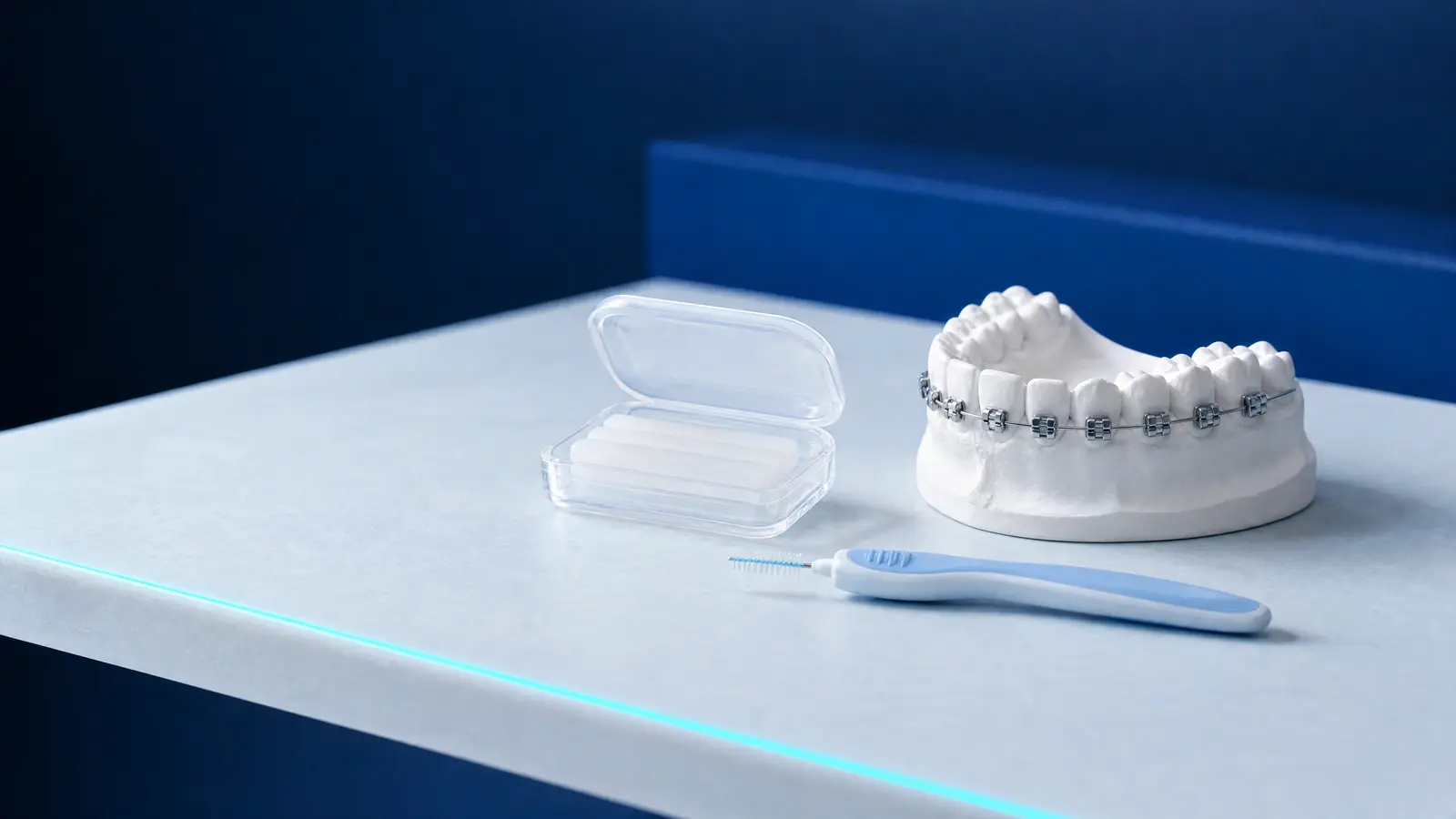
- Orthodontic wax on a bracket that rubs against the cheek or lip.
- Rinsing with warm salt water if a bracket or wire cuts the cheek, as advised by the American Association of Orthodontists (AAO).
- An over-the-counter painkiller for a day or two, used according to the leaflet.
What can you eat with fixed braces, and what should you avoid?
You can eat almost everything with fixed braces, but hard foods need cutting up and sticky ones should be avoided. The BOS warns in its patient leaflet that sticky sweets such as toffee and caramel can dislodge brackets and break the archwire. Damaged braces prolong treatment because the teeth do not move correctly.
For hard and crunchy foods such as apples, raw carrots, pizza crusts, nuts and biscuits, the BOS recommends cutting them into small pieces and chewing with the back teeth. Fizzy drinks, including sugar-free versions, harm teeth during treatment, and sweets are best limited to mealtimes.
Regular meals rather than snacking help protect against decay, because after sugary food or drink, plaque bacteria attack enamel with acid for up to an hour. Between meals, the BOS recommends plain water or milk, with fruit juice only at mealtimes.
How do you clean your teeth with fixed braces?
Brush teeth with fixed braces at least twice a day for 2 minutes with fluoride toothpaste, and clean around the brackets and between the teeth as well. The BOS also recommends using an alcohol-free fluoride mouthwash daily, but at a different time from brushing.
Hygiene matters with braces because white spots, areas of enamel demineralisation, can easily form around brackets. A meta-analysis of 57 studies involving 9 101 patients (Hussain et al., 2025) estimated the pooled incidence of new white spots among the orthodontic patients studied at 34.2%; the prevalence of white spots increased with treatment duration.
A 2019 Cochrane review found low-certainty evidence that toothpaste containing 5 000 ppm fluoride and fluoride foam applied at the practice every 6 to 8 weeks may reduce new spots. The dentist assesses whether this preventive care is needed. A separate article on white spots on teeth discusses post-brace spots in more detail.
- A soft-bristled toothbrush and fluoride toothpaste, as recommended by the AAO.
- Interdental brushes or floss to clean under the archwire and between the teeth.
- A water flosser as an additional aid, which the AAO lists among tools for hard-to-reach areas.
- Regular check-ups with your own dentist throughout treatment, as the BOS reminds patients.
Braces rubbing your cheek: when does orthodontic wax help?
Orthodontic wax helps when a bracket or wire end rubs against the cheek, lip or tongue: it covers the sharp edge and gives the lining of the mouth time to adapt. Recommendations published in 2020 (Caprioglio et al.) describe it as a useful temporary measure, and the AAO advises applying it to sharp wire ends and bracket edges.
If a bracket has already cut your cheek, the AAO recommends rinsing with warm salt water to soothe the irritation.
Wax does not solve the problem if a protruding archwire end is the cause. Caprioglio et al. note that such a wire can cause extensive, painful ulcers, so a poking wire that cannot be covered is a reason to contact your orthodontist.
A bracket has come loose or a wire is poking: what should you do?
A loose bracket or poking wire is usually urgent rather than an emergency: Caprioglio et al. write that orthodontic problems need attention within a short time but are not emergencies. The BOS recommends arranging an appointment as soon as possible for broken braces, because repeated breakages slow down and prolong treatment.
The exception is a brace fragment that may have been swallowed or inhaled into the airways: contact a doctor without delay, even if you are not short of breath, as an X-ray may be needed. According to Guy’s and St Thomas’ NHS, an object that an X-ray shows in the windpipe or lungs must be removed. After swallowing a fragment, go to a hospital emergency department (SOR) if you have stomach pain, red or black stools, or difficulty swallowing or breathing; if symptoms are severe, call 112, the emergency number.
The AAO adds that an orthodontist may postpone repairing a bracket until the next appointment if it is not causing discomfort or interfering with treatment. The table lists common situations and what you can do before the appointment.
| Problem | What to do at home | When to contact your orthodontist |
|---|---|---|
| Bracket debonded but sitting against the tooth | Leave it alone | Within the next few days to arrange a repair |
| Bracket rotating freely on the archwire | Move it with tweezers so it does not injure you, or cover it with wax | If it still rubs despite wax; arrange a repair in any case |
| Wire poking the cheek | Use wax; bend a thin wire towards the tooth with tweezers | If wax does not help or a wound has formed |
| Protruding ligature | Press it down with the rubber end of a pencil, then apply wax | At the next appointment if it is not bothering you |
| Lost orthodontic elastic | Put on a new one from your supply | When your supply of elastics runs out |
| Rubbing or a small sore on the cheek | Wax on the bracket, rinsing with warm salt water | If the wound grows or takes a long time to heal |
| Pain, redness and swelling of the gum | Take a photo and describe the symptoms | Immediately, as this could be an abscess |
| Swallowed brace fragment and breathing difficulty | Call for help | If breathing difficulty is severe, call 112 immediately |
How should you wear orthodontic elastics?
Orthodontic elastics are small rubber bands that patients put on themselves. According to the AAO, they apply extra force to teeth where the braces alone are not enough. They work only when worn exactly as instructed by the orthodontist.
The AAO recommends changing elastics daily or as often as instructed by your orthodontist, removing them only for eating and cleaning your teeth, then putting on new ones. According to a University Hospitals Plymouth (NHS) leaflet, instructions to wear elastics “full time” mean all day and night except when brushing. It is worth always carrying spares.
Teeth may be tender when you first start wearing elastics, but the AAO asks patients not to remove them even briefly for this reason. Wearing more elastics than prescribed can harm the teeth and jaws or slow tooth movement, while old, stretched elastics delay treatment.
These elastics are different from the coloured rings on the brackets. The BOS describes the latter as small rings that hold the archwire in the brackets.
Can you play sport and musical instruments with fixed braces?
You can play sport with fixed braces, including contact sports, but the BOS recommends wearing a mouthguard. A mouthguard protects against cuts from the braces and damage to the appliance, and may also prevent tooth injuries.
The BOS considers orthodontic mouthguards with a channel for the brackets suitable for fixed braces, as they allow the teeth to move. A conventional custom-made mouthguard would need frequent replacement because teeth change position during treatment. The BOS also recommends a mouthguard for rollerblading, skateboarding and horse riding.
Fixed braces may make playing wind instruments harder. The BOS recommends discussing this with your music teacher and orthodontist. A facial injury with a knocked-out or broken tooth needs urgent care. The article on a knocked-out tooth explains what to do in the first few minutes.
How to report a brace problem at DentalBlue
At DentalBlue, you can report a brace problem to reception on 85 748 00 50, Monday to Friday from 8:00 to 20:00 and Saturdays from 8:00 to 16:00. In the clinic’s price list, “Awaria aparatu” (brace repair) is listed as “from 80 zł”, while “Wizyta kontrolna przy 1 łuku metalowym” (check-up for metal braces on one arch) costs 270 zł, or 350 zł for two arches.
The orthodontist determines the final scope and cost of the repair, and prices may change.
Frequently asked questions
Do fixed braces hurt after every check-up?
Tenderness may return after an appointment at which the orthodontist changes or adjusts the archwire. The BOS says teeth may be slightly sore for 3 to 5 days after braces are first fitted and after each adjustment appointment. Tell your orthodontist about pain that increases rather than easing.
When can you eat normally again after getting braces?
Usually after a few days. Immediately after braces are fitted, and sometimes after adjustments, the BOS recommends foods that need little chewing, such as soups, pasta dishes, yoghurt and cheese, because teeth are tender when biting. You can then eat normally, cutting up hard foods and avoiding sticky ones.
Can you chew gum with fixed braces?
The BOS patient leaflet advises avoiding sticky, chewy sweets and chewing gum containing sugar. A 2016 Cochrane review rated studies on chewing gum for pain after getting braces as very low quality. It is best to ask your own orthodontist about sugar-free gum.
Can you drink fizzy drinks with fixed braces?
The BOS advises avoiding fizzy drinks during treatment, including sugar-free ones, as well as large amounts of fruit juice, because they can damage teeth. Fruit juice is best kept to mealtimes, with water or milk between meals.
Do you need fluoride mouthwash with braces?
The BOS recommends daily use of an alcohol-free fluoride mouthwash during brace treatment, at a different time from brushing. Mouthwash does not replace brushing with fluoride toothpaste for 2 minutes twice a day or cleaning around the brackets.
Sources
- European Journal of Orthodontics: Scheurer PA et al., pain after fitting fixed braces (1996)
- British Orthodontic Society: Orthodontic Treatment, patient leaflet (2019)
- British Orthodontic Society: Teeth and brace-friendly food and drink, patient leaflet (2012)
- Cochrane: Monk AB et al., painkillers in orthodontic treatment (2017)
- Orthodontics and Craniofacial Research: Hussain U et al., white spots in orthodontic treatment, meta-analysis (2025)
- Progress in Orthodontics: Caprioglio A et al., management of orthodontic emergencies (2020)
- AAO: Orthodontic Elastics (2026)
- Guy's and St Thomas' NHS Foundation Trust: swallowing or breathing in an object during dental treatment (2026)
An informational article. It does not replace a consultation, and treatment decisions are made during a visit.