What does silver treatment of teeth involve?
Lapisowanie is the everyday Polish name for impregnating dentine with a silver preparation: the dentist applies a liquid to the decayed dentine, and the silver and fluoride stop the decay from progressing. Traditionally silver nitrate, known in Polish as lapis, was used, and today silver diamine fluoride (SDF) is used as well.
Silver ions act against bacteria by binding to their cell membrane and cell wall, while fluoride promotes remineralisation, that is, the rebuilding of minerals in the dentine; this is how a 2018 review (Gao et al.) describes the mechanism. The treatment does not restore the shape of the tooth: the cavity remains, but the decay in it is no longer active.
According to the 2017 guidelines of the American Academy of Pediatric Dentistry (AAPD), decay does not need to be removed with a drill beforehand. The stages of treatment with silver diamine fluoride are as follows:
- A conversation with the parent and consent, with a particular warning about the black discolouration, possible stains on skin and clothes and the need for repeat applications.
- Removing food debris from the cavity and protecting the gums, for example with cotton rolls.
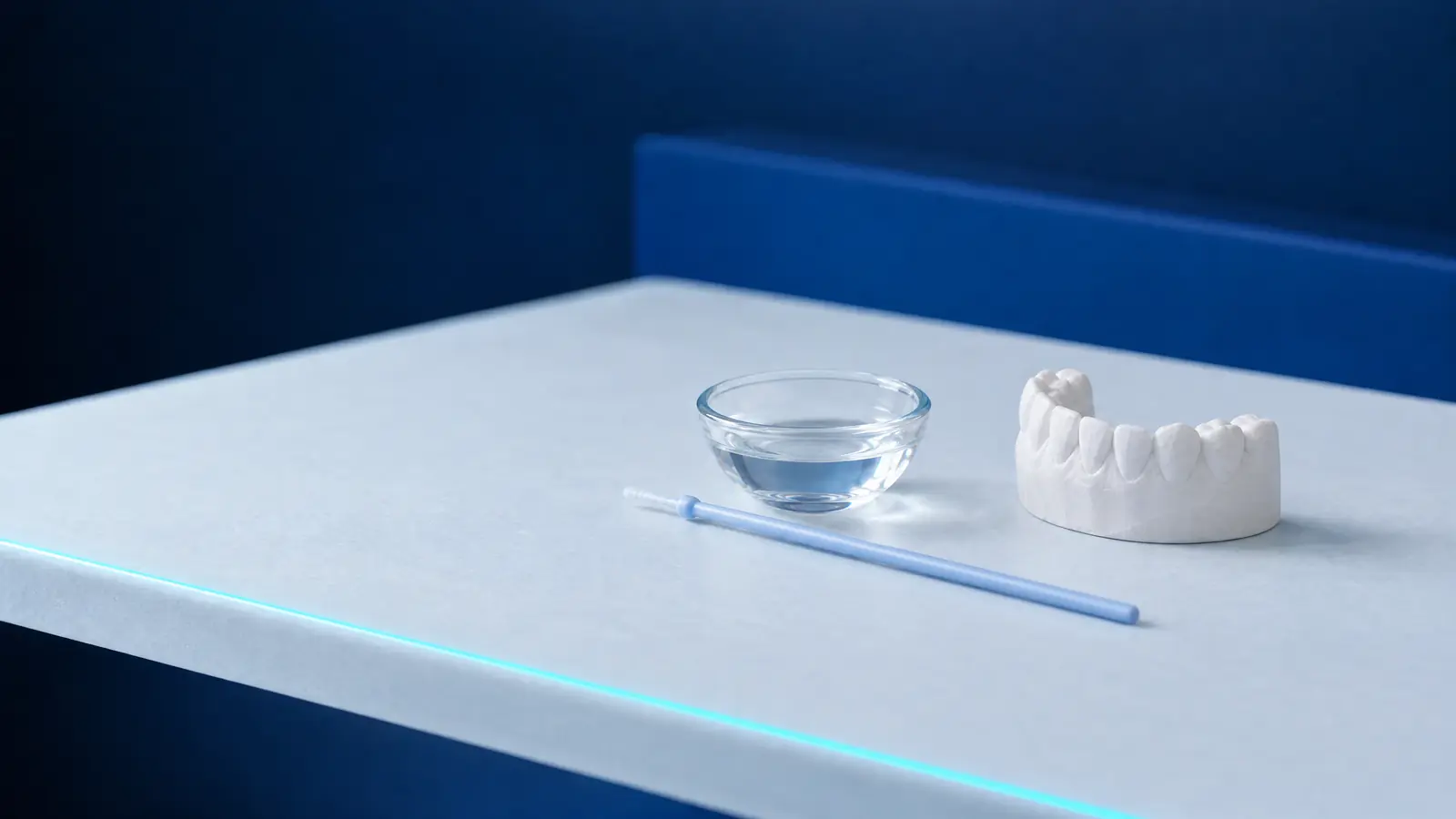
- Drying the tooth and applying a small amount of the liquid with a microbrush only to the affected surface.
- Air-drying for at least a minute and removing excess preparation.
- A check-up after 2 to 4 weeks where possible, and reapplication if not all lesions have been arrested.
Silver nitrate or silver diamine fluoride: how do they differ?
Silver nitrate and silver diamine fluoride work in a similar way, but silver nitrate contains no fluoride, which is why in the newer protocol it is followed by a sodium fluoride varnish. According to a report from a paediatric dentistry conference published by the Regional Medical Chamber in Łódź (Okręgowa Izba Lekarska w Łodzi, 2023), silver nitrate was used for many years in Polish paediatric dentistry, faded into the background over the last decade because of the staining and the arrival of new materials, and is now returning as 25% silver nitrate with 5% sodium fluoride varnish.
Silver diamine fluoride is a 38% liquid which, according to the AAPD, contains about 24 to 28% silver and 5 to 6% fluoride. In 2021 the World Health Organization (WHO) added it to its list of essential medicines, including for children, for the treatment of decay; it did not list it for the prevention of decay because of uncertain data on the benefit. The same report from the Łódź chamber states that in Poland SDF may be used under specific conditions as a liquid or as a varnish.
The table compares both methods with a filling, that is, the conventional treatment of a cavity. The effectiveness data come from a 2016 systematic review, a 2020 randomised trial and the AAPD guidelines.
| Feature | Silver nitrate and fluoride varnish | Silver diamine fluoride (SDF) | Conventional filling |
|---|---|---|---|
| How it works | Silver inhibits bacteria, fluoride from the varnish remineralises | Silver and fluoride in one liquid | Decay is removed and the cavity restored |
| Drilling | No | No | Yes, with anaesthesia for a deep cavity |
| Appearance of the tooth | Cavity permanently black | Cavity permanently black | Cavity restored with a material |
| Study results | Every 6 months, no worse than SDF (1,070 children, 30 months) | 81% of lesions arrested in a meta-analysis of 8 studies | Restores the shape of the tooth, needs the child’s cooperation |
| Repeat applications | Every 6 months in the 2020 trial | Once or twice a year; more often is more effective | The filling is checked at visits |
Does silver treatment of teeth work? What the studies say
Silver treatment of teeth effectively arrests dentine decay in milk teeth, although the AAPD rates the quality of this evidence as low. A 2016 systematic review (Gao et al.) included 19 clinical trials, 16 of which concerned milk teeth; in a meta-analysis of 8 trials with 38% silver diamine fluoride, 81% of active lesions were arrested (95% confidence interval 68 to 89%).
The 2017 AAPD guidelines estimate that 2 years after treatment, with application once or twice a year, about 68% of cavities in milk teeth are arrested. In two studies with a follow-up of at least 30 months, lesions were arrested in 76% of cases with SDF and in 51% in the comparison groups. The AAPD issued a conditional recommendation based on low-quality evidence and placed the treatment within a broader programme of caries management.
Silver nitrate was tested in a randomised trial in 1,070 three-year-olds (Gao et al., 2020). After 30 months, six-monthly application of 25% silver nitrate with 5% fluoride varnish had arrested an average of 3.7 decayed surfaces, and 38% SDF 3.6, which the authors judged to be at least equal effectiveness.
According to the AAPD, more frequent application increases the proportion of arrested lesions, while the presence of plaque reduces it. That is why silver treatment is combined with brushing with fluoride toothpaste and limiting sugar.
Black teeth after silver treatment: why does it happen, and will it go away?
Black teeth after silver treatment are an expected effect of the treatment, not a complication: silver permanently stains decayed dentine black, and according to the AAPD the visible staining is in fact a sign that the decay has been arrested. The staining does not disappear on its own and remains until the cavity is restored.
The preparation also stains skin it comes into contact with, to a colour resembling henna; according to the AAPD this mark disappears within 2 to 14 days, because silver does not penetrate the dermis. On clothes and work surfaces the stains are permanent.
In a survey of parents’ opinions cited by the AAPD, staining of the back teeth was accepted more readily than of the front teeth, and most parents preferred it to sedation or general anaesthesia. About a third of parents did not accept it under any circumstances, which is why the decision is made after a conversation, ideally based on photos of typical staining.
Once the decay is under control and the child allows it, the arrested cavity can be restored with a filling that covers the staining. The AAPD states that earlier use of SDF does not weaken the bond of a composite filling to dentine.
When does silver treatment make sense, and when is a filling better?
Silver treatment makes sense above all in young children with many active cavities who are unable to cooperate with drilling, and when not all cavities can be treated straight away. A filling may be the more appropriate choice when the child cooperates, restoring the shape of the tooth matters, or the staining would be unacceptable to the family.
Silver treatment does not treat a tooth in which decay has reached the pulp. Spontaneous pain, swelling, a fistula or an abscess mean that different treatment is needed: pulp amputation, root canal treatment of the milk tooth or extraction, as described in the article on treating milk teeth.
- A child at high risk of decay with active cavities in the front or back teeth.
- A child who is difficult to treat conventionally because of their behaviour or state of health.
- Many cavities that cannot all be prepared in a single visit.
- Cavities that are difficult to treat with a drill for other reasons.
- Cavities without signs of pulp involvement, that is, without spontaneous pain and without an abscess.
Is silver treatment of teeth harmful?
Silver diamine fluoride treatment carried out by a dentist, with the gums protected and in the amount recommended by the manufacturer, has not been associated with serious systemic effects in studies. The AAPD states that clinical trials involving more than 4,000 young children have reported no deaths and no adverse effects on the body as a whole, and that one drop of SDF contains less fluoride than 0.25 ml of fluoride varnish.
Silver nitrate itself is a toxic and corrosive substance, as the 2018 review stresses, which is why it is applied precisely to the spot, protecting the gums, skin and eyes. The AAPD also lists minor side effects of SDF: a metallic or bitter taste, temporary staining of the skin and irritation of the mucosa, which resolved within 48 hours.
- An allergy to silver compounds is a contraindication to silver diamine fluoride.
- The preparation is not applied to exposed pulp.
- Teeth with deep cavities need clinical and X-ray monitoring.
- No severe pulp reactions have been described after the use of SDF.
Silver treatment of teeth on the NFZ: is it funded?
Silver treatment of milk teeth is funded by the NFZ for children and young people up to the age of 18 as “impregnacja zębiny” (dentine impregnation) of milk teeth, charged per tooth. The service is listed in the Minister of Health’s regulation on guaranteed dental services (consolidated text Dz.U. 2025 poz. 615), including in the lists for dental buses (dentobusy) and school dental surgeries; legal status as of 24 October 2026.
The regulation does not specify which preparation is used for impregnation, so it is worth asking the dentist about the type of agent and the number of visits. Silver treatment does not rule out other NFZ services for children, such as fluoride varnish no more often than once a quarter and fillings in milk teeth.
Silver treatment of teeth at DentalBlue
In the price list of DentalBlue in Białystok, the item “Lapisowanie 1 łuk” (silver treatment of one arch) costs 250 zł; the price list does not state which preparation is used, so it is worth asking before the visit. Children are seen by the paediatric dentistry team, and the item “Wizyta Adaptacyjna” (adaptation visit) costs 250 zł. When the dentist proposes restoring the tooth, “Wypełnienie w zębie mlecznym Kromoglass” (glass ionomer filling in a milk tooth) costs 250 zł and “Wypełnienie kompozyt ząb mleczny” (composite filling in a milk tooth) 270 zł. When a child cannot cooperate with necessary treatment, treatment under general anaesthesia is possible in the clinic’s own anaesthesiology department, after a joint qualifying consultation. The final scope and cost are set at the visit, and prices may change.
Frequently asked questions
How many times does silver treatment of teeth need to be repeated?
Usually several times. The AAPD states that reapplication may be necessary to maintain caries arrest, and that application twice a year worked better than once a year. In the 2020 trial the treatment was repeated every 6 months. The intervals are set by the dentist according to the risk of decay.
Does silver treatment of teeth hurt?
The treatment does not require drilling or removing decay, because the liquid is brushed onto the surface of the cavity; the 2018 review describes it as simple and non-invasive. The child may notice a metallic or bitter taste. Accidental contact of the preparation with the gum can irritate it; according to the AAPD, such irritation resolved within 48 hours.
Can permanent teeth be given silver treatment?
Silver treatment mainly concerns milk teeth, and the NFZ funds dentine impregnation only in milk teeth. Silver diamine fluoride has also been studied in permanent teeth: 3 of the 19 trials in the 2016 review. The WHO has added it to its list of essential medicines for the treatment of decay in adults and children.
Can the black colour after silver treatment be removed?
The staining is permanent: according to the AAPD, it remains until the cavity is restored. It can be covered by restoring the arrested cavity with a filling once the decay is under control. The AAPD states that earlier use of SDF does not impair the bond of a composite filling.
Can silver treatment replace dental treatment under general anaesthesia?
Sometimes it allows treatment to be postponed or reduced, but it does not always replace it. In a survey of parents’ opinions cited by the AAPD, most preferred the staining to sedation or general anaesthesia. Teeth with pulp involvement, pain or an abscess, however, need different treatment, and general anaesthesia is decided at qualification.
Sources
- JDR Clinical and Translational Research: Gao SS et al., silver diamine fluoride in children, a systematic review (2016)
- AAPD: Crystal YO et al., Use of Silver Diamine Fluoride for Dental Caries Management in Children and Adolescents (2017)
- Journal of Dentistry: Gao SS et al., silver nitrate with fluoride varnish versus silver diamine fluoride, a randomised trial (2020)
- International Journal of Environmental Research and Public Health: Gao SS et al., silver nitrate in caries management (2018)
- WHO: Model List of Essential Medicines, silver diamine fluoride (2021)
- Okręgowa Izba Lekarska w Łodzi, Panaceum: Co nowego w stomatologii dziecięcej? (2023)
- ELI: Rozporządzenie MZ w sprawie świadczeń gwarantowanych z zakresu leczenia stomatologicznego, t.j. Dz.U. 2025 poz. 615
An informational article. It does not replace a consultation, and treatment decisions are made during a visit.