What are gum pockets, and when are they too deep?
A gum pocket is a deepened gap between the gum and tooth root that forms when periodontitis destroys the ligament and bone. Poland’s national oral health survey, based on the CPI index, records pockets of 4 to 5 mm separately from those measuring 6 mm or more.
In that 2017 survey, 25.0% of adults aged 35 to 44 had pockets of 4 to 5 mm, and 7.1% had pockets of 6 mm or more. Pockets are usually painless, so they are detected with a periodontal probe during examination; bleeding on probing indicates active inflammation. The article on periodontitis and bleeding gums explains the basics of the disease.
Treatment aims to close the pocket. The European Federation of Periodontology (EFP) 2020 guideline defines closure as a probing depth of up to 4 mm without bleeding. Treatment is considered successful when no pockets deeper than 4 mm with bleeding, or pockets measuring 6 mm or more, remain.
What does closed curettage, or subgingival scaling, involve?
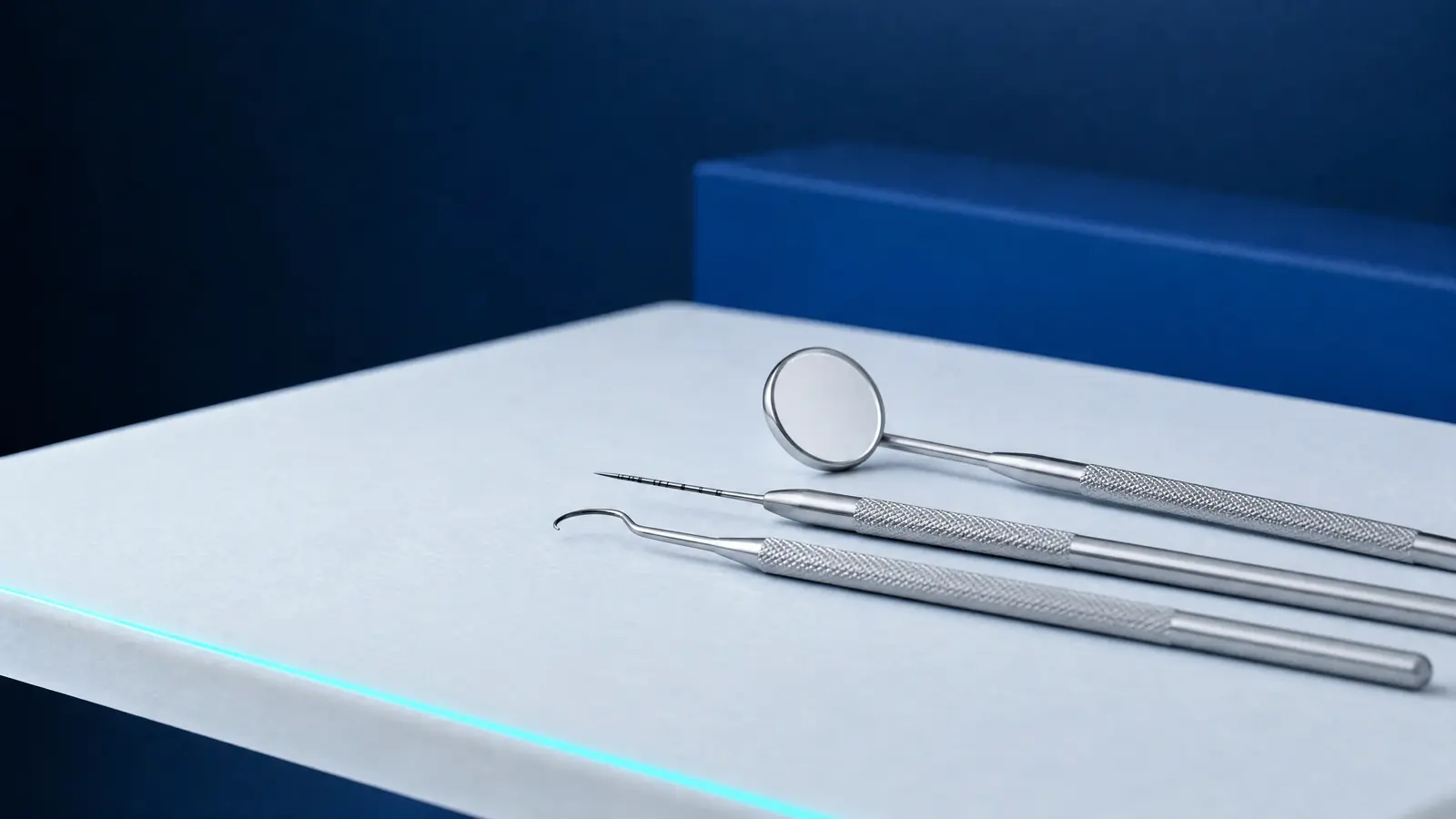
Closed curettage cleans roots inside pockets without cutting the gum: the dentist uses hand instruments or an ultrasonic tip to remove calculus and bacterial biofilm below the gum line. Dental surgeries also call it subgingival scaling, pocket curettage or root planing; the EFP guidelines use the term subgingival instrumentation.
According to the EFP guideline, results do not depend on the type of instrument or on whether treatment is split into quadrants over several visits or covers the whole mouth within 24 hours. It is usually performed under local anaesthesia, as in most studies underpinning the guideline.
- Examination: measuring pockets around every tooth, assessing bleeding and mobility, and taking X-rays of the bone.
- First treatment step: oral hygiene instruction and removal of calculus above the gum line, called scaling.
- Local anaesthesia for the area the dentist will clean.
- Cleaning root surfaces in the pockets with hand or ultrasonic instruments.
- Follow-up after healing, when the dentist remeasures pockets and decides on further treatment.
Where curettage fits into the EFP’s four steps of periodontal treatment
Curettage is neither the first nor the last stage of periodontal treatment. The EFP 2020 guideline describes four steps; reassessment of pockets after tissue healing determines when to move to the next.
The EFP recommends maintenance visits every 3 to a maximum of 12 months, with intervals tailored to risk. At each visit, pockets are measured again and sites that bleed again or have deepened are cleaned.
| Step | What it involves | When it is used |
|---|---|---|
| Step 1 | Hygiene instruction, scaling above the gum line, stopping smoking, diabetes control | For every patient at the start of treatment |
| Step 2 | Closed curettage: cleaning roots below the gum line | After step 1, for diseased pockets |
| Step 3 | Repeat curettage, open curettage or regenerative surgery | If pockets deeper than 4 mm with bleeding, or 6 mm or more, remain |
| Step 4 | Supportive care: check-ups and repeat cleaning | After active treatment, every 3 to 12 months, with no end date |
When is open curettage or regenerative surgery needed?
Open curettage is a surgical procedure in which the dentist lifts a gum flap to clean the root under direct vision. The EFP guideline suggests it for pockets of 6 mm or more remaining after the first two steps; for pockets of 4 to 5 mm, it favours repeating closed curettage.
In the review underpinning this recommendation, open curettage produced an additional average pocket depth reduction of 0.67 mm in deep pockets after a year compared with repeat closed cleaning. Retreatment was needed in 0 to 14% after open procedures and 8 to 29% after closed procedures, but at shallow sites, up to 4 mm, open surgery caused greater attachment loss.
When a deep pocket is accompanied by a vertical bone defect at least 3 mm deep, the EFP recommends regenerative surgery intended to rebuild some of the lost tissues. Compared with open curettage alone, this produced additional attachment gains of 1.27 mm with enamel matrix derivatives and 1.43 mm with membrane-based guided tissue regeneration. The guideline stresses that advanced procedures require additional specialist training.
What results does research report for curettage?
According to the EFP 2020 guideline, closed curettage reduced pocket depth by an average of 1.7 mm after 6 to 8 months, closed an average of 74% of pockets and reduced bleeding by 63%. In pockets deeper than 6 mm, the average depth reduction was 2.6 mm.
The result depends on the patient as well as the procedure. A 2019 meta-analysis by Leite et al. found that non-surgical treatment reduced pocket depth by an additional 0.32 mm in people who stopped smoking compared with smokers. The EFP therefore recommends help with stopping smoking as part of treatment.
The EFP guideline suggests against using lasers as an adjunct to curettage and does not recommend routine systemic antibiotics. Antibiotics may be considered only for selected patient groups, at the clinician’s discretion.
Does curettage hurt, and what is healing like?
Curettage is usually performed under local anaesthesia, and the teeth and gums can feel tender afterwards. A 2021 systematic review found that pain was common shortly after non-surgical treatment, but oral health-related quality of life improved markedly over longer follow-up.
The most common problem is root sensitivity to cold. The review by Lin and Gillam (2012) found this in 62.5 to 90% of patients the day after non-surgical treatment and 52.6 to 55% after a week. After surgery, the proportion fell from 76.8 to 80.4% on the first day to 21.7% after 8 weeks. Symptoms were usually mild or moderate and temporary.
- Brush with a soft toothbrush, including around the treated area, as your dentist advises.
- Resume interdental cleaning when your dentist allows it: otherwise plaque fills the pockets again.
- Ask your dentist about a toothpaste or product for sensitive teeth if sensitivity develops.
- Seek an appointment before your scheduled review if swelling increases, pus appears or you develop a fever.
- A review with repeat pocket measurements takes place once the tissues have healed, at a time set by your dentist.
NFZ and private curettage: what is covered, and what does it cost?
For adults, the NFZ, Poland’s National Health Fund, covers closed curettage within a quadrant, pocket irrigation with medication and calculus removal once per calendar year. Open curettage in the oral surgery and periodontology list is available only to children and young people under 18 and women during pregnancy and the postpartum period. The basis is the Ministry of Health regulation (consolidated text Dz.U. 2025 poz. 615), legal status as of 24 October 2026.
According to the Podlaskie NFZ branch, since 1 July 2025, oral surgery and periodontology services have been provided at 16 locations in the province, and periodontology services at 4 locations. The NFZ “Gdzie się leczyć” (where to get treatment) search tool lists current addresses in Białystok and the region (as of 24 October 2026).
Private costs depend on the number of pockets, whether closed curettage is sufficient and the number of maintenance visits. The clinic’s price list gives “Konsultacja periodontologiczna” (periodontal consultation) at 300 zł, “Kiretaż otwarty 1 ząb” (open curettage, one tooth) at 400 zł and “Płukanie kieszonek dziąsłowych” (gum pocket irrigation) at 100 zł. The price of “Regeneracja ubytku pionowego (śródkostnego)” (regeneration of a vertical intrabony defect) depends on the extent of the procedure. The final scope and cost are agreed at consultation, and prices may change.
How gum pockets are treated at DentalBlue
At DentalBlue in Białystok, gum pocket treatment is provided within periodontology and professional cleaning within preventive care; the team includes dental hygienists. The clinic’s own radiology unit takes panoramic and intraoral X-rays to assess bone, and CBCT scans when indicated. A “Wizycie bez bólu” (visit without pain, 300 zł) includes a panoramic X-ray, consultation, examination and written treatment plan. The clinic is open Monday to Friday from 8:00 to 20:00 and Saturdays from 8:00 to 16:00.
Frequently asked questions
Is curettage the same as scaling?
No. Scaling removes calculus above the gum line and at its edge, while closed curettage cleans the root inside a pocket below the gum. In the EFP guideline, scaling belongs to step one and curettage to step two. A separate article explains scaling as part of professional cleaning.
How long does curettage take, and how many visits are needed?
It depends on the number of pockets. Treatment can cover one quadrant at successive visits or the whole mouth within 24 hours; the EFP considers both approaches similarly effective. A follow-up after healing is also needed to assess the result.
Does laser curettage give better results?
The EFP 2020 guideline suggests against adding lasers to subgingival instrumentation. Mechanical cleaning of roots with hand or ultrasonic instruments remains the basis of treatment; any adjunctive methods are for the clinician to decide.
How often does curettage need repeating?
Active treatment is followed by supportive care, which the EFP recommends every 3 to 12 months according to risk. At each visit, the dentist or hygienist measures pockets and recleans sites that bleed or have deepened, so this does not always involve the whole mouth.
Will teeth stop being loose after curettage?
Not always. Mobility is reassessed after periodontal treatment. If it persists or increases, the EFP 2022 guideline allows long-term splinting for comfort. The article on tooth splinting explains when and how a splint is fitted.
Sources
- Journal of Clinical Periodontology: Sanz M et al., EFP S3 guideline, treatment of stage I to III periodontitis (2020)
- Journal of Clinical Periodontology: Herrera D et al., EFP S3 guideline, treatment of stage IV periodontitis (2022)
- International Journal of Dentistry: Lin YH, Gillam DG, root sensitivity after periodontal treatment, systematic review (2012)
- International Journal of Dental Hygiene: Khan S et al., non-surgical treatment and patient quality of life, systematic review (2021)
- Nicotine and Tobacco Research: Leite FRM et al., smoking cessation and periodontitis, meta-analysis (2019)
- Ministerstwo Zdrowia, WUM: Choroba próchnicowa i stan tkanek przyzębia populacji polskiej, findings from 2016 to 2019 (2021)
- ELI: Rozporządzenie MZ w sprawie świadczeń gwarantowanych z zakresu leczenia stomatologicznego, t.j. Dz.U. 2025 poz. 615
- Podlaski Oddział Wojewódzki NFZ: Leczenie stomatologiczne, service locations from 1 July 2025
An informational article. It does not replace a consultation, and treatment decisions are made during a visit.