Why does a tooth become loose in an adult?
A loose tooth in an adult is a symptom rather than a separate disease: the periodontal ligament and bone hold the tooth in its socket, so anything that weakens or damages them increases mobility. Cleveland Clinic identifies periodontitis as the most common cause of loose teeth in adults, because it destroys the bone and ligaments supporting them.
Other common causes include injury, such as a blow during sport, and clenching and grinding, which overload teeth over time. During pregnancy, hormones can temporarily loosen the supporting tissues. The table pairs causes with their usual management; a splint is only one possible part of treatment.
| Cause of mobility | What happens | Usual management |
|---|---|---|
| Periodontitis | Bone and ligament around the root are lost | Periodontal treatment; a splint may be considered for comfort |
| Injury: luxation or root fracture | The tooth is displaced or its attachment in the socket is damaged | Repositioning and a flexible splint, usually for 2 to 4 weeks |
| Clenching and grinding | Bite forces overload the teeth | Bite adjustment, an occlusal splint at night |
| Pregnancy | Hormones temporarily loosen the tissues | Careful hygiene and a dental check-up |
| Abscess beside a tooth | Acute infection in a pocket or around the root | Urgent appointment: drainage and treatment of the cause |
| After orthodontic treatment | Teeth need to be held in their new position | A fixed retainer, often permanently in periodontitis |
How does a dentist assess whether a tooth is too loose?
The dentist assesses mobility by moving the tooth and checking how far and in which direction it moves. The three-grade Miller classification is often used; the American Dental Association (ADA) SNODENT terminology describes it as listed below.
The grade alone is not enough. The dentist also measures pockets around the tooth, checks the bite and assesses the bone on an X-ray, such as a panoramic or intraoral image, and tests pulp vitality after injury. The European Federation of Periodontology (EFP) 2022 guideline includes mobility of grade 2 or above among the features distinguishing the most severe, stage IV periodontitis from stage III.
- Grade 1: the tooth moves sideways by less than 1 mm.
- Grade 2: sideways movement is 1 mm or more, with no vertical movement.
- Grade 3: movement is 1 mm or more and the tooth can also be pressed into its socket, meaning it moves vertically.
What does tooth splinting involve, and what types of splint are there?
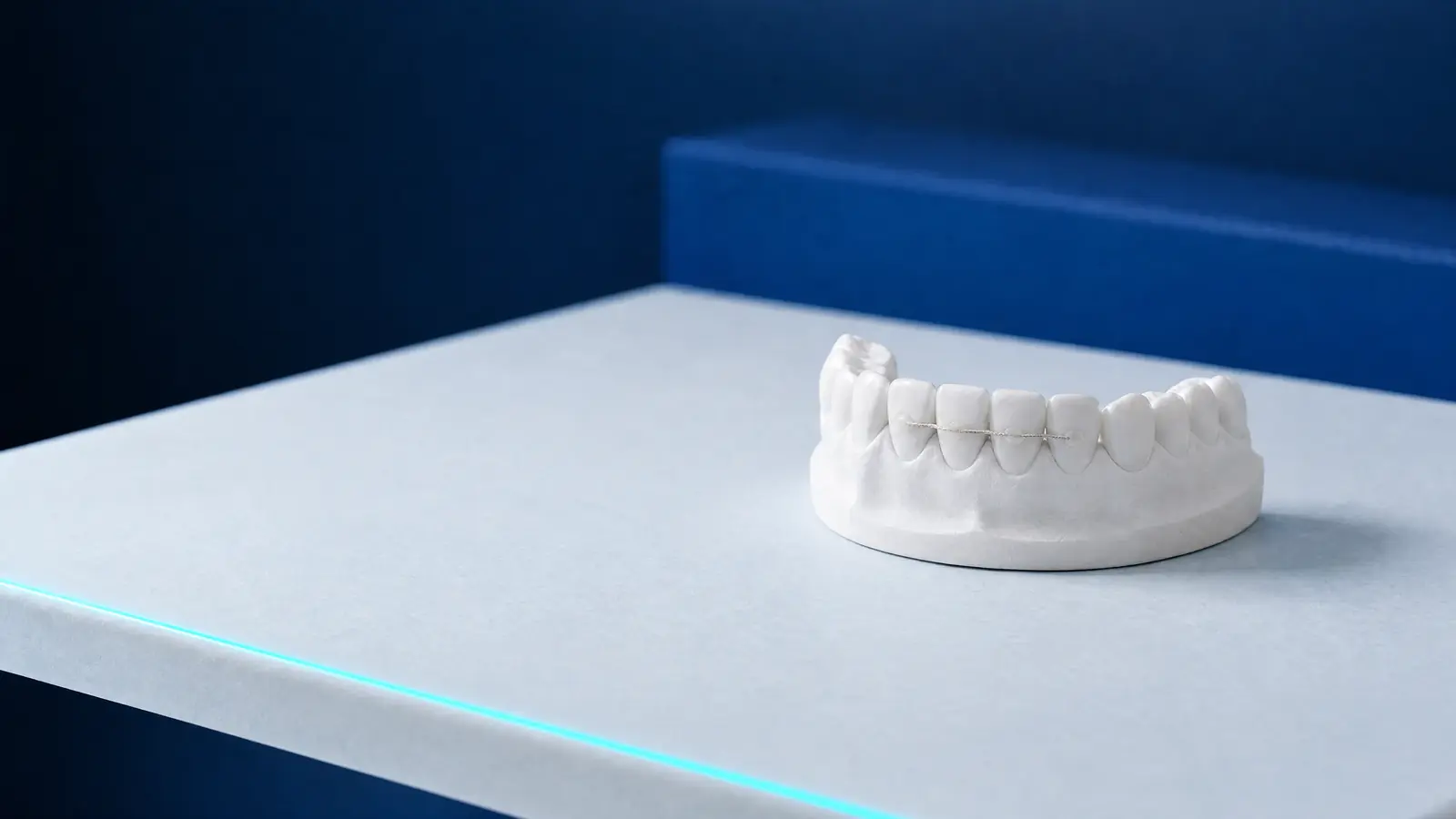
Tooth splinting joins a mobile tooth to stable neighbouring teeth so that chewing forces are shared across several teeth. A splint is usually bonded to the tooth surfaces with composite; in prosthodontics, a bridge or joined crowns can also act as a splint.
After injury, the International Association of Dental Traumatology (IADT) 2020 guidelines recommend short-term, passive, flexible splints, because slight tooth movement helps the ligament heal. Composite and bonding agent must be kept away from the gum and interdental spaces to prevent plaque accumulating there.
- Wire and composite splint: thin stainless steel wire, up to 0.4 mm in diameter according to the IADT, bonded to several teeth.
- Nylon fishing line splint, 0.13 to 0.25 mm thick, which the IADT allows after injuries but does not recommend for children with few permanent teeth.
- Reinforcing fibre embedded in composite, used, for example, for mobile lower incisors in people with periodontitis.
- Immobilisation with a wire ligature, meaning wire wrapped around the teeth, listed among NFZ-funded services.
- A prosthetic splint, meaning a bridge or joined crowns, when the teeth need restoring anyway.
How long is a splint worn after a tooth injury?
How long a splint stays in place depends on the injury and ranges from 2 weeks to 4 months under the IADT 2020 guidelines. The dentist removes it at one of the follow-up appointments that the IADT schedules for each type of injury.
A tooth injury needs prompt dental attention, and minutes matter for a knocked-out permanent tooth; the article on knocked-out teeth explains what to do at the scene. At night and weekends, the NFZ, Poland’s National Health Fund, provides emergency dental care including repositioning and immobilising a luxated tooth. According to the Podlaskie regional NFZ branch, there is one such service in the whole province, in Białystok (as of 24 October 2026).
- Subluxation, a slightly loose tooth without displacement: usually no splint, or up to 2 weeks only for marked mobility or pain on biting.
- Extrusive luxation, where the tooth has moved out of its socket: 2 weeks, with an additional 4 weeks if the marginal bone is fractured.
- Lateral luxation, where the tooth has moved sideways: 4 weeks.
- Intrusion, where the tooth is pushed into the bone, following surgical repositioning: 4 weeks.
- Avulsion and replantation, where a knocked-out tooth is put back: 2 weeks.
- Root fracture in the middle or apical third: 4 weeks, or up to 4 months for a fracture near the neck of the tooth.
- Fracture of the alveolar process together with the teeth: 4 weeks.
Tooth splinting for periodontitis: what can it achieve?
Splinting teeth in periodontitis does not treat the disease: it reduces mobility, making biting and chewing easier. A systematic review by Dommisch et al. (2022) concluded that splinting does not improve survival of mobile teeth in advanced periodontitis: within 2 years after non-surgical treatment, 8.4% of splinted and 10.1% of unsplinted teeth were lost, with low-quality evidence.
The EFP 2022 guideline therefore treats splinting as an adjunct: temporary splinting may be considered at any stage of periodontal treatment, particularly early on, to improve comfort and facilitate treatment. If mobility persists or increases after treatment, long-term splinting may be considered. Both are open recommendations based on very low-quality evidence.
Treatment therefore starts with periodontitis itself, removing calculus and bacteria from pockets, and the need for a splint is reassessed after successive treatment stages. The article on periodontal curettage explains this cleaning process.
How do you look after a splint, and how long does it last?
A splint for loose teeth needs careful hygiene because plaque readily accumulates around composite and sustains gum inflammation. The EFP guideline states that the technique, material and shape of the splint should allow thorough cleaning at home and in the dental surgery.
Splints also need repairs. In a study of 57 patients with 227 splinted teeth, followed at a university centre for an average of 11 years, 75.3% of splints needed repair, averaging 0.4 repairs a year; splinted teeth were no more likely to be lost than the other teeth (Graetz et al., 2019).
- Clean the spaces around the splint with an interdental brush or floss, following the instructions given at the surgery.
- After an injury, eat soft food for the first few days and do not bite off hard pieces with the splinted teeth.
- See your dentist if the splint debonds, breaks or starts rubbing: a loose fragment traps plaque and can injure the lip.
- Attend check-ups and maintenance appointments at the intervals agreed with your dentist.
What does tooth splinting cost, and does the NFZ cover it?
The NFZ funds several types of tooth immobilisation. The list of general dental services includes immobilisation with a wire ligature and repositioning and immobilisation of a luxated tooth or group of teeth with simple fixation to neighbouring teeth. The oral surgery and periodontology list includes fitting a wire splint for luxations, replantations and tooth transplants.
Bonded fibre splints are not listed in the regulation. The legal basis is the Minister of Health’s regulation on guaranteed dental services (consolidated text Dz.U. 2025 poz. 615), legal status as of 24 October 2026; treatment is provided by a dentist with an NFZ contract.
The private cost depends on the number of teeth, the type of splint and whether periodontal treatment is needed alongside it, so the dentist sets it after examination. In the clinic’s price list, “Konsultacja periodontologiczna” (periodontal consultation) costs 300 zł. The final scope and cost are agreed at consultation, and prices may change.
How loose teeth are assessed at DentalBlue
At DentalBlue in Białystok, loose teeth are assessed within periodontology and oral surgery. The clinic’s own radiology unit takes images needed to assess the bone: panoramic and intraoral X-rays, and CBCT scans when indicated. A first appointment can be a “Wizyty bez bólu” (visit without pain, 300 zł), including a panoramic X-ray, consultation, examination and written treatment plan, or, for pain, a “Wizyty z bólem” (visit in pain, 340 zł), including a panoramic X-ray, consultation, examination and pain relief. The clinic is open Monday to Friday from 8:00 to 20:00 and Saturdays from 8:00 to 16:00.
Frequently asked questions
Can a loose tooth become firm again on its own?
Sometimes. According to the IADT, a slightly loosened tooth after a blow, without displacement, usually needs no treatment, only pulp monitoring for at least a year. In periodontitis, mobility is reassessed after periodontal treatment, but lost bone does not grow back on its own.
Is a night guard the same as tooth splinting?
No. A relaxation or occlusal splint is a removable appliance usually worn at night for clenching and grinding, as described in the article on bruxism. Tooth splinting is a fixed connection bonded to the tooth surfaces to reduce mobility of particular teeth.
Can a tooth remain loose after the splint is removed?
Yes. The IADT guideline on avulsed and replanted permanent teeth warns that the tooth may still be mobile after splint removal. An extra week of splinting is considered only if the bite keeps loading it traumatically or the tooth cannot hold its correct position. For other injuries, the period depends on injury type; the dentist assesses it at follow-up.
How long is a splint worn for periodontitis?
For as long as it is needed. The EFP guideline allows temporary splinting during treatment and long-term splinting when mobility persists afterwards. In the study by Graetz et al., splints remained in place for an average of 7.3 years, and most needed repairs along the way.
Does a very loose tooth need immediate extraction?
Not always. The EFP 2022 guideline recommends assessing whether a severely weakened tooth can be retained through periodontal treatment and mobility control before deciding on extraction. The decision follows examination, pocket measurements and an X-ray, rather than mobility alone.
Sources
- IADT: guidelines for dental trauma management 2020, fractures, luxations and avulsion of permanent teeth, official German translation (2024)
- Journal of Clinical Periodontology: Herrera D et al., EFP S3 guideline, treatment of stage IV periodontitis (2022)
- Journal of Clinical Periodontology: Dommisch H et al., effectiveness of tooth splinting and occlusal adjustment, systematic review (2022)
- Journal of Dentistry: Graetz C et al., long-term survival and repair of splints in patients with periodontitis (2019)
- Cleveland Clinic: Loose tooth, causes and treatment of loose teeth in adults (2024)
- HL7 Terminology: SNODENT (ADA), Miller classification of tooth mobility
- ELI: Rozporządzenie MZ w sprawie świadczeń gwarantowanych z zakresu leczenia stomatologicznego, t.j. Dz.U. 2025 poz. 615
- Podlaski Oddział Wojewódzki NFZ: Leczenie stomatologiczne, service locations from 1 July 2025
An informational article. It does not replace a consultation, and treatment decisions are made during a visit.