Can a bite problem cause a speech problem?
A bite problem can make some sounds harder to pronounce, but does not in itself determine a speech problem, because the tongue can adapt. A 1999 research review concludes that some abnormalities of tooth position are associated with speech disorders, and patients’ ability to compensate for an abnormal bite is well known.
The review’s authors also note that there is no conclusive evidence that changing tooth positions alone improves articulation disorders. An orthodontic appliance is therefore not a treatment for a speech problem, although it can be an important adjunct.
The American Speech-Language-Hearing Association (ASHA) recommends that speech and language therapists examine oral structures when assessing speech, including the bite and tongue frenulum. The aim is to identify anatomical causes that need cooperation with a dentist or orthodontist.
Lisps and the bite: how do interdental, dentalised and lateral lisps differ?
A lisp is distorted pronunciation of sibilant sounds, such as the Polish s, z, c, sz or ś; its type depends on the tongue’s position. In an interdental lisp the tongue tip protrudes between the teeth, while in a dentalised lisp the tongue presses too hard against the incisors, which distorts the sounds.
A 2022 study in which a speech and language therapist assessed patients with skeletal discrepancies describes interdental lisps as often accompanying anterior open bite, and dentalised lisps as accompanying a skeletal underbite, or Class III malocclusion. Some of these distortions are visible but barely audible.
In a lateral lisp, air escapes along the sides of the tongue rather than down its centre. ASHA gives a lateral s as an example of sound distortion, and the 2022 study lists lateral distortions among audible distortions without associating them with any one bite problem. A speech and language therapist is primarily responsible for assessment and exercises for a lateral lisp.
Open bite and speech: what do studies show?
Anterior open bite, in which the upper and lower incisors do not meet when the back teeth are together, is the bite problem most often associated with speech errors. In a 2016 American study of 115 people aged 8 to 36 seeking orthodontic treatment, 62% had a speech error, most often with s and t.
The key factor in that study was an open bite exceeding 2 mm, and errors became more frequent as malocclusion severity increased. Most distortions were visible, meaning the tongue could be seen between the teeth; audible distortions were less frequent.
A 2022 study compared 39 patients with skeletal open bite and 62 controls. Patients with open bite had more sound distortions, and acoustic measurements showed changes in k, t, cz and s; for k and t, the severity of the skeletal discrepancy was associated with the degree of distortion.
ASHA lists open bite and increased overjet among signs that often accompany dysfunction of the lip and tongue muscles, alongside an open mouth at rest and an interdental lisp. This is why speech and language therapists and orthodontists usually work together in open-bite cases.
Underbite and speech: when does a skeletal discrepancy make speaking harder?
An underbite, in which the lower teeth and lower jaw project ahead of the upper teeth, can change the sound of many Polish speech sounds. In a 2006 Polish study, all 23 patients with mandibular prognathism had speech disorders; distortions affected sounds including s, z, c, dz, ś, ź, sz, cz, l and r.
The most common error in that study was insufficient tongue elevation during speech. The author links the disorders to jaw structure and the forward position of the tongue and hyoid bone, and recommends including a speech and language therapist in the team treating underbite.
This was a small study of patients with a marked skeletal discrepancy, so it does not mean every child with a mild underbite will speak incorrectly. It does, however, show the value of speech assessment before and after orthodontic or surgical treatment for skeletal discrepancies.
When is a child’s pronunciation still part of normal development?
Some substitutions of harder sounds with easier ones are a stage of speech development, but they need to be distinguished from distorted articulation. A 2018 review covering 27 languages and over 26 thousand children found that by their fifth birthday, children pronounced at least 93% of consonants correctly. The review did not include Polish and did not set an age to wait for before assessing an interdental lisp.
ASHA reports estimated speech sound disorder rates of 2.1% to 23% among children aged 4 to 6, with persistent disorders in 3.6% of 8-year-olds. In school-aged boys they occur about twice as often as in girls.
If the tongue pushes between the teeth during speech or air escapes over the sides, it is worth seeing a speech and language therapist even before the fifth birthday. The therapist can tell developmental sound substitutions apart from distortions and judge whether an orthodontic consultation is needed.
Speech and language therapist or orthodontist: who does what?
A speech and language therapist assesses and treats speech, while an orthodontist diagnoses and treats bite problems; both are usually needed for a lisp associated with the bite. ASHA notes that diagnosing malocclusion is outside the speech therapist’s role; an orthodontist may, for example, expand the upper jaw to support nasal breathing.
The sequence can matter. ASHA gives an example in which the orthodontist must treat open bite before the speech therapist addresses tongue protrusion or an interdental lisp, and warns against using lip and tongue muscle exercises alone in place of speech therapy. The table sets out typical situations.
| Speech sign | Possible oral factor | Who to see |
|---|---|---|
| Tongue between the teeth for s, z, c | Anterior open bite, tongue protrusion | Speech and language therapist and orthodontist |
| Tongue against the teeth, flattened sound quality | More often a skeletal underbite | Orthodontist and speech and language therapist |
| Air escaping along the sides of the tongue | No confirmed association with one specific bite problem | Speech and language therapist |
| Distorted s and t with a gap between the incisors | Open bite greater than 2 mm | Orthodontist, then speech and language therapist |
| Difficulty raising the tongue | Possible tongue tie, but more often another cause | Speech and language therapist, dentist if needed |
| Changes in sounds after an appliance is fitted | The appliance changes the space available for the tongue | Orthodontist; usually time is enough |
Tongue tie and speech: what is known?
Tongue tie causes speech problems less often than is commonly believed. ASHA says studies of its effects on feeding and speech produce conflicting findings, and not everyone with a short tongue frenulum needs it released.
ASHA lists tongue tie among factors that may contribute to forward tongue protrusion, alongside delayed motor development and facial structural anomalies. Surgery is decided on the basis of tongue function, not simply the frenulum’s appearance; a separate article covers indications for release.
Orthodontic appliances and speech: how long does adjustment take?
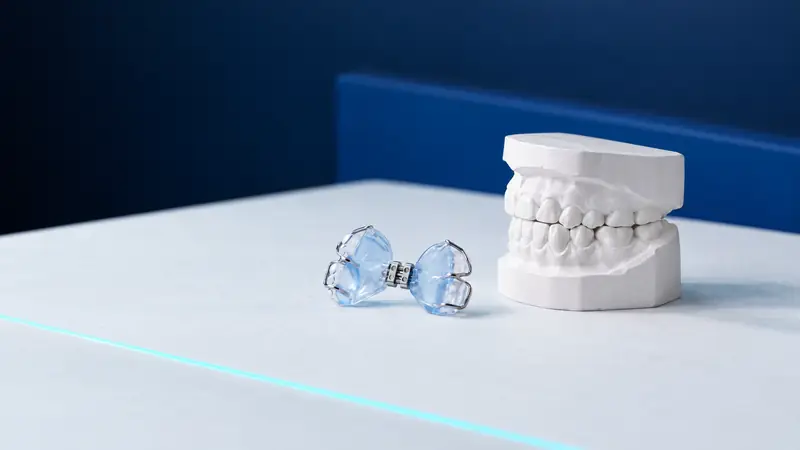
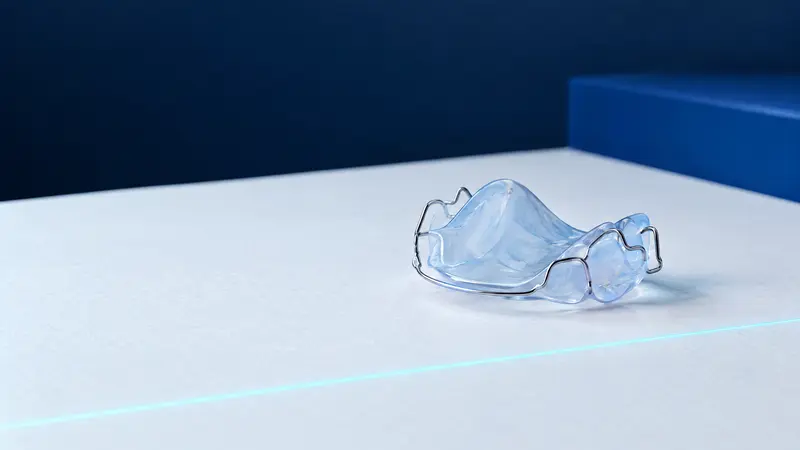
An orthodontic appliance usually changes some sounds at first because it takes up space needed by the tongue; in a randomised study, speech differences disappeared after about a month. A 2021 Brazilian randomised study assessed 40 adults treated with aligners or fixed braces from fitting to 180 days.
A speech and language therapist noticed speech changes only in aligner wearers, immediately after fitting and after 3 days; by 30 days, the groups no longer differed. In their own assessments, patients in both groups reported speaking difficulties in the first few days, but no longer felt them after 30 days.
That study involved adults, so adjustment time may differ in children and with other appliance types. If a speech change persists for more than a few weeks or causes problems for your child at school, tell the orthodontist, who will assess the appliance and whether a speech and language consultation would help.
Speech and the bite at DentalBlue
At DentalBlue in Białystok, the orthodontist assesses the bite, including open bite and underbite, while cephalometric and panoramic X-rays are taken in the clinic’s own radiology unit. Treatment with Clear Aligner aligners or fixed braces is planned digitally using cephalometric analysis. In the price list, “Konsultacja ortodontyczna” (orthodontic consultation) costs 300 zł and “Plan leczenia z analizą cefalometryczną” (treatment plan with cephalometric analysis) 380 zł. Speech assessment is the role of a speech and language therapist. The final scope and cost are agreed at the consultation, and prices may change.
Frequently asked questions
Is an interdental lisp in a 4-year-old already a speech disorder?
An interdental lisp in a 4-year-old is worth having assessed by a speech and language therapist, without waiting for the fifth birthday. Pushing the tongue between the teeth is different from the developmental substitution of harder sounds with easier ones. The therapist will check articulation, tongue position, breathing and whether the bite needs assessing.
Will an orthodontic appliance cure a lisp?
Usually not on its own. The 1999 review stresses that there is no conclusive evidence that moving teeth improves articulation. However, treating open bite can make the speech therapist’s work easier, so ASHA describes situations in which orthodontic treatment precedes lisp therapy.
Does tongue thrusting during swallowing damage the bite?
This is uncertain. ASHA associates tongue protrusion and an open mouth at rest with open bite and interdental lisp, but stresses that there is no known single cause of these disorders and several factors usually act together. A speech and language therapist assesses tongue posture, and an orthodontist the bite.
Can an adult with an underbite improve their speech?
Yes, usually through work with a speech and language therapist, sometimes alongside orthodontic or surgical treatment. The Polish author of the study of 23 patients with mandibular prognathism recommends that a speech and language therapist be part of the team treating this condition.
Is a lateral lisp caused by a bite problem?
It usually cannot be attributed to a single bite problem. ASHA describes a lateral s as a sound distortion, while studies linking the bite and speech mainly concern interdental and dentalised lisps. A speech and language therapist is primarily responsible for assessing and treating a lateral lisp.
Sources
- ASHA: Speech Sound Disorders, Articulation and Phonology, Practice Portal
- ASHA: Orofacial Myofunctional Disorders, Practice Portal
- American Journal of Speech-Language Pathology: McLeod S, Crowe K, consonant development in 27 languages, review (2018)
- American Journal of Orthodontics and Dentofacial Orthopedics: Leavy KM et al., malocclusion and speech (2016)
- FACE: Keyser MMB et al., skeletal open bite and speech (2022)
- Annales Academiae Medicae Stetinensis: Konopska L, tongue posture for Polish sounds in people with mandibular prognathism (2006)
- Angle Orthodontist: Johnson NC, Sandy JR, tooth position and speech, review (1999)
- Angle Orthodontist: Damasceno Melo PE et al., aligners, fixed appliances and speech, randomised study (2021)
An informational article. It does not replace a consultation, and treatment decisions are made during a visit.