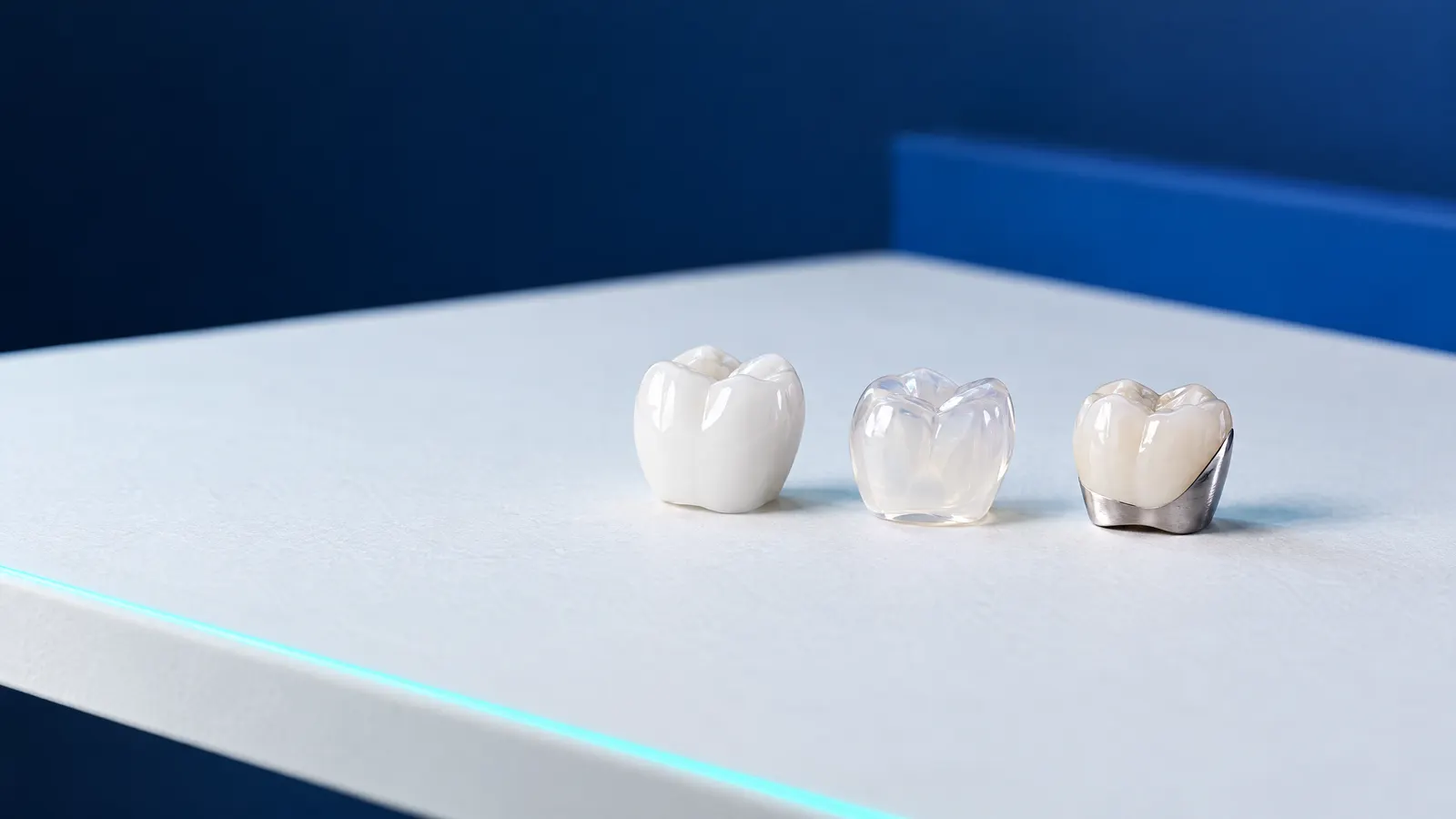
What is an all-ceramic crown, and what does ‘porcelain crown’ mean?
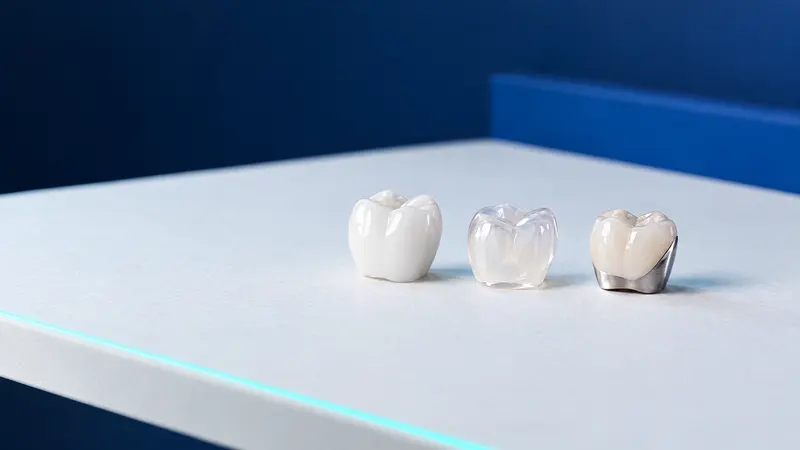
An all-ceramic crown is made entirely of ceramic, with no metal framework. Studies distinguish metal-ceramic from all-ceramic crowns, and divide all-ceramic crowns into veneered crowns, with a layer of porcelain, and monolithic crowns, made of a single material (Pjetursson et al., 2026). Zirconia also belongs to the ceramic group. The review by Zarone et al. (2019) describes zirconium dioxide as a material with ceramic properties, and a zirconia crown has no metal framework.
Porcelain can cover either a metal or a zirconia framework, so in everyday speech ‘porcelain crown’ can mean a porcelain-fused-to-metal crown or a metal-free crown. When comparing your options, ask how the crown is made. The clinic’s price-list labels mean the following:
- ‘Full zirconia crown’ is a monolithic zirconia crown without a porcelain layer. It is all-ceramic.
- ‘Zirconia-ceramic crown’ has a zirconia framework covered with porcelain. It is all-ceramic.
- ‘Lithium disilicate crown’ is an all-ceramic crown made from a glass-ceramic.
- ‘Porcelain-fused-to-metal crown’ has porcelain on a metal framework and falls into the metal-ceramic group.
- ‘Composite crown’ is made from a resin with filler.
How do zirconia, lithium disilicate and porcelain fused to metal differ?
The commonly used crown types have similar 5-year survival rates, with differences in appearance, strength and how they are fitted. A 2026 review of 64 studies reported 98.5% for monolithic lithium disilicate, 97.3% for veneered zirconia, 97.1% for porcelain-fused-to-metal crowns and 96.8% for monolithic zirconia. Monolithic crowns made from either material had significantly fewer fractures and ceramic chips than veneered crowns (Pjetursson et al., 2026).
Zirconia usually has greater flexural strength than lithium disilicate glass-ceramic, which usually lets more light through. The properties depend on the type of ceramic. The thickness of the crown and the colour of the tooth underneath also affect its appearance (Zarone et al., 2019).
| Price-list item | Construction | What to consider | 5-year survival in studies |
|---|---|---|---|
| ‘Full zirconia crown’ | Monolithic zirconia | Strong with little chipping. Its lower translucency can mask a dark tooth. | 96.8% |
| ‘Zirconia-ceramic crown’ | Zirconia covered with porcelain | More natural-looking. The porcelain can chip. | 97.3% |
| ‘Lithium disilicate crown’ | Glass-ceramic | Highly translucent and bonded to the tooth. Lower strength than zirconia. | 98.5% for monolithic lithium disilicate |
| ‘Porcelain-fused-to-metal crown’ | Porcelain on metal | Metal framework | 97.1% |
Which all-ceramic crown is used for front teeth, and which for back teeth?
Appearance is particularly important for front teeth. Zarone et al. (2019) recommend porcelain-veneered crowns mainly where appearance is especially important and describe lithium disilicate as offering a range of aesthetic options. The authors consider monolithic zirconia with greater translucency a compromise between appearance and strength in the front of the mouth, as far back as the first premolars.
For back teeth, chewing forces and the space available for the crown are important. The 2026 review found similar outcomes for single tooth-supported zirconia and lithium disilicate crowns in front and back teeth (Pjetursson et al., 2026). The dentist chooses the material and crown thickness after assessing the tooth and the bite.
- Colour under the crown. Conventional zirconia is less translucent and can mask a dark tooth or a metal post. Glass-ceramic reproduces natural translucency more closely.
- Available space. Some monolithic zirconia crowns can be thinner than veneered crowns. The thickness needed depends on the ceramic and your bite.
- Clenching and grinding. Tell the dentist about these habits so they can account for the forces on the crown and the condition of the opposing teeth.
- Opposing teeth. Grinding and glazing the crown’s surface can increase wear on the teeth it touches, so the dentist carefully polishes the ceramic after adjusting the bite (Zarone et al., 2019).
Which materials are used for all-ceramic and porcelain bridges?
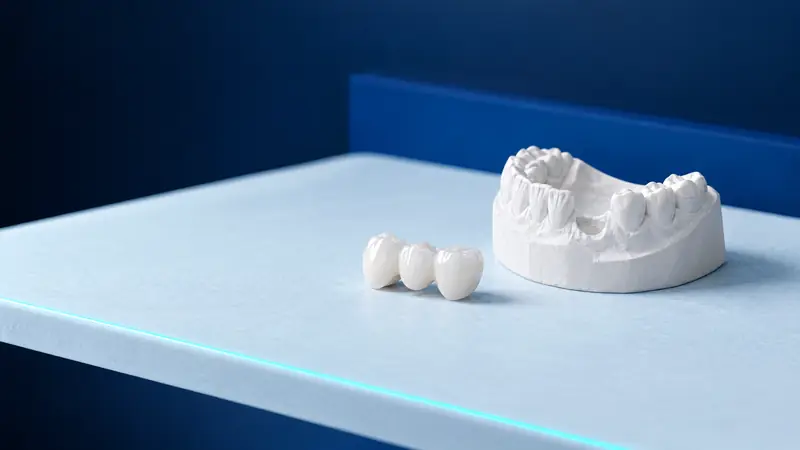
Most all-ceramic bridges use zirconia, either monolithic or veneered with porcelain. The review by Zarone et al. (2019) describes zirconia in bridges of up to 5 units supported by teeth or implants and considers it the material of choice for 3- and 4-unit bridges. In everyday speech, ‘porcelain bridge’ can mean either porcelain fused to metal or zirconia veneered with porcelain.
In a review of tooth-supported bridges, 5-year survival was 92.9% for veneered zirconia, 91.3% for porcelain fused to metal and 87.9% for monolithic zirconia, with no statistically significant differences between these groups. Survival for lithium disilicate bridges was 82.5%, significantly lower than for porcelain fused to metal. Framework fractures occurred in more than 10% of lithium disilicate bridges (Romandini et al., 2026). The review authors conclude that, because of high fracture rates, weaker ceramics are unsuitable for multi-unit bridges.
All-ceramic bridges also developed decay at the crown margins and lost retention more often than porcelain-fused-to-metal bridges. Chipping was least common with monolithic zirconia. If one front tooth is missing, the dentist may consider a ceramic adhesive bridge bonded to a neighbouring tooth with minimal preparation (Zarone et al., 2019). The dental bridge guide discusses how long these bridges last.
All-ceramic crowns and bridges on dental implants
For an implant-supported restoration, ‘all-ceramic’ describes the material of the crown or bridge. The materials of the implant and abutment are chosen separately. A 2018 review estimated that 97.6% of single ceramic-veneered zirconia crowns on implants and 98.3% of porcelain-fused-to-metal crowns were still in function after 5 years. Material fracture led to the loss of 2.1% and 0.2% of crowns respectively (Pjetursson et al., 2018).
The comparison did not include newer monolithic zirconia crowns. Zirconia is also used for implant-supported bridges, whose survival is assessed separately (Zarone et al., 2019).
In the implantology section of DentalBlue’s price list, ‘Zirconia crown on implant’ costs 3 500 zł, ‘Three-unit zirconia bridge’ 10 000 zł and ‘Four-unit zirconia bridge’ 14 000 zł. ‘Implant placement’ (3 500 zł) is a separate item. The written treatment plan explains what each item covers.
What happens when you get an all-ceramic crown or bridge?
A laboratory-made crown or bridge usually takes at least two visits. The dentist prepares the tooth at the first visit and fits the finished restoration at the second. Before that, the dentist assesses the tooth on an X-ray and treats any decay or carries out root canal treatment if needed. Treatment proceeds in these stages:
- Consultation and examination, with a dental X-ray or CT scan if needed. The dentist chooses the material and assesses whether preparatory treatment is needed.
- Tooth preparation under local anaesthesia. The dentist shapes the tooth to fit the crown.
- An impression or scan and shade selection. The review by Zarone et al. found similar accuracy at the margins of lithium disilicate crowns made using conventional and digital methods.
- ‘Temporary crown’ (250 zł), which protects the prepared tooth until the next visit.
- Try-in to check the fit at the margins, the colour, the contact with neighbouring teeth and the bite.
- Fitting the crown. Lithium disilicate is bonded to the tooth after the ceramic is etched. Zirconia cannot be acid-etched, so it can be fitted with conventional cement if the shape of the prepared tooth provides adequate retention (Zarone et al., 2019).
How much do all-ceramic crowns cost in Białystok, and does the NFZ cover them?
In DentalBlue’s published price list, ‘Full zirconia crown’, ‘Zirconia-ceramic crown’ and ‘Lithium disilicate crown’ each cost 3 000 zł. Preparatory treatment, such as root canal treatment or rebuilding the tooth with a post, may add to the cost. Prices may change, and the dentist determines the final scope and cost at consultation.
The price list gives no single price for a conventional bridge on your own teeth. The total depends on the number of units, meaning crowns and pontics, the material and any treatment needed on the abutment teeth. ‘Crown recementation’ (250 zł) and ‘Crown removal’ (300 zł) are separate items, so ask which your treatment plan includes.
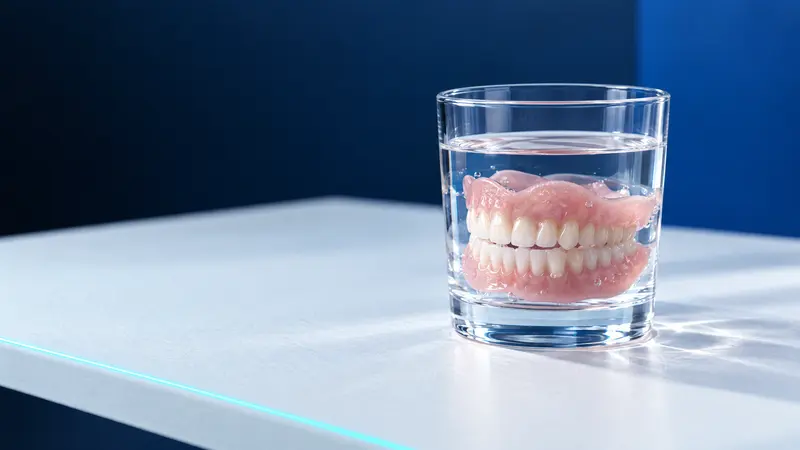
The guaranteed dental services for adults do not cover all-ceramic or porcelain-fused-to-metal crowns or bridges. They include removable acrylic dentures, among other services. Partial dentures are covered when at least 5 teeth in one arch are missing, and full dentures when all teeth are missing, generally once every 5 years (consolidated text, Dz.U. 2025 poz. 615, as of November 2026). The prices in this article come from the clinic’s private price list.
| Price-list item | What it covers | Price |
|---|---|---|
| ‘Prosthetic consultation’ | Before prosthetic treatment | 300 zł |
| ‘Full zirconia crown’ | Monolithic zirconia crown | 3 000 zł |
| ‘Zirconia-ceramic crown’ | Porcelain-veneered zirconia | 3 000 zł |
| ‘Lithium disilicate crown’ | Glass-ceramic crown | 3 000 zł |
| ‘Porcelain-fused-to-metal crown’ | Porcelain on metal | 2 500 zł |
| ‘Composite crown’ | Crown made from composite | 1 500 zł |
| ‘Temporary crown’ | Worn while the crown is made | 250 zł |
| ‘Adhesive zirconia bridge (AET)’ | Zirconia bridge bonded to a tooth | 2 500 zł |
| ‘Zirconia crown on implant’ | Implantology: implant-supported crown | 3 500 zł |
| ‘Three-unit zirconia bridge’ | Implantology: zirconia bridge | 10 000 zł |
| ‘Four-unit zirconia bridge’ | Implantology: zirconia bridge | 14 000 zł |
| ‘Crown recementation’ | Cementing a crown in place | 250 zł |
All-ceramic crowns at DentalBlue in Białystok, with directions and booking details
DentalBlue provides crowns and bridges, including all-ceramic restorations, as part of prosthetic treatment. The clinic’s own radiology unit takes images from intraoral X-rays to CBCT scans. Call 85 748 00 50 to book a ‘Prosthetic consultation’ (300 zł) or a ‘First visit without pain’ (300 zł, including a panoramic X-ray, consultation, examination and written treatment plan). A member of the reception team answers during opening hours.
The clinic is at ul. Kazimierza Pułaskiego 35, 15-337 Białystok, at the junction with Wspólna, south of the city centre. The nearest bus stop is Pułaskiego/Wspólna, 50 m from the entrance, served by routes 16, 23 and 26. DentalBlue is open Monday to Friday from 8:00 to 20:00 and Saturday from 8:00 to 16:00. It is closed on Sundays. The team speaks Polish, English, Ukrainian and Russian.
When you call, say you would like a prosthetic consultation about an all-ceramic crown or bridge. Tell reception which tooth is involved and whether it has had root canal treatment or already has a crown. Bring the following:
- A list of the medicines you take and details of any long-term health conditions.
- Any previous dental images and reports, especially an intraoral X-ray, panoramic X-ray or CT scan.
- Any existing treatment plan or estimate if you want to compare your options.
- Details of whether you clench your teeth at night or wear a splint.
Frequently asked questions
Is a zirconia crown an all-ceramic crown?
Yes. Zirconium dioxide is a material with ceramic properties, and a crown made from it has no metal framework (Zarone et al., 2019). All-ceramic items on the clinic’s price list include ‘Full zirconia crown’, ‘Zirconia-ceramic crown’ and ‘Lithium disilicate crown’.
How much does an all-ceramic crown cost in Białystok?
In DentalBlue’s price list, ‘Full zirconia crown’, ‘Zirconia-ceramic crown’ and ‘Lithium disilicate crown’ each cost 3 000 zł, and ‘Porcelain-fused-to-metal crown’ costs 2 500 zł. ‘Prosthetic consultation’ costs 300 zł. The dentist determines the full cost, including any preparatory treatment, after an examination.
Does the NFZ cover all-ceramic crowns?
The guaranteed dental services for adults do not list all-ceramic or porcelain-fused-to-metal crowns or bridges made from either material (as of November 2026). The list includes removable acrylic dentures, among other services, for people who meet the eligibility criteria.
Does an all-ceramic crown last longer than a porcelain-fused-to-metal crown?
Studies found similar results. After 5 years, 96.8% to 98.5% of monolithic all-ceramic crowns and 97.1% of porcelain-fused-to-metal crowns were still in place (Pjetursson et al., 2026). How long a particular crown lasts also depends on the condition of the tooth, the bite and oral hygiene.
Can I have an all-ceramic crown if I grind my teeth?
Yes, if the dentist examines you and finds that the condition of your tooth and your bite allow it. In the 2026 review, monolithic zirconia and lithium disilicate crowns had fewer fractures and chips overall than veneered crowns. If you have bruxism, the choice depends on an individual assessment of the forces on your teeth.
Can a porcelain-fused-to-metal crown be replaced with an all-ceramic crown?
Yes, if the tooth beneath the old crown can be restored. The dentist assesses it during examination, using an X-ray if indicated, and after removing the old crown. In DentalBlue’s price list, ‘Crown removal’ costs 300 zł, and ‘Full zirconia crown’, ‘Zirconia-ceramic crown’ and ‘Lithium disilicate crown’ each cost 3 000 zł.
Sources
- Pjetursson BE et al., Int J Prosthodont: tooth-supported metal-ceramic and all-ceramic crowns, systematic review (2026)
- Romandini P et al., Int J Prosthodont: tooth-supported metal-ceramic and all-ceramic bridges, meta-analysis (2026)
- Pjetursson BE et al., Clin Oral Implants Res: zirconia and metal-ceramic crowns on implants, systematic review (2018)
- Zarone F et al., BMC Oral Health: lithium disilicate and zirconia, properties and indications, review (2019)
- ELI: Rozporządzenie Ministra Zdrowia w sprawie świadczeń gwarantowanych z zakresu leczenia stomatologicznego (Minister of Health regulation on guaranteed dental services), consolidated text, Dz.U. 2025 poz. 615
- DentalBlue: published price list (prosthetics and implantology)
An informational article. It does not replace a consultation, and treatment decisions are made during a visit.