What does tooth reshaping by contouring involve?
Tooth contouring, also called enameloplasty or cosmetic enamel reduction, removes and polishes a thin layer of enamel from a tooth edge or surface. The dentist only removes tissue and adds nothing, so a tooth can be shortened, rounded or evened out, but not lengthened or widened.
Pontons-Melo et al. (2019) describe enameloplasty-based contouring as a conservative treatment with low biological and financial costs that can be combined with adding composite directly to the tooth. If the change consists solely of adding material, it is called bonding rather than contouring.
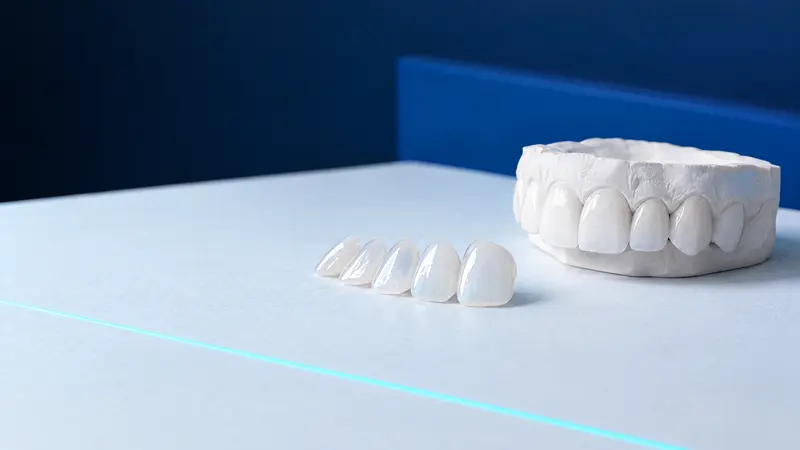
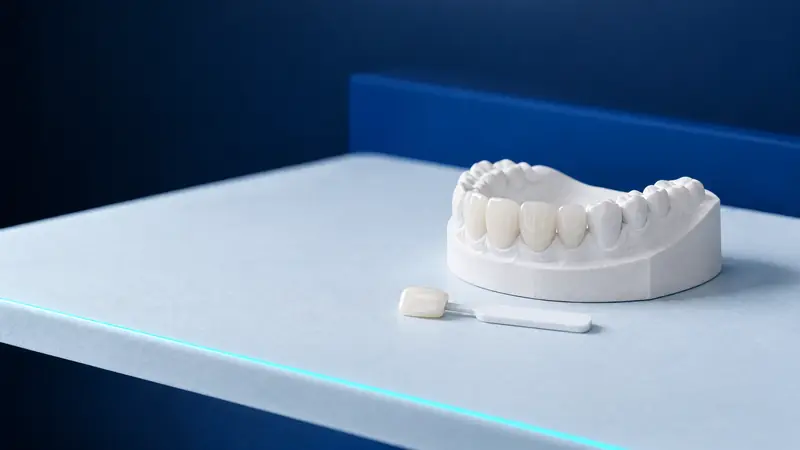
An examination and bite assessment come first; after examining you, the dentist decides whether new images are needed. The dentist marks the areas to adjust, smooths them with fine-grit instruments and finally polishes the enamel; for several teeth, the planned shape may first be shown on a model or trial mock-up before any enamel is removed.
What can tooth contouring change?
Contouring suits minor changes confined to enamel that do not require adding material. Typical situations are listed below; a dentist assesses whether your tooth is suitable after an examination.
Mamelons are a normal feature of newly erupted permanent incisors. In a study of 1 000 teeth in people aged 5 to 40, 60.8% of teeth had mamelons, and their presence declined markedly with age (Nath et al., 2024), so there is usually no reason to remove them in a child.
- Small enamel chips at a tooth edge that can be smoothed without restoration.
- Uneven incisor edges, where one tooth is slightly longer than its neighbour or has a jagged edge.
- Sharp, pointed canines whose tips can be gently rounded if the bite allows.
- Mamelons, the small ridges along incisor edges that have not worn away in some adults.
- Minor edge adjustments after orthodontic treatment, when the teeth are aligned but their edges do not form an even line.
- Reshaping a canine to resemble a lateral incisor after an orthodontist has moved it into the place of a missing lateral incisor; according to Akli et al. (2020), canines often need enameloplasty in this situation.
What can contouring not change?
Contouring only removes enamel, so it cannot help where tooth tissue needs adding or a tooth needs moving. In these situations, the dentist suggests bonding, a veneer or orthodontic treatment, often combining several methods.
- Tooth colour: discolouration requires whitening, bonding or veneers.
- Gaps between teeth, including a diastema, which is closed with an orthodontic appliance or composite.
- Short or worn teeth that need lengthening rather than shortening.
- Crooked, rotated or crowded teeth that need moving with an orthodontic appliance.
- Larger chips involving dentine and fractures requiring restoration.
- Wear from tooth grinding or acids, where the cause is treated first.
Is contouring irreversible, and how much enamel can be removed?
Yes, contouring is irreversible: removed enamel does not grow back, and the tooth keeps its new shape permanently. The procedure is therefore limited to minor changes; when in doubt, a dentist chooses a method that can be adjusted later, such as composite.
How much enamel can be removed depends on the tooth and the site. A micro-CT study of 32 extracted upper canines found thinner enamel near the gum than near the edge, and particularly thin enamel on the palatal cusp, so reshaping it requires great caution (Akli et al., 2020).
The same study found that the more worn the canine edge, the thinner its remaining enamel. An already worn tooth therefore has less enamel to spare; excessive reduction can expose dentine, which is a common cause of sensitivity.
Why does the dentist check the bite and cause of wear first?
Incisor and canine edges contact opposing teeth when biting and moving the lower jaw forwards and sideways. Pontons-Melo et al. (2019) emphasise that planning must consider tooth function as well as smile harmony, so the dentist checks tooth contacts before reduction, for example with articulating paper.
The cause of the irregularity matters equally. If edges are jagged because of grinding, clenching or acids, simply smoothing them will not stop the process, and a worn edge has thinner enamel. The cause is identified and the teeth protected first, for example with a splint for bruxism; lost shape is then generally restored with composite rather than by further reduction.
The mamelon study’s authors also note that bite problems can contribute to their persistence in older people (Nath et al., 2024). Intact ridges in an adult are therefore another reason to assess the bite before smoothing them. Before treatment, the dentist usually checks the points below.
- How teeth contact when biting and during forwards and sideways jaw movements.
- Whether tooth edges are worn and why: grinding, clenching, acids or habits such as nail-biting.
- Enamel thickness at the treatment site, plus any fillings, cracks or decay in the tooth.
- Gum health and whether orthodontic treatment is planned, as this will change the edge line anyway.
Are teeth sensitive after contouring?
Contouring is confined to enamel, while tooth sensitivity usually comes from exposed dentine, the tissue beneath enamel. The less tissue removed, the lower the risk of discomfort: Edelhoff and Sorensen (2002) note that preserving healthy tooth tissue helps maintain pulp vitality and reduce postoperative sensitivity.
Tell your dentist if a tooth reacts to cold after reshaping; fluoride varnish or a desensitising product may be applied. The clinic’s price list gives ‘Sensitivity treatment, Duraphat, per tooth’ at 40 zł and ‘Sensitivity treatment, Tokuyama agent’ at 100 zł. Pain that persists long after a stimulus or worsens requires another visit because it may have another cause.
Contouring, bonding, veneers or orthodontics: which should you choose?
The choice depends on whether a tooth needs tissue removed, tissue added or its position changed. Contouring removes enamel, bonding adds composite, a veneer covers the front of a tooth and an orthodontic appliance changes its position; the table compares the main differences.
Methods are often combined. Pontons-Melo et al. (2019) describe a case combining enameloplasty with direct composite additions to balance smile proportions; a typical example is slightly shortening a longer central incisor and lengthening the shorter one with bonding. If teeth are crooked, edges are usually adjusted only after orthodontic treatment because moving teeth changes the edge line.
| Method | What it changes | How much tooth tissue it removes | Can it be reversed? | Clinic price-list cost |
|---|---|---|---|---|
| Contouring (enameloplasty) | Shortens, evens and rounds edges | A thin layer of enamel | No | No separate item; cost agreed at consultation |
| Bonding (composite) | Lengthens, widens, masks chips and gaps | Often little or none | Composite can usually be repaired or modified | ‘Bonding, one tooth’ 1 000 zł; ‘Bonding, three to four teeth’ 900 zł for the whole procedure |
| Veneer (ceramic or zirconia) | Tooth colour, shape and proportions | Usually a thin enamel layer; around 3 to 30% of crown tissue in a model study | No; the tooth is permanently prepared | ‘Full ceramic veneer’ 3 000 zł; ‘Full zirconia veneer’ 2 800 zł |
| Orthodontic treatment | Tooth position, gaps, crowding and bite | Usually no reduction; sometimes minor interproximal reduction (IPR) between teeth | Teeth may move back, so retention is needed after treatment | According to the treatment plan; ‘Orthodontic consultation’ 300 zł |
How much does tooth reshaping cost, and does the NFZ cover it?
DentalBlue’s published price list has no separate item for enamel contouring, so the dentist sets the cost at consultation depending on the number of teeth and whether it is combined with other treatment. ‘Filling adjustment’ (100 zł) means adjusting an existing filling, not enamel.
When reshaping is combined with composite, ‘Bonding, one tooth’ costs 1 000 zł and ‘Bonding, three to four teeth’ 900 zł: the latter covers the whole procedure on 3 or 4 teeth, not each tooth. A ‘Dental consultation’ costs 300 zł; prices may change, and the final scope and cost are agreed at consultation.
Cosmetic tooth reshaping is not on the guaranteed dental benefits list (rozporządzenie Ministra Zdrowia w sprawie świadczeń gwarantowanych z zakresu leczenia stomatologicznego, Health Minister’s regulation on guaranteed dental benefits, consolidated text Dz.U. 2025 poz. 615, as at November 2026). ‘Corrective tooth grinding’ appears only in the orthodontic benefits list for children and young people under 18, meaning treatment of bite problems rather than a cosmetic procedure.
For a chip requiring restoration, the NFZ funds a filling, and chemically cured composite may be used in front teeth from canine to canine. Find contracted practices using the NFZ ‘Gdzie się leczyć’ (Where to get treatment) search tool; prices in this article come from DentalBlue’s private price list.
Tooth reshaping at DentalBlue in Białystok
At DentalBlue in Białystok, planning tooth reshaping begins with examination and bite assessment; the dentist checks earlier images and decides whether additional imaging is needed in the clinic’s own radiology unit. You can start with a ‘First visit without pain’ (300 zł), including a panoramic X-ray, consultation, examination and written treatment plan. The dentist assesses whether contouring is sufficient or bonding, a veneer or orthodontic appliance is more suitable; a ‘Mock-up, upper and lower’ (1 800 zł) lets you see the planned shape before an irreversible step.
Where teeth need moving, the clinic provides fixed and removable appliances and Clear Aligner trays, planned digitally using cephalometric analysis from its own radiology unit; the team page lists the role ‘Orthodontist’. You can speak Polish, English, Ukrainian or Russian at the clinic.
The clinic is at ul. Kazimierza Pułaskiego 35, near the junction with Wspólna, south of the city centre; the ‘Pułaskiego/Wspólna’ stop, served by buses 16, 23 and 26, is 50 m from the entrance. Opening hours are Monday to Friday 8:00 to 20:00 and Saturday 8:00 to 16:00; the clinic is closed on Sundays.
Book by calling 85 748 00 50. Say you are interested in tooth reshaping, which teeth concern you and for how long, whether you grind or clench, and whether you have had orthodontic treatment. Bring previous X-rays, orthodontic records, a retainer or splint if you have one, and older photographs of your smile if tooth shape has changed over time.
Frequently asked questions
Does tooth contouring damage enamel?
Contouring permanently removes a thin layer of enamel because enamel does not grow back. With minor adjustments confined to enamel, the tooth retains its protective layer, but excessive reduction can expose dentine, so a dentist determines the extent after examination.
How much does tooth reshaping cost?
DentalBlue’s published price list has no separate enamel contouring item, so the cost is agreed at consultation. Where reshaping is combined with composite, ‘Bonding, one tooth’ costs 1 000 zł and ‘Bonding, three to four teeth’ costs 900 zł for the whole procedure on 3 or 4 teeth.
Does the NFZ cover tooth reshaping?
Cosmetic tooth reshaping is not on the guaranteed benefits list (as at November 2026). ‘Corrective tooth grinding’ appears only in the orthodontic benefits list for children and young people under 18.
Can sharp canines be filed down?
Often, yes: gently rounding a canine tip is a typical use of contouring. However, canines contact opposing teeth during jaw movements, so the dentist first checks the bite and enamel thickness; sometimes composite is more suitable.
Should the ridges on a child’s central incisors be smoothed?
Usually not. These ridges, called mamelons, are normal features of newly erupted incisors; in a study of 1 000 teeth their presence declined markedly with age (Nath et al., 2024). If they persist in an adult, the dentist assesses the bite before smoothing them.
Can you even out your teeth with a file at home?
No. Removed enamel cannot be recovered, and without assessing the bite and enamel thickness it is easy to remove too much, expose dentine or chip a tooth edge. Tooth reshaping is carried out by a dentist after an examination.
Sources
- Pontons-Melo JC et al., Int J Esthet Dent: cosmetic contouring of anterior teeth, enameloplasty and composite (2019)
- Akli E et al., Am J Orthod Dentofacial Orthop: maxillary canine enamel thickness assessed by micro-CT (2020)
- Nath A et al., Cureus: incisor mamelons and age, cross-sectional study (2024)
- Edelhoff D, Sorensen JA, J Prosthet Dent: tissue removal for crown and veneer preparation (2002)
- Rozporządzenie Ministra Zdrowia w sprawie świadczeń gwarantowanych z zakresu leczenia stomatologicznego (Health Minister’s regulation on guaranteed dental benefits), consolidated text Dz.U. 2025 poz. 615
- DentalBlue: price list
An informational article. It does not replace a consultation, and treatment decisions are made during a visit.