What does cosmetic dentistry in Białystok include?
Cosmetic dentistry is a common term for treatment that changes tooth colour, shape, proportions or alignment. In practice, it combines methods from several fields: whitening, composite restorations or bonding, veneers, crowns, orthodontics and gum procedures. Appearance is the aim, but planning must also consider the bite, gum health and whether the teeth can be cleaned properly afterwards.
Poland has no recognised specialist qualification in cosmetic dentistry. The list of dental specialties in the ‘Rozporządzenie Ministra Zdrowia w sprawie specjalizacji lekarzy i lekarzy dentystów’ (Minister of Health regulation on medical and dental specialist training, Dz.U. 2023 poz. 975) includes 9 fields, among them prosthodontics, orthodontics, periodontology and conservative dentistry with endodontics. ‘Cosmetic dentist’ therefore describes a scope of work rather than a specialist title.
This page brings together information useful to patients in Białystok before deciding: DentalBlue’s published prices, differences between methods, the role of a mock-up and treatment order. A separate page on teeth whitening in Białystok explains whitening methods and prices.
How much does cosmetic dentistry cost in Białystok?
The cost of cosmetic treatment depends on the number of teeth, material, need for a mock-up and preparatory treatment, for example for decay or gum problems. The table brings together items from DentalBlue’s published private price list; prices may change, and the final scope and cost are agreed at consultation.
When comparing proposals, check whether the price is per tooth or for the whole procedure. The clinic’s ‘Bonding, three to four teeth’ price covers the whole procedure on 3 or 4 teeth, while veneers and crowns are priced per restoration, so for several teeth the amount is multiplied accordingly.
The examples below are simply arithmetic using price-list items, rather than an estimate for your treatment. They exclude preparatory treatment, whitening and check-ups; the clinician decides the number of teeth and method after an examination.
- Bonding on four front teeth: ‘Bonding, three to four teeth’, 900 zł for the whole procedure.
- Four ceramic veneers: 4 × ‘Full ceramic veneer’ at 3 000 zł = 12 000 zł; adding ‘Mock-up, upper and lower’ at 1 800 zł gives 13 800 zł.
- One metal-free crown on a front tooth: ‘Lithium disilicate crown’ at 3 000 zł, potentially plus ‘Temporary crown’ at 250 zł.
| Clinic price-list item | Price | What it concerns |
|---|---|---|
| ‘First visit without pain’ | 300 zł | Panoramic X-ray, consultation, examination and written treatment plan |
| ‘Bonding, one tooth’ | 1 000 zł | Composite restoration of one tooth |
| ‘Bonding, three to four teeth’ | 900 zł | Whole procedure on 3 or 4 teeth together, not per tooth |
| ‘Flow injection tooth build-up’ | 800 zł | Composite injection technique |
| ‘Full ceramic veneer’ | 3 000 zł | One laboratory-made ceramic veneer |
| ‘Full zirconia veneer’ | 2 800 zł | One zirconia veneer |
| ‘Lithium disilicate crown’ | 3 000 zł | Metal-free glass-ceramic crown |
| ‘Full zirconia crown’ | 3 000 zł | Metal-free monolithic zirconia crown |
| ‘Mock-up, upper and lower’ | 1 800 zł | Trial model of new tooth shapes on both arches |
| ‘Tray whitening’ | 1 000 zł | Whitening at home in trays |
| ‘Lamp whitening, first session’ | 1 200 zł | Whitening in the practice |
| ‘Surgical crown lengthening’ | from 300 zł | Gum correction when teeth appear short |
Bonding in Białystok: what it involves, when it is suitable and what it costs
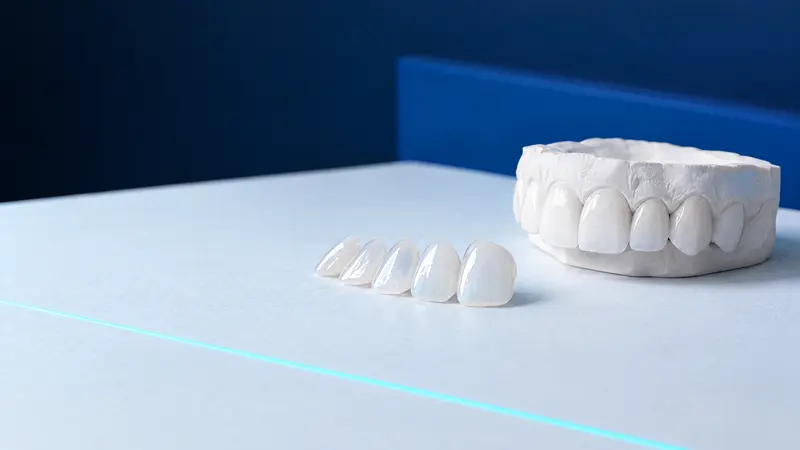
Bonding is a composite restoration using a tooth-coloured material that the dentist bonds to enamel, shapes directly in the mouth, cures with a special light and polishes. When composite covers the whole front surface, it is also called a composite veneer; the American Dental Association (ADA) notes that this may require less enamel removal and fewer appointments than porcelain.
According to the ADA, veneers, including composite veneers, improve the appearance of chipped or broken, stained, crooked or misshapen teeth and can conceal gaps. Bonding does not move teeth, however, so with marked crowding the dentist may first suggest an orthodontic consultation.
DentalBlue’s published price list gives ‘Bonding, one tooth’ at 1 000 zł and ‘Bonding, three to four teeth’ at 900 zł: the second price covers the whole procedure on 3 or 4 teeth, rather than each tooth separately. ‘Flow injection tooth build-up’ (800 zł) is a separate item, explained in the article on restoring a front tooth. The clinician decides the technique and number of teeth after examining you.
Bonding usually requires no laboratory work, so the tooth shape is created chairside and adjustments can be made immediately. Composite nevertheless needs check-ups, where the dentist assesses the surface, margins and any staining; small chips are usually repaired with the same material.
Composite or ceramic veneers: which should you choose?
A ceramic veneer is a thin shell made in a laboratory from an impression or 3D scan and bonded to the front surface of a tooth; a composite veneer is made directly in the mouth, like bonding. The ADA describes porcelain veneers as strong, long-lasting and usually more expensive, and composite veneers as easier to repair but less resistant to staining and wear.
Before a ceramic veneer, the dentist usually removes a thin layer of enamel from the front and sides of the tooth, so the ADA describes this treatment as irreversible. In a study using models of front teeth, preparation for ceramic veneers removed around 3 to 30% of the tooth crown’s mass (Edelhoff and Sorensen, 2002).
According to the ADA, veneers may be unsuitable if you clench or grind your teeth or have a deep overbite. Decay and gum disease must be treated first because veneers on unhealthy teeth may worsen problems. Any veneer may eventually chip, crack or come loose; the article on veneers and bonding compares research on the longevity of both types.
If you are unsure about composite or ceramic, ask for a comparison for your particular teeth rather than in general. Ask how much enamel each option requires removing, how many appointments it takes and what future repair costs may be.
| Criterion | Composite veneer | Ceramic veneer |
|---|---|---|
| Where it is made | Directly on the tooth in the practice | In a laboratory from an impression or scan |
| Appointments | Usually fewer visits | Preparation and impression, then bonding; sometimes a temporary veneer in between |
| Enamel preparation | Often less extensive | Thin layer from the front and sides of the tooth |
| Staining and wear | Less resistant | More resistant |
| If damaged | Usually repaired with composite in the mouth | Rebonding, repair or replacement |
| Clinic price-list cost | Depends on scope, agreed after examination | ‘Full ceramic veneer’ 3 000 zł, ‘Full zirconia veneer’ 2 800 zł |
All-ceramic crowns: when is a crown used instead of bonding or a veneer?
Bonding and veneers mainly change the front tooth surface, whereas a crown covers the whole tooth; the ADA gives this as the basic difference between a veneer and a crown. The choice depends on remaining healthy tissue, pulp health, previous restorations and the bite, assessed during examination and imaging. A separate article on dental crowns explains indications.
A crown requires substantially more tooth preparation. In the same study on models of front teeth, preparation for all-ceramic and porcelain-fused-to-metal crowns removed around 63 to 72% of the tooth crown’s mass, clearly more than veneer preparation (Edelhoff and Sorensen, 2002). When two methods offer a similar result, the one removing less healthy tissue is therefore usually chosen.
An all-ceramic crown is a common term for a crown without a metal substructure. The clinic’s price-list items of this type are ‘Lithium disilicate crown’, ‘Full zirconia crown’ and ‘Zirconia-ceramic crown’, each at 3 000 zł; ‘Porcelain-fused-to-metal crown’ costs 2 500 zł and ‘Temporary crown’ 250 zł.
Mock-up: how can you see a new tooth shape before preparation?
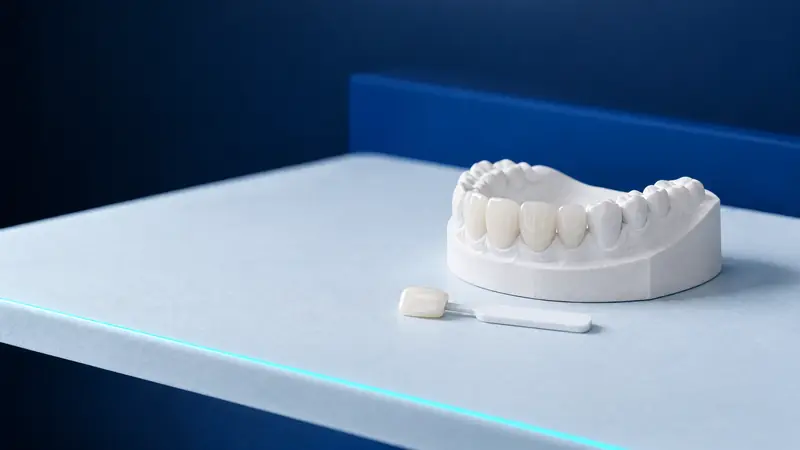
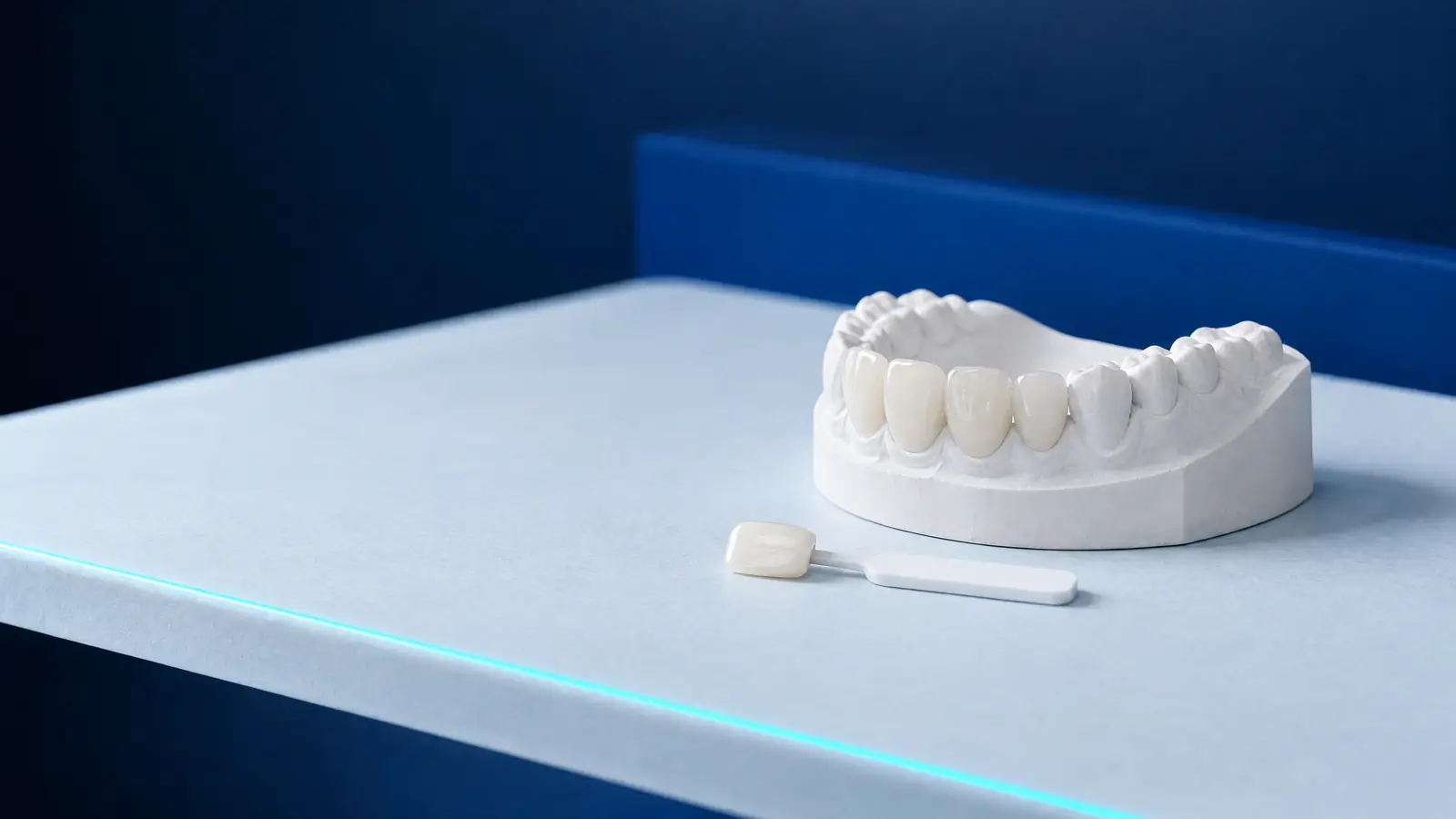
A mock-up is a trial transfer of a design into the mouth: the dentist applies a temporary tooth-coloured material to your teeth, reproducing the planned shape previously prepared on a model as a wax-up, or digitally. No tooth preparation is needed, and it is removed after the trial.
With a mock-up, you assess tooth length, width and proportions in the mirror, in photographs and while speaking; the shape can be changed before even one tooth is prepared. The approved design then guides the dentist and dental technician, and any planned gum correction.
DentalBlue’s published price list gives ‘Mock-up, upper and lower’ at 1 800 zł. A mock-up does not determine the final result, because the teeth, gums and bite govern what is possible, but it allows a decision based on your own smile rather than photographs of other people. Pay attention to the following during the trial.
- How the teeth look with a broad smile and at rest, from the front and side.
- Whether you can pronounce sounds comfortably, especially ‘s’, ‘f’ and ‘v’, and whether your lips close naturally.
- How tooth shape and length look in a daylight photograph.
- What you want changed in the design before the dentist starts preparing teeth.
In what order is cosmetic treatment planned?
Treatment progresses from treating disease, through changing tooth alignment and the gum line, to changing tooth surfaces, because each step depends on the previous result. Your plan may follow a different order, but the usual sequence is listed below.
This order reduces the risk of having to adjust new restorations when tooth positions, the gum line or neighbouring tooth colour change. The clinician records the sequence in the treatment plan after examining you.
The overall duration depends on which stages are needed. Bonding can usually be completed in one or several visits; veneers and crowns also require laboratory work, while orthodontic treatment, if included, is measured in months.
- Treating decay and gum disease; the ADA warns that veneers on unhealthy teeth can worsen problems.
- Orthodontic treatment if the plan includes changing alignment, because bonding and veneers change tooth surfaces rather than positions.
- Gum correction, for example surgical crown lengthening when teeth appear short because the gum covers them.
- Whitening natural teeth if you want a lighter colour, because composite and ceramic shades are matched to teeth after whitening.
- A break after whitening: in a meta-analysis of 52 laboratory studies, whitening reduced adhesive bond strength to enamel and dentine, with the effect persisting for around 2 weeks (Savian et al., 2021).
- Bonding, veneers or crowns based on the approved mock-up, followed by check-ups and protection of the result, for example retention after braces or a splint for tooth grinding.
Does NFZ cover cosmetic dentistry in Białystok?
Veneers, prosthetic crowns and whitening are absent from the list of guaranteed dental treatment benefits (‘Rozporządzenie Ministra Zdrowia w sprawie świadczeń gwarantowanych z zakresu leczenia stomatologicznego’, the Minister of Health regulation on guaranteed dental treatment benefits, consolidated text Dz.U. 2025 poz. 615, as at November 2026). The list is the same nationwide, including Podlaskie, so these procedures are provided privately.
NFZ does fund fillings: adults are entitled to chemically cured composite in front teeth, from canine to canine, while children and young people under 18 are entitled to light-cured composite in incisors and canines. Children’s benefits also include restoring a fractured incisor corner and ‘cosmetic coverage of enamel hypoplasia’ in permanent teeth.
The NFZ ‘Gdzie się leczyć’ (‘Where to get treatment’) directory lists contracted practices in Białystok. DentalBlue’s prices on this page come from its published private price list; the clinic also provides NFZ-funded treatment under general anaesthesia for patients who meet the eligibility criteria.
How do you choose a dentist for cosmetic treatment in Białystok?
Because cosmetic dentistry is not a recognised specialty, assess how treatment is planned rather than the service name. You can check a clinician’s licence and specialist qualifications in the Central Register of Doctors run by Poland’s Supreme Medical Chamber (NIL); the ADA also advises checking that a licensed dentist will provide veneers.
Photographs of other patients’ results do not show how your teeth will look, because the result depends on their condition, your gums, bite and facial features. Base your decision on an examination, written plan and mock-up, and note the answers to the questions below to compare proposals.
For an extensive plan, such as several veneers or crowns, you can ask for copies of the images and written plan and discuss them at another practice. A second opinion before irreversible tooth preparation is a normal precaution rather than a lack of trust in the dentist.
- Before discussing appearance, did the dentist examine the teeth, gums and bite and take any necessary images?
- Does the plan present at least two options, including a less invasive one?
- Can you see the design as a mock-up before any tooth preparation?
- Do you know which stages are irreversible and how much enamel each method requires removing?
- Does the plan cover check-ups, possible repairs and their cost?
- Is the price per tooth or for the whole procedure, and exactly what does it include?
Cosmetic dentistry at DentalBlue in Białystok
DentalBlue is at ul. Kazimierza Pułaskiego 35 in Białystok, by the junction with Wspólna, south of the city centre. The ‘Pułaskiego/Wspólna’ stop, served by buses 16, 23 and 26, is 50 m from the entrance. Appointments run Monday to Friday from 8:00 to 20:00 and Saturday from 8:00 to 16:00; the clinic is closed on Sundays.
Book a consultation by calling 85 748 00 50. Say you want cosmetic treatment and describe what you want changed: colour, shape, gaps or chips. Mention any existing veneers or crowns and tooth grinding. You can start with a ‘First visit without pain’ (300 zł), which includes a panoramic X-ray from the clinic’s own radiology unit, consultation, examination and written treatment plan.
Bring previous X-rays or scans, treatment records and any splint you wear; older photographs from before a chip or tooth colour change may also help. If the plan includes changing tooth positions, the clinic offers fixed braces, removable appliances and Clear Aligner treatment, planned digitally using cephalometric analysis from its own unit. The clinic’s team page lists roles including ‘Orthodontist’ and ‘Specialist in periodontology’; Polish, English, Ukrainian and Russian are spoken at the clinic.
If you are anxious about dental procedures, mention it when booking. The clinic provides inhalation sedation with nitrous oxide; the price-list item ‘Nitrous oxide’ costs 170 zł.
Frequently asked questions
How much does bonding cost in Białystok?
DentalBlue’s published price list gives ‘Bonding, one tooth’ at 1 000 zł and ‘Bonding, three to four teeth’ at 900 zł; the second price covers the whole procedure on 3 or 4 teeth, rather than each tooth. The final scope and cost are agreed at consultation.
How much do veneers cost in Białystok?
The clinic lists ‘Full ceramic veneer’ at 3 000 zł and ‘Full zirconia veneer’ at 2 800 zł. Composite veneers are made directly in the mouth, like bonding; the clinician determines their scope and cost after an examination.
Does NFZ cover veneers and bonding in Białystok?
Veneers and prosthetic crowns are not in the NFZ benefits package, so they are provided privately. NFZ funds fillings: chemically cured composite in adults’ front teeth and light-cured composite for children under 18.
Do I need a referral for a cosmetic consultation?
No. You book a private consultation directly by telephone; the dentist starts by examining the teeth, gums and bite.
Must teeth be whitened before veneers?
No, but if you want lighter teeth, whitening is planned before veneers or bonding because the material’s shade is matched to the whitened teeth. A meta-analysis of laboratory studies found bonding to enamel was reduced for around 2 weeks after whitening (Savian et al., 2021).
What is a mock-up, and is it necessary?
A mock-up is a temporary trial model of new tooth shapes, applied without tooth preparation. It is not compulsory, but when changing several teeth it lets you assess the appearance before an irreversible step; the clinic lists ‘Mock-up, upper and lower’ at 1 800 zł.
Can I have veneers if I grind my teeth?
According to the ADA, clenching or grinding teeth and a deep overbite may make veneers unsuitable. The dentist assesses this during examination and may suggest another option or additional protection.
How should I care for veneers and bonding?
The ADA recommends brushing twice daily with fluoride toothpaste and cleaning between teeth every day, because decay can still develop under or around a veneer. It also advises care with coffee, tea and red wine, avoiding biting nails or hard objects, and wearing a mouthguard for sports with a risk of injury.
Sources
- DentalBlue: published price list, prosthetics, hygiene and aesthetics
- ADA MouthHealthy: Veneers
- Edelhoff D, Sorensen JA, J Prosthet Dent: tissue removal in veneer and crown preparation (2002)
- Savian TG et al., Oper Dent: whitening and adhesive bond strength, meta-analysis of laboratory studies (2021)
- ELI: Rozporządzenie MZ w sprawie świadczeń gwarantowanych z zakresu leczenia stomatologicznego (Minister of Health regulation on guaranteed dental treatment benefits), consolidated text Dz.U. 2025 poz. 615
- Sejm: Rozporządzenie MZ w sprawie specjalizacji lekarzy i lekarzy dentystów (Minister of Health regulation on medical and dental specialist training), Dz.U. 2023 poz. 975
An informational article. It does not replace a consultation, and treatment decisions are made during a visit.