How much does teeth whitening cost in Białystok?
The cost of teeth whitening depends on the method, number of sessions in the practice and amount of product needed to complete treatment. The table brings together items from DentalBlue’s published price list at ul. Kazimierza Pułaskiego 35; these are private prices because whitening is not an NFZ benefit.
The price list has separate items for ‘Tray whitening’, ‘Whitening tray’ and ‘Tray whitening agent’. Before starting, ask which apply to your plan, for example whether trays and the first supply of gel are already included. Prices may change, and the final scope and cost are agreed at consultation.
To estimate a budget, you can add together price-list items commonly associated with lamp whitening. The amounts below are simply arithmetic using listed items, rather than an estimate: the clinician decides after examining you whether professional cleaning or a second session is needed.
- ‘First visit without pain’ 300 zł + ‘Lamp whitening, first session’ 1 200 zł = 1 500 zł.
- Adding ‘Complete hygiene treatment (scaling, air polishing, fluoride)’ at 350 zł gives a total of 1 850 zł.
- If the clinician also plans ‘Lamp whitening, second session’ at 600 zł, the total is 2 450 zł.
- For tray whitening, the total depends on which items your plan includes, so ask for an itemised breakdown before starting.
| Clinic price-list item | Price | When it matters |
|---|---|---|
| ‘First visit without pain’ | 300 zł | First visit: panoramic X-ray, consultation, examination and written treatment plan |
| ‘Lamp whitening, first session’ | 1 200 zł | Whitening in the practice |
| ‘Lamp whitening, second session’ | 600 zł | If the clinician plans a second session |
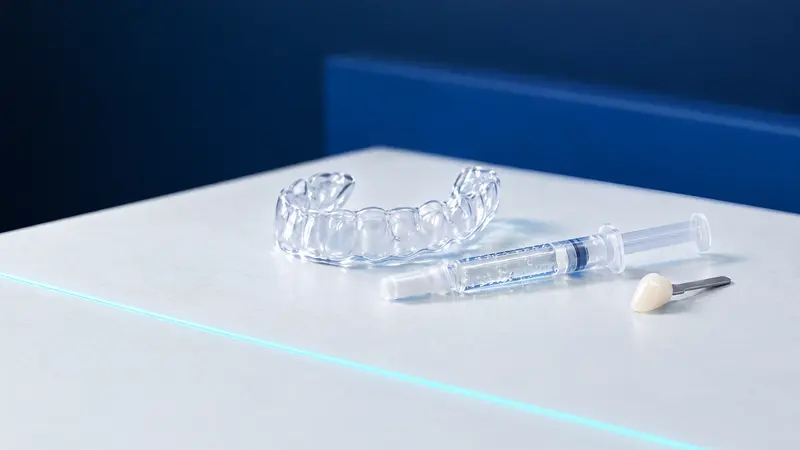
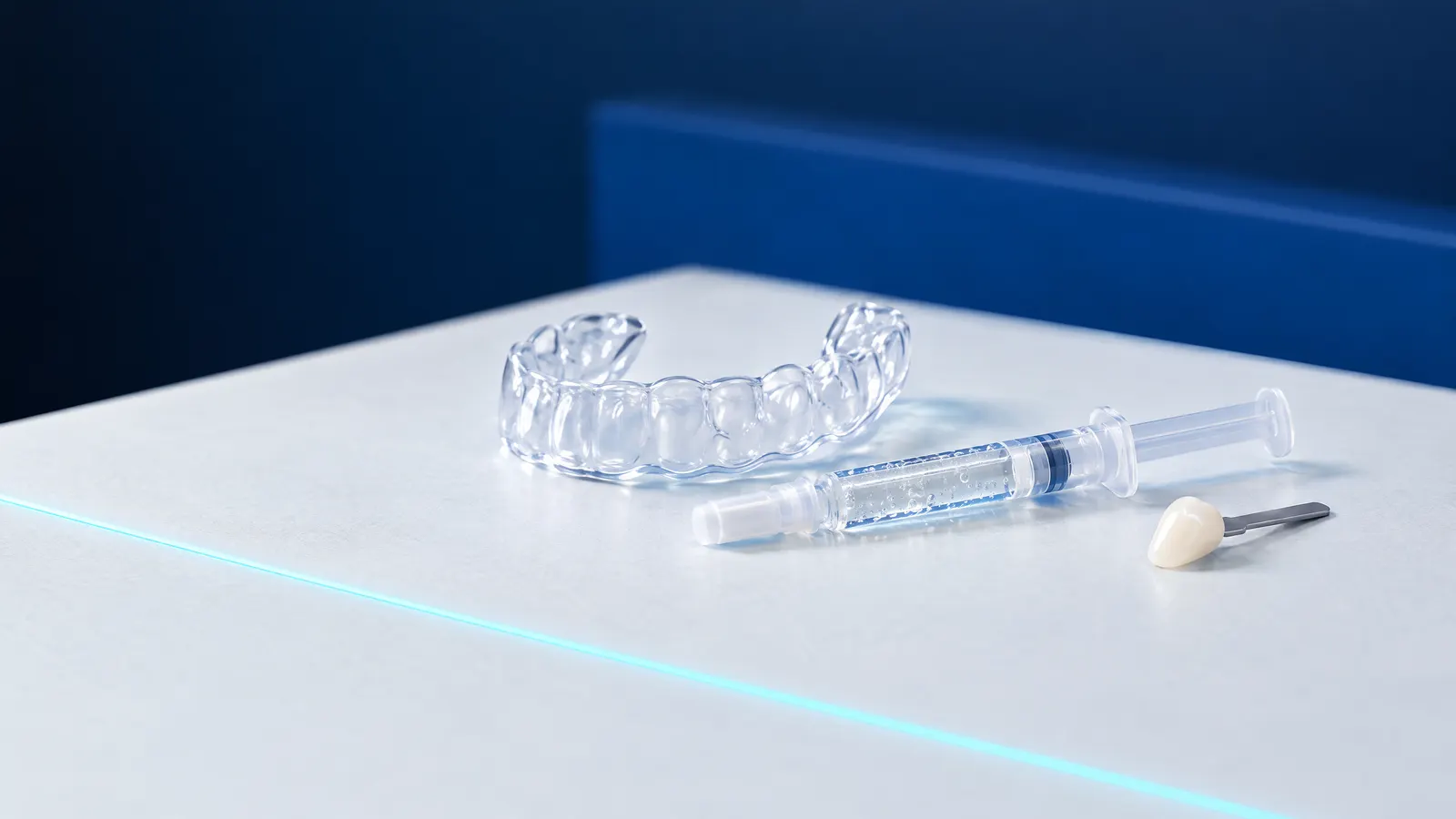
| ‘Tray whitening’ | 1 000 zł | Whitening at home in custom-made trays |
| ‘Whitening tray’ | 700 zł | Separate price-list item; agree the scope at consultation |
| ‘Tray whitening agent’ | 150 zł | Gel for trays; quantity depends on the treatment plan |
| ‘Complete hygiene treatment (scaling, air polishing, fluoride)’ | 350 zł | Removing calculus and deposits before whitening, if needed |
| ‘Sensitivity treatment, Duraphat, per tooth’ | 40 zł | For sensitive teeth |
| ‘Sensitivity treatment, Tokuyama agent, per tooth’ | 100 zł | For sensitive teeth |
Lamp or tray whitening: which should you choose?
Both methods use hydrogen peroxide or carbamide peroxide gel and both require a dentist’s involvement, but their timings differ. According to the NHS, whitening in the practice usually involves one appointment lasting 1 to 2 hours, while gel-filled trays are worn at home for about 2 to 6 weeks.
The choice rarely comes down to the result alone: it also matters whether you prefer treatment in the practice or spread over time, and how your teeth react. A separate article on teeth whitening discusses studies comparing shade change and sensitivity with both methods; the table compares practical differences.
If you have sensitive teeth or know you will struggle to wear trays regularly, mention this at consultation. This affects the method, gel concentration and spacing of sessions, and the clinician may suggest an option different from the one you originally asked about.
| Question | Lamp whitening in the practice | Tray whitening |
|---|---|---|
| Where it takes place | In the practice; the dentist applies and monitors the gel | At home in trays fitted to your teeth, after the first application in the practice |
| Duration according to the NHS | Usually 1 visit lasting 1 to 2 hours | About 2 to 6 weeks of tray wear |
| What you need to do | Attend the agreed session, sometimes a second one too | Wear the trays consistently as instructed by the clinician |
| Clinic price-list items | ‘Lamp whitening, first session’ 1 200 zł, ‘Lamp whitening, second session’ 600 zł | ‘Tray whitening’ 1 000 zł |
| Who may find it more convenient | People who prefer a single appointment in the practice | People who prefer gradual whitening at home |
Laser teeth whitening in Białystok: what does the name mean?
‘Laser whitening’ is a common term for whitening in the practice, where light from a lamp or laser is directed at gel-coated teeth. DentalBlue’s price list calls the method ‘Lamp whitening’; it does not list an item with laser in its name.
Peroxide gel is responsible for lightening the teeth. In a network meta-analysis of 28 randomised clinical trials (Maran et al., 2019), none of the light-activation methods compared produced a greater colour change than the same whitening in the practice without light, regardless of gel concentration. The authors explicitly related this finding to the popular term ‘laser whitening’.
The name does not change the rules: gel used with a lamp, a laser or neither may contain no more than 6% hydrogen peroxide. When asking about ‘laser whitening’, focus on gel concentration, session numbers, gum protection and what to do about sensitivity.
The clinic prices lamp sessions separately: ‘Lamp whitening, first session’ costs 1 200 zł and ‘Lamp whitening, second session’ 600 zł. The clinician decides whether a second session is needed after assessing the shade and the teeth’s response to the first.
What happens during teeth whitening at the dentist?
Whitening starts with an examination. The NHS emphasises that a dentist should check the teeth and gums are healthy before treatment. The EU experts whose opinion underpinned the rules considered stronger gels potentially safe only when an examination rules out risk factors and oral disease.
If teeth look darker mainly because of deposits, for example from coffee, tea or smoking, the clinician may start with professional cleaning and then assess whether whitening is still needed. This means shade is assessed on clean teeth and the gel contacts enamel rather than calculus.
The next steps depend on the method but usually include those listed below. The clinician explains the plan for your teeth after examining you.
No one should promise you a particular shade before treatment, because the result depends on the starting colour and type of discolouration. After examining you, the clinician can explain what to expect realistically for your teeth and what to do if the lightening is less than you want.
- Examination of the teeth and gums and assessment of discolouration and front-tooth fillings, which will not change colour during treatment.
- Treatment of decay or gum problems and removal of calculus and deposits if the clinician considers it necessary.
- Recording the starting tooth colour on a shade guide to allow comparison afterwards.
- In the practice: protecting the gums, applying gel and a lamp session; the NHS also mentions protective eyewear.
- For trays: checking the fit, the first gel application in the practice and instructions on how often and how long to wear them at home.
- Assessing colour after treatment and deciding whether a second session or more product is needed.
What peroxide limits apply, and at what age can teeth be whitened?
Council Directive 2011/84/EU, applied from 31 October 2012, introduced whitening rules throughout the European Union, including Poland. The same conditions now appear in Annex III to Regulation (EC) 1223/2009 on cosmetic products (as at November 2026). The limit concerns hydrogen peroxide present or released, so it also covers carbamide peroxide gels.
This is why tray treatment also starts in the practice, and gels stronger than 0.1% hydrogen peroxide are not bought online or at a beauty salon. The NHS warns that whitening outside a dental practice is less effective and may harm teeth and gums. A separate article on home whitening covers strips, toothpastes and other home methods.
If you receive gel for home tray treatment, its hydrogen peroxide concentration should appear on the packaging. You can ask about it when the product is supplied and keep the packaging until treatment ends so that, if symptoms develop, you know what you are using.
- Up to 0.1% hydrogen peroxide: oral products available through ordinary retail, including toothpaste, mouthwash and whitening products.
- Over 0.1% and up to 6%: products sold only to dentists; for each treatment cycle, the first use must be by a dentist or under their direct supervision, after which the patient can complete treatment at home.
- At these concentrations, use in people under 18 is prohibited, and the peroxide concentration must appear on the label.
- The rules do not provide for concentrations above 6% hydrogen peroxide in teeth-whitening products.
Does NFZ cover teeth whitening in Białystok?
No. Teeth whitening is absent from the list of guaranteed dental treatment benefits (‘Rozporządzenie Ministra Zdrowia w sprawie świadczeń gwarantowanych z zakresu leczenia stomatologicznego’, the Minister of Health regulation on guaranteed dental treatment benefits, consolidated text Dz.U. 2025 poz. 615, as at November 2026). The list is the same nationwide, including Podlaskie. You therefore pay privately for whitening, regardless of whether a practice has an NFZ contract for other services.
NFZ does fund some treatment that may be needed before whitening, for example fillings and calculus removal once per calendar year. The NFZ ‘Gdzie się leczyć’ (‘Where to get treatment’) directory lists contracted practices in Białystok; DentalBlue’s prices on this page come from its published private price list.
You can therefore have calculus removed through NFZ at a contracted practice and whitening privately, including elsewhere. Bring information about what was done and when, so the dentist overseeing whitening knows the condition of your teeth and gums.
When is whitening insufficient, or best postponed?
Whitening lightens only natural teeth: the NHS notes that it does not change the colour of crowns, dentures or implants. The same applies to other restorations such as fillings and veneers. If you have visible front-tooth restorations, discuss before treatment how they will look beside lighter teeth.
The NHS does not recommend whitening when teeth or gums are unhealthy, during pregnancy or while breastfeeding; for pregnancy, this is a precautionary recommendation rather than a prohibition in EU law. Show a single darkened tooth, for example after an injury, to the dentist before deciding to whiten the whole arch; a separate article explains the causes of such discolouration.
If you also want to change tooth shape, close gaps or conceal chips, whitening alone is insufficient. The page on cosmetic dentistry in Białystok explains bonding, veneers and crowns, their prices and treatment sequence.
- You are under 18: EU law prohibits products containing more than 0.1% hydrogen peroxide.
- You have decay, gum inflammation or calculus: treatment and professional cleaning come first.
- You are pregnant or breastfeeding: the NHS advises postponing whitening.
- You have crowns, veneers or large fillings in front teeth: these will not change colour.
- One tooth has darkened: an examination comes first because different treatment may be needed.
Sensitivity, white patches and food after whitening
The NHS lists sensitivity to cold and sweet foods, sore gums or throat, and short-lived white patches on the gums among whitening side effects. If your teeth are sensitive before treatment, mention it at consultation, and report symptoms that persist after whitening to the clinician.
White spots on the teeth themselves differ from patches on the gums, so show them to the dentist to assess their cause. Your treating clinician provides dietary advice during and after treatment; a separate article discusses research on the so-called white diet.
With tray whitening, do not increase the amount of gel or wearing time yourself, even if results seem slow. Contact the practice if sensitivity or gum irritation develops; the clinician will assess whether to adjust product use or take a break.
How should you prepare for whitening, and what should you ask?
Specific questions help you compare proposals covering the same treatment scope and avoid unexpected costs. Before choosing a method, ask about the points below.
Whitening is not permanent: the NHS says results may last around 3 years if you follow your dentist’s advice. It lists age, frequent coffee, tea and red wine consumption, and smoking among causes of tooth darkening.
When comparing proposals from practices in Białystok, compare the same scope: session numbers, gel type and concentration, whether trays and product are included, and a check-up. The price of a single session does not tell you the cost of the complete course.
- Do I need professional cleaning or treatment for decay or gum problems before whitening?
- Which of my fillings, crowns or veneers will not change colour?
- What gel concentration is planned, and how many sessions or weeks of tray wear?
- Does the price include the examination, trays, product and check-up?
- What should I do if I develop sensitivity or gum irritation?
- How and when can the result be refreshed?
Teeth whitening at DentalBlue in Białystok
DentalBlue is at ul. Kazimierza Pułaskiego 35 in Białystok, by the junction with Wspólna, south of the city centre. The ‘Pułaskiego/Wspólna’ stop, served by buses 16, 23 and 26, is 50 m from the entrance. The clinic opens Monday to Friday from 8:00 to 20:00 and Saturday from 8:00 to 16:00, and is closed on Sundays.
Book by calling 85 748 00 50; a receptionist answers during opening hours. Say you want teeth whitening, and mention crowns, veneers or visible front-tooth fillings and any sensitivity. If it has been a long time since your last check-up, ask about the ‘First visit without pain’ (300 zł), which includes a panoramic X-ray, consultation, examination and written treatment plan.
Bring a medicines list and previous X-rays if you have them, and tell the dentist if you are pregnant or breastfeeding. Imaging is provided by the clinic’s own radiology unit; Polish, English, Ukrainian and Russian are spoken at the clinic.
Whitening is elective, so you can choose a convenient time. If a tooth or gum hurts, however, the cause must be treated first; the price list includes ‘First visit in pain’ (340 zł), covering a panoramic X-ray, consultation, examination and pain relief.
Frequently asked questions
How much does teeth whitening cost in Białystok?
DentalBlue’s published price list gives ‘Lamp whitening, first session’ at 1 200 zł, ‘Lamp whitening, second session’ at 600 zł and ‘Tray whitening’ at 1 000 zł. The final scope and cost are agreed at consultation, and prices may change.
Does NFZ reimburse teeth whitening?
No. Whitening is not listed among guaranteed dental treatment benefits, so patients pay privately in Białystok, as throughout Poland.
Does laser teeth whitening work better than lamp whitening?
‘Laser’ is a common term for whitening in the practice using light, while peroxide gel determines the effect. In a meta-analysis of 28 randomised trials (Maran et al., 2019), no light-activation method increased lightening compared with the same whitening without light.
Do I need a referral for teeth whitening?
No, you can book private whitening directly. The dentist examines your teeth and gums beforehand because gels stronger than 0.1% hydrogen peroxide may only be used with a dentist’s involvement.
At what age can I have teeth whitening at the dentist?
From age 18. EU law prohibits whitening products containing more than 0.1% hydrogen peroxide for people under 18, both in the practice and at home.
How long does tray whitening take?
The NHS says gel-filled trays are usually worn at home for about 2 to 6 weeks. The clinician determines the precise plan, including wearing times, after an examination.
Will whitening change the colour of crowns and fillings?
No. Whitening lightens only natural teeth, so crowns, veneers and fillings retain their existing colour; discuss them with the dentist beforehand.
What should I eat after teeth whitening?
Your treating clinician gives advice on food and drink after treatment according to the method. A separate article explains research findings on the so-called white diet and coffee after whitening.
Sources
- EUR-Lex: Regulation (EC) 1223/2009 on cosmetic products, consolidated text, Annex III entry 12 (version dated 18.05.2026)
- EUR-Lex: Council Directive 2011/84/EU, teeth-whitening products (2011)
- DentalBlue: published price list, hygiene and aesthetics
- NHS: Teeth whitening (2025)
- Clinical Oral Investigations: Maran BM et al., light activation in whitening in the practice, network meta-analysis (2019)
- ELI: Rozporządzenie MZ w sprawie świadczeń gwarantowanych z zakresu leczenia stomatologicznego (Minister of Health regulation on guaranteed dental treatment benefits), consolidated text Dz.U. 2025 poz. 615
An informational article. It does not replace a consultation, and treatment decisions are made during a visit.