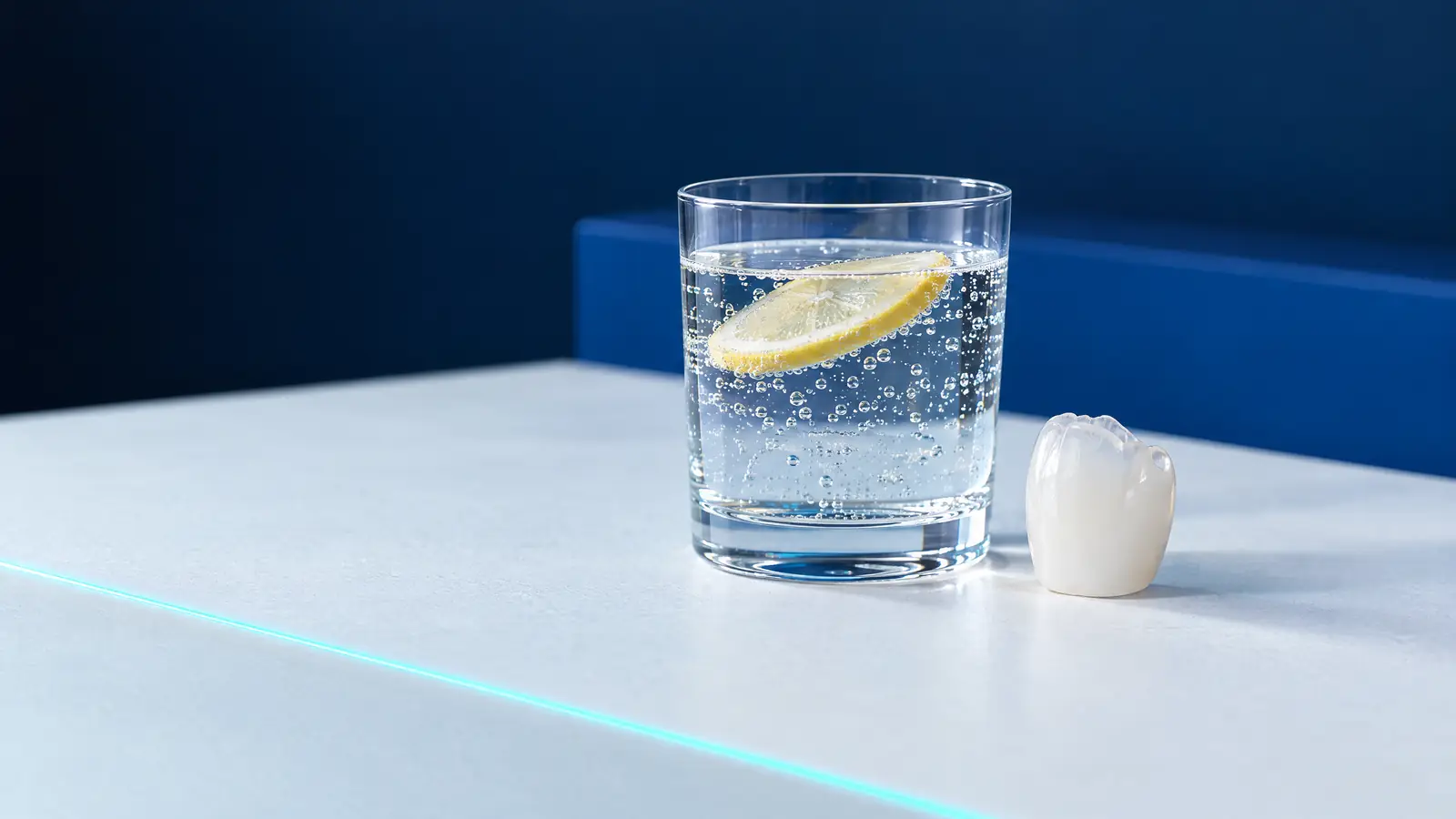
Is water good for your teeth?
Plain water contains no sugar to feed tooth decay and does not dissolve enamel the way acidic drinks do. The UK prevention guidance Delivering better oral health (DBOH, updated on 10 September 2025) recommends reducing how much and how often you have sugary foods and drinks. Water is a straightforward substitute for sugary drinks between meals.
In a study by Lussi, Megert and Shellis (Swiss Dental Journal, 2023), researchers immersed pieces of enamel in 226 products for 2 minutes. Mineral waters did not soften enamel, which the authors attribute to their calcium content. The authors also note that saliva helps protect teeth by reducing the effect of acids. DBOH advises avoiding sugary foods and drinks before bed because saliva production falls overnight.
Does sparkling water damage your teeth?
In the laboratory study, plain still and sparkling mineral waters had a pH of 5.6 to 7.7 and were classified as non-erosive. The cola samples had a pH of 2.4 to 2.8, and enamel surface hardness fell by 12.2 to 46.1% after 2 minutes.
In the study, water with lemon flavouring alone was classified as non-erosive. Flavoured waters with added citric acid reduced enamel surface hardness even when their pH was above 3.2.
The researchers used saliva-coated enamel samples and products bought in Switzerland. Brands available in Poland may have different ingredients. The results give no reason to give up plain sparkling water.
Can lemon water damage your enamel?
Lemon water can damage enamel because lemon juice contains citric acid. It was this ingredient that made water erosive in the study. Selected samples of lemon- or fruit-flavoured water with added citric acid had a pH of 3.2 to 4.3, and enamel surface hardness fell by 3.5 to 23.3% after 2 minutes.
The study did not test homemade water with a slice of lemon, so it cannot establish a safe amount of lemon juice. The authors stress that frequent exposure to acidic drinks can lead to progressive erosion. Sipping lemon water all day matters more than an occasional glass.
- If you drink lemon water, have it with a meal.
- Drink the glass in one sitting and avoid sipping it for hours.
- Follow it with a drink of plain water or rinse your mouth with water.
- Avoid holding it in your mouth.
How do flavoured waters, vitamin waters and sports drinks affect enamel?
Flavoured waters, vitamin waters, isotonic sports drinks and energy drinks can contain citric acid, and some also contain sugar. Treat them as you would other soft drinks. In the 2023 study, most energy and sports drinks softened enamel, as did all the products tested for children, including juice drinks. DBOH advises limiting sugary drinks and having no more than 150 ml of juice and smoothies a day.
Check the ingredients on the label for citric acid (E330), sugar or syrups. The table gives pH and changes in enamel surface hardness after 2 minutes from the study by Lussi and colleagues. The authors classified a drop in hardness of more than 15% as strongly erosive in this test. The sugar column describes typical ingredients because the study did not measure sugar.
| Drink | Sugar | Acidity (pH) | Effect on enamel in the study |
|---|---|---|---|
| Mineral water, still or sparkling | No | 5.6 to 7.7 | No softening, change of up to 1% |
| Mineral water with lemon flavouring alone | Depends on the product | 5.1 to 5.6 | No softening, change of up to 1.6% |
| Selected flavoured waters containing citric acid | Depends on the product | 3.2 to 4.3 | Softening of 3.5 to 23.3% |
| Regular, diet and zero-sugar cola | Regular cola contains sugar. Diet and zero-sugar versions do not. | 2.4 to 2.8 | Softening of 12.2 to 46.1% |
| Energy drink | Depends on the version | 3.3 to 3.5 | Softening of 6.0 to 19.1% |
| Isotonic sports drink | Depends on the product | 2.9 to 3.9 | Softening of 1.2 to 24.9%, less with added calcium |
| Freshly squeezed orange juice | Yes, sugars from fruit | 3.6 and 3.9 | Hardness fell by 17.3% in the permanent tooth enamel sample and by 3.2% in the primary tooth enamel sample |
| UHT whole milk | Lactose, no added sugar | 6.7 | No softening |
How much water should you drink each day?
The European Food Safety Authority (EFSA) considers 2.0 litres a day for women and 2.5 litres for men to be adequate. This is total water intake, including drinking water, other drinks and food. The same figures apply to older adults, and young people aged 14 and over are counted as adults.
The EFSA figures apply to moderate temperatures and physical activity. You may need more water in hot weather or during intense exercise. EFSA gives a daily increase of about 300 ml during pregnancy and about 700 ml while breastfeeding.
How much water you drink depends on factors such as temperature, exercise and how much water you get from food. If your mouth stays dry despite drinking water, there may be another cause. Lussi and colleagues list sedatives, antihistamines, antiemetics and radiotherapy to the head and neck among the causes of reduced saliva production. Talk to your doctor before stopping any medicines.
- Children in their second year of life: 1.1 to 1.2 litres a day, including water from food.
- Children aged 2 to 3: 1.3 litres. Children aged 4 to 8: 1.6 litres.
- Ages 9 to 13: 2.1 litres for boys and 1.9 litres for girls. From age 14, use the adult figures.
How much fluoride is in tap water and mineral water?
Fluoride in water can protect against tooth decay, and the amount matters. EFSA notes that in studies conducted before the 1970s, protection against decay was near its maximum at around 1 mg of fluoride per litre, a level at which about 10% of people had mild fluorosis. According to EFSA, the main dietary sources of fluoride are water, drinks made with water, tea and marine fish.
In Poland, water intended for drinking, including tap water, can contain no more than 1.5 mg of fluoride per litre under the Ministry of Health regulation of 22 May 2026, in force since 24 June 2026 (as of November 2026). Ask your local water supplier how much fluoride is in your tap water.
Natural mineral water can contain more fluoride than tap water. The Polish Ministry of Health regulation of 31 March 2011 allows up to 5 mg of fluoride per litre and sets out what must appear on the label.
Fluoride toothpaste remains the main protection against decay for children. DBOH recommends using it from the first tooth. EFSA notes that its adequate intake value of 0.05 mg of fluoride per kilogram of body weight per day covers all sources, including toothpaste.
- The label ‘Contains fluoride’ can be used if the fluoride content exceeds 1 mg/L.
- More than 1.5 mg/L: the label must state ‘Contains more than 1.5 mg/L of fluoride. It should not be consumed regularly by infants or children under 7 years of age.’
- One condition for using the label ‘Suitable for preparing infant food’ is a fluoride content no higher than 0.7 mg/L.
Does drinking or rinsing with water after eating help?
Taking a sip of water or rinsing with water after an acidic drink helps dilute the acid. According to calculations cited by Lussi et al., rinsing immediately after a glass of orange juice reduced the concentration of hydrogen ions 16-fold. Rinsing after 2 minutes reduced it 9-fold and after 5 minutes, 4-fold.
Brushing is still needed to remove plaque. DBOH recommends brushing at least twice a day, including before bed, with fluoride toothpaste. Spit out the foam without rinsing with water to avoid diluting the fluoride. You can rinse with water after eating and leave the fluoride on your teeth after brushing.
You can brush your teeth straight after an acidic meal. Lussi et al. describe a large European study in which waiting even 60 minutes between breakfast and brushing made no difference to the amount of tooth wear. They say the advice to wait before brushing can be dropped. They make an exception for vomiting, after which they advise rinsing with water.
Offer children water at night
If your child is thirsty after brushing at night, offer water. DBOH recommends brushing a child’s teeth with fluoride toothpaste from the first tooth, twice a day, with the last brush before bed. Avoid sugary foods and drinks before bed because saliva production drops overnight and saliva is less able to neutralise acids.
Putting juice, sweetened flavoured milk or tea with sugar in a night-time bottle exposes teeth to sugar for a long time. All the children’s products tested by Lussi et al., including juice drinks, also softened enamel.
- Put only breast milk, infant formula or boiled and cooled water in a bottle.
- Start offering drinks from a cup without a valve at about 6 months of age. After your child turns 1, gradually phase out the bottle.
- Avoid adding sugar to food or drinks for young children.
- Do not regularly give infants or children under 7 natural mineral water labelled as containing more than 1.5 mg/L of fluoride.
Water and your teeth: preventive care at DentalBlue in Białystok
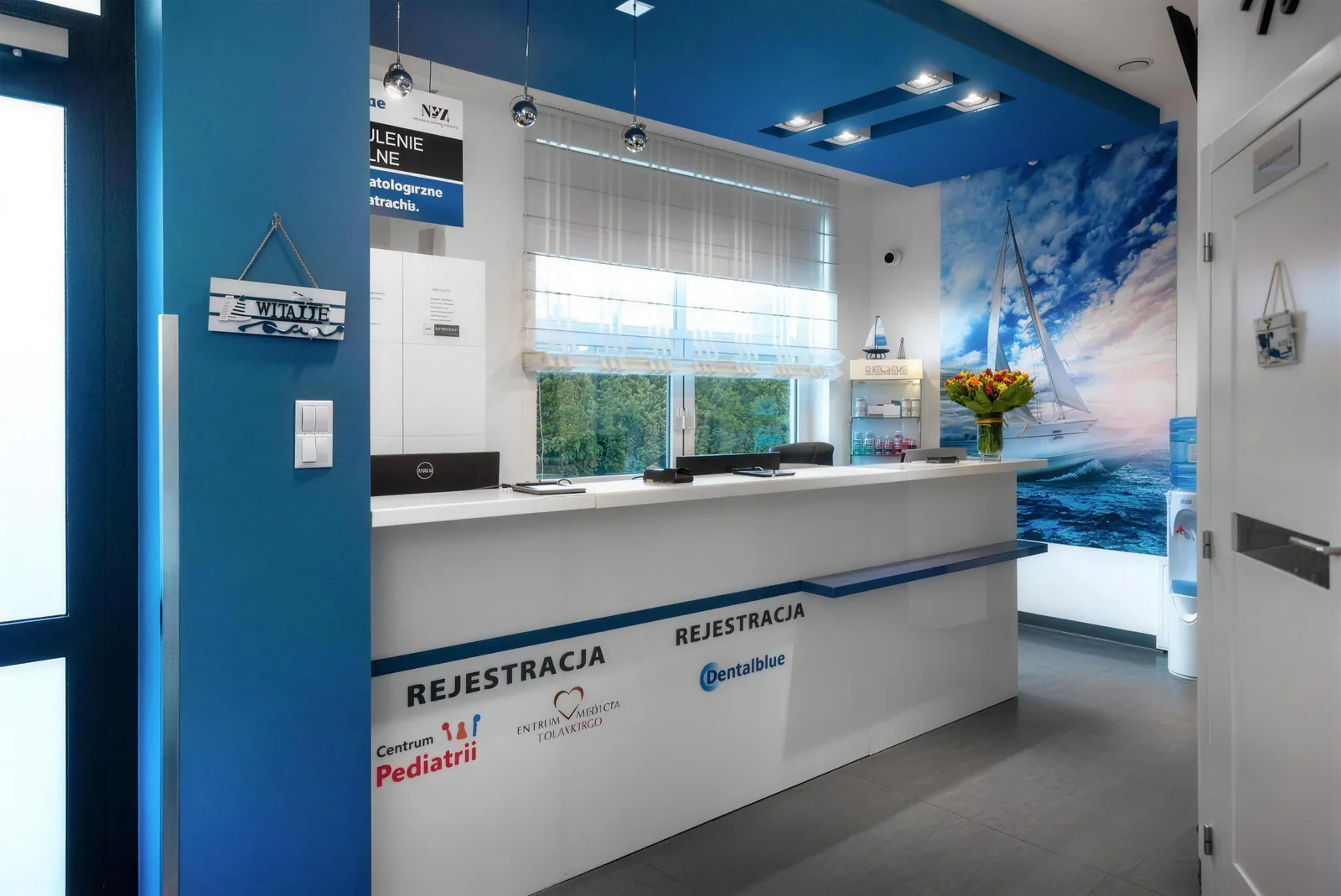
At DentalBlue in Białystok, you can discuss your drinking habits with a dentist at a consultation. The clinic offers preventive care including hygiene treatment and fluoride treatment. In the price list, a ‘Dental consultation’ costs 300 zł, ‘Fluoride treatment’ 100 zł and ‘Complete hygiene treatment (scaling, air polishing, fluoride)’ 350 zł. In children’s dentistry, ‘Tooth cleaning with fluoride’ costs 250 zł. Prices may change, and the final scope and cost are agreed at the consultation.
The clinic is at ul. Kazimierza Pułaskiego 35 in Białystok, at the junction with Wspólna. The ‘Pułaskiego/Wspólna’ bus stop, served by buses 16, 23 and 26, is 50 m from the entrance. The clinic is open Monday to Friday from 8:00 to 20:00 and Saturday from 8:00 to 16:00. To book in Polish, English, Ukrainian or Russian, call 85 748 00 50.
When you book, say whether you need a consultation, hygiene treatment with fluoride or an appointment for a child. Mention any tooth sensitivity or dry mouth.
- For a few days, write down what you drink between meals and how often.
- Bring a list of your medicines, especially if you have a dry mouth.
- If your child regularly drinks bottled water, take a photo of the label showing its composition.
Frequently asked questions
Does sparkling water damage your teeth?
Plain, unflavoured sparkling water did not soften enamel in a 2023 laboratory study, despite being slightly acidic. Flavoured waters containing citric acid did soften enamel.
Is lemon water on an empty stomach bad for your teeth?
It can, because lemon juice contains citric acid. If you drink lemon water, have it with a meal and avoid sipping it throughout the day. Afterwards, you can rinse your mouth with plain water.
Can you drink water after brushing your teeth at night?
Yes. DBOH advises avoiding sugary drinks before bed because saliva production falls overnight. Plain water contains no sugar. After brushing, spit out the toothpaste without rinsing with water so you don’t dilute the fluoride.
Does tap water in Białystok contain fluoride?
All tap water in Poland must meet the limit of 1.5 mg of fluoride per litre under the 2026 Ministry of Health regulation (as of November 2026). Ask your local water supplier, which tests water quality, for the exact fluoride content of your tap water.
Is mineral water better for children than tap water?
Both are tooth-friendly because they contain no sugar. The fluoride content can differ. Natural mineral water with more than 1.5 mg/L of fluoride must carry a warning that infants and children under 7 should not drink it regularly.
How much does fluoride treatment cost at DentalBlue?
In the DentalBlue price list, ‘Fluoride treatment’ costs 100 zł and ‘Complete hygiene treatment (scaling, air polishing, fluoride)’ costs 350 zł. For children, ‘Tooth cleaning with fluoride’ costs 250 zł. Prices may change, and the final scope is agreed at the appointment.
Sources
- EFSA, Dietary Reference Values for nutrients, summary report, chapters on water and fluoride (2017)
- Rozporządzenie Ministra Zdrowia z dnia 22 maja 2026 r. w sprawie jakości wody przeznaczonej do spożycia przez ludzi (Minister of Health regulation on the quality of water intended for human consumption), Dz.U. 2026 poz. 748
- Rozporządzenie Ministra Zdrowia z dnia 31 marca 2011 r. w sprawie naturalnych wód mineralnych, wód źródlanych i wód stołowych (Minister of Health regulation on natural mineral waters, spring waters and table waters), Dz.U. 2011 nr 85 poz. 466
- Swiss Dental Journal, Lussi A, Megert B and Shellis RP. Erosive effects of drinks, foods, stimulants, medicines and mouthwashes on enamel (2023)
- OHID, Delivering better oral health, chapter 2, summary guidance tables (2021, updated 2025)
- DentalBlue published price list, preventive care and children’s dentistry
An informational article. It does not replace a consultation, and treatment decisions are made during a visit.