What harms teeth the most?
Two things in the diet harm teeth the most: sugar, which plaque bacteria turn into the acids that cause tooth decay, and acids from food and drinks, which dissolve enamel directly, that is cause erosion. The two processes have different causes, but what they have in common is that the main harm comes from frequent contact of the teeth with sugar or acid.
The link between sugar and tooth decay is well documented. In a systematic review prepared for the WHO (Moynihan and Kelly, 2014; 55 studies), at least one positive association between sugars and tooth decay was found in 42 of 50 studies in children and in all 5 studies in adults.
Enamel erosion, its symptoms and its treatment are described in a separate article. Here we focus on what in an everyday diet increases the risk of both problems and how to reduce it without giving up your favourite dishes.
Sugar and tooth decay: how much sugar a day is safe for your teeth?
In its 2015 guideline, the World Health Organization (WHO) recommends that free sugars provide less than 10% of dietary energy (a strong recommendation), and that a further reduction to below 5%, which on a 2000 kcal diet is about 25 g or roughly 6 teaspoons a day, would bring additional benefits (a conditional recommendation). The WHO names tooth decay as one of the reasons for these limits.
Free sugars are sugars added to food and drinks by the manufacturer, the cook or you yourself, plus the sugars naturally present in honey, syrups and fruit juices. The WHO does not count as free sugars the sugars in fresh fruit and vegetables or the sugars naturally present in milk.
Hidden sugar is easy to overlook: according to the WHO, a can of sugar-sweetened fizzy drink contains up to 40 g of free sugars, around 10 teaspoons, and a tablespoon of ketchup about 4 g. The review by Moynihan and Kelly rated the evidence for the 10% threshold as moderate quality and for the 5% threshold as very low quality.
Why does snacking on sweets do more harm than a dessert after a main meal?
Snacking on sweets does more harm to teeth because what counts is not only the amount of sugar but also how often the teeth are in contact with it. The UK prevention guidance Delivering better oral health (DBOH) states that more frequent consumption of sugary foods and drinks is associated with a higher risk of tooth decay, and recommends limiting both the amount and the frequency.
The simplest rule from DBOH is: eat and drink anything containing sugar as part of a meal, not as a snack between meals. A dessert eaten straight after a main meal means one contact with sugar, while the same amount spread over several snacks means several.
DBOH also states that people aged 11 and over should have no more than 30 g of free sugars a day, and that young children are given only water or plain milk between meals. Preventing tooth decay in the youngest children is described in a separate article.
Fizzy drinks, juices and energy drinks: how do they affect teeth?
Fizzy drinks harm teeth in two ways: sugary ones supply sugar, and the acid in the drinks promotes enamel erosion. Among the causes of erosion, DBOH lists fizzy drinks other than unflavoured sparkling water, as well as wine, smoothies, energy drinks and sports drinks, fruit teas and drinks containing citric acid.
A sugar-free drink removes the sugar problem but not the acid, because DBOH does not exclude such drinks from its list of causes of erosion. According to the WHO, juices and smoothies count as a source of free sugars, and DBOH recommends limiting them to a combined total of 150 ml a day, drunk with a meal.
The way you drink matters too. DBOH advises drinking acidic drinks with meals rather than sipping them throughout the day, and not holding them in the mouth or swishing them around the teeth.
What harms teeth and what helps them: an overview
The table lists popular foods and drinks with their effect on the teeth and a practical tip. It is based on the WHO and DBOH guidelines and on the reviews of studies cited in this article.
| Food or drink | Effect on the teeth | Practical tip |
|---|---|---|
| Sweets and biscuits between meals | Frequent sugar raises the risk of decay (DBOH) | Eat them with a meal, not as a snack |
| Sugar-sweetened fizzy drinks | Sugar and acid at once; a can holds up to 40 g of sugar (WHO) | Switch to water, and if you do drink them, have them with a meal |
| Sugar-free fizzy drinks | No sugar, but still on the list of causes of erosion (DBOH) | Drink them with a meal, do not sip them all day |
| Fruit juices and smoothies | Free sugars according to the WHO, fruit acids | Up to 150 ml a day in total, with a meal (DBOH) |
| Energy drinks and sports drinks | A cause of enamel erosion (DBOH) | Limit them; drink water day to day |
| Fresh fruit | Its natural sugars are not free sugars (WHO) | A recommended snack; do not hold acidic fruit in your mouth |
| Milk without added sugar | Very low potential to cause decay (Woodward 2020) | A good drink between meals, for children too |
| Water, including unflavoured sparkling water | Not listed among the causes of erosion (DBOH) | The basic drink between meals |
| Sugar-free chewing gum | Less decay in a meta-analysis, preliminary evidence (Newton 2020) | Chew for about 20 minutes after eating |
Xylitol and chewing gum after eating: do they help?
Sugar-free chewing gum after eating may reduce the risk of tooth decay, but the evidence is preliminary. A 2020 meta-analysis by Newton et al. (12 studies) reports that chewing sugar-free gum reduced the increase in tooth decay by an average of 28%, with large variation in results and low to moderate certainty evidence; the authors describe the evidence as preliminary.
The EU list of permitted health claims, Commission Regulation (EU) No 432/2012, allows products to state that sugar-free chewing gum contributes to the maintenance of tooth mineralisation and to the neutralisation of plaque acids, provided it is chewed for at least 20 minutes after eating or drinking (legal status as of 24 October 2026).
The evidence for xylitol is modest. A 2015 Cochrane review (10 studies, 5,903 participants) found, with low certainty evidence, that toothpaste containing fluoride and 10% xylitol reduced tooth decay in children by about 13% more than fluoride-only toothpaste, while the evidence for lozenges, tablets and other xylitol products was insufficient.
Healthy teeth: what should you eat and drink every day?
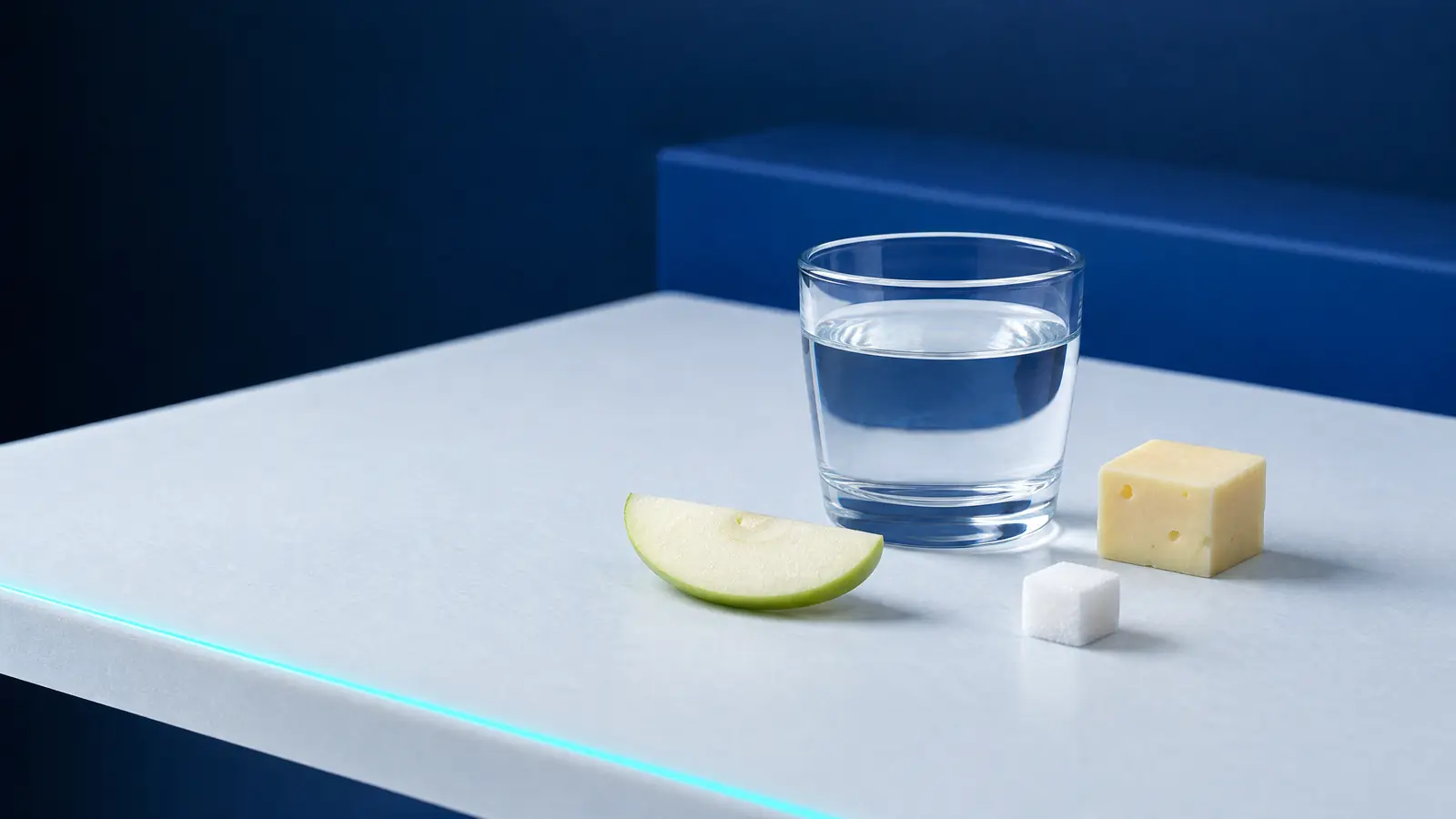
The diet that suits healthy teeth is one in which sugar appears rarely and only at mealtimes, with water or milk between meals. DBOH recommends fresh fruit as a snack between meals, and among drinks it lists water, lower-fat milk, and tea and coffee without sugar.
Milk has a very low potential to cause decay and may have a protective effect, as Woodward and Rugg-Gunn (2020) summarise, but added sugar, for example in sweetened milk drinks, increases the risk of decay. A 2002 review by Kashket and DePaola describes the mechanisms by which cheese may protect teeth: neutralising acids, stimulating saliva, and supplying calcium, phosphates and casein, while noting that there were few studies.
The list brings together habits that follow from the guidelines and help protect teeth without giving up the pleasure of eating.
- Eat sweet things as part of a meal, not as a snack between meals.
- Between meals, drink water or milk without added sugar.
- Check labels: sugar also hides in sauces, such as ketchup, and in drinks.
- For snacks, choose fresh fruit, vegetables or cheese instead of sweets.
- Drink acidic drinks with meals and do not hold them in your mouth.
- Brush your teeth twice a day with fluoride toothpaste, the last time before bed.
Does vitamin D protect teeth against decay?
Vitamin D may be linked to less tooth decay, but the evidence is weak and not enough to justify taking it specifically for your teeth. A 2013 meta-analysis by Hujoel (24 controlled trials, 2,827 children) showed about half as much tooth decay with vitamin D supplementation (relative risk 0.53), but 22 of the 24 trials dated from before modern research standards, and the author rated the certainty of the result as low.
A more recent meta-analysis of observational studies (Ji et al., 2024) found lower vitamin D levels in children with early childhood caries than in children without decay, but this design does not allow the conclusion that the deficiency causes decay. Supplementation is a decision for a doctor, and teeth are protected above all by limiting sugar and by fluoride.
Diet and preventive care at DentalBlue
At DentalBlue in Białystok, preventive care includes hygiene treatment, fissure sealing and fluoride application, and the team includes dental hygienists. According to the clinic’s price list, a “Wizyta bez bólu” (visit without pain) includes a panoramic X-ray, a consultation, an examination and a written treatment plan and costs 300 zł, and “Fluoryzacja” (fluoride application) 100 zł. At the visit you can discuss the eating habits that affect your risk of tooth decay. The final scope and cost are set at the visit, and prices may change.
Frequently asked questions
Should you brush straight after eating something sweet or acidic?
You can, whenever it suits you. DBOH states that there is no strong evidence that the timing of brushing matters much for tooth wear, or that everyone should wait before brushing. The exception is vomiting: in that case rinse your mouth with water and do not brush your teeth straight away.
Are honey, maple syrup or cane sugar healthier for teeth?
No. The WHO counts the sugars naturally present in honey and syrups as free sugars, just like sugar added to food, and cane sugar is still sucrose. For teeth, what counts is the amount and the frequency, not the source of the sugar.
Are sweeteners bad for teeth?
Replacing sugar with sweeteners, for example xylitol, may reduce the risk to teeth: the EU list of health claims allows products to state that consuming them instead of sugar contributes to the maintenance of tooth mineralisation. A drink with sweetener may, however, still be acidic and promote erosion.
Can children be given fruit juice?
Yes, but in limited amounts and with a meal. DBOH recommends limiting juices and smoothies to a combined total of 150 ml a day, and giving young children only water or plain milk between meals. According to the WHO, juice is a source of free sugars, even without added sugar.
Are coffee and tea bad for teeth?
Without sugar they do not increase the risk of tooth decay, and DBOH lists tea and coffee without sugar among drinks for everyday drinking. They can, however, stain the teeth, and sweetened ones, for example with syrup, supply free sugars. DBOH counts fruit teas among the causes of erosion.
Sources
- WHO: WHO calls on countries to reduce sugars intake among adults and children (2015)
- Journal of Dental Research: Moynihan PJ, Kelly SA, restricting sugars and dental caries, a review for the WHO (2014)
- OHID: Delivering better oral health, chapter 10, healthier eating (2021, updated 2025)
- OHID: Delivering better oral health, chapter 7, tooth wear (2021, updated 2025)
- Cochrane: Riley P et al., xylitol-containing products for preventing dental caries (2015)
- JDR Clinical and Translational Research: Newton JT et al., sugar-free chewing gum and dental caries (2020)
- Commission Regulation (EU) No 432/2012, list of permitted health claims (2012)
- Nutrition Reviews: Hujoel PP, vitamin D and dental caries in controlled clinical trials (2013)
An informational article. It does not replace a consultation, and treatment decisions are made during a visit.