How much does a relaxation splint cost in Białystok?
DentalBlue’s published price list has two different items: ‘Hard relaxation splint’ at 1 250 zł in the prosthetics category, and ‘Occlusal splint’ at 600 zł under hygiene and aesthetics. These are separate price-list items, rather than two prices for the same splint. The dentist decides which to suggest in your situation after examining you.
The starting point is an appointment with an examination. A ‘First visit without pain’ at 300 zł includes a panoramic X-ray, consultation, examination and written treatment plan. These are private treatment prices and may change; the dentist agrees the final scope and cost at consultation.
When comparing prices in Białystok, ask what is included: an impression or scan, fitting and adjustment of the splint, a follow-up visit and any further adjustments. The name ‘splint’ alone does not tell you how it was designed or what it is made of. If it is intended to protect new crowns or veneers, ask whether it is included in the plan for that work or charged separately.
| DentalBlue price-list item | Price-list category | Price |
|---|---|---|
| ‘First visit without pain’ | First visit | 300 zł |
| ‘Hard relaxation splint’ | Prosthetics | 1 250 zł |
| ‘Occlusal splint’ | Hygiene and aesthetics | 600 zł |
| ‘Bruxism (both cheeks)’, botulinum toxin | Aesthetic medicine | 900 zł |
What does a relaxation splint achieve for bruxism? What the research says
Bruxism is repetitive jaw muscle activity: clenching or grinding the teeth, or bracing and thrusting the lower jaw, during sleep or during the day. A 2018 international expert consensus states that in otherwise healthy people it should be regarded as a behaviour rather than a disorder, which may be a risk factor for certain consequences and sometimes a protective factor. The experts also advise against fixed cut-offs defining whether bruxism ‘is present’ or ‘is absent’, suggesting assessment on a continuum.
The consensus distinguishes sleep bruxism from awake bruxism, meaning clenching or bracing the jaw during the day. A night splint relates to the first form. If you clench your teeth at a computer or while driving, tell the dentist, as the plan should consider both times of day.
The consensus gives severe jaw muscle or temporomandibular joint pain, extreme mechanical tooth wear and prosthetic complications as examples of adverse consequences. If you are planning crowns, bridges or other prosthetic work, tell the dentist about grinding or clenching so it can be taken into account.
A Cochrane review of occlusal splints for sleep bruxism (5 randomised trials) found insufficient evidence to regard a splint as effective treatment for sleep bruxism. The authors questioned its indication for sleep outcomes, but allowed for some possible benefit regarding tooth wear. The review dates from 2007 and calls for better-designed studies.
A splint is therefore not a cure for grinding. Discussing one makes most sense when there is something to protect: visibly worn or cracked teeth, fillings and prosthetic restorations that chip. If someone promises a splint will ‘cure bruxism’, ask which studies support that promise.
Splints for jaw and temporomandibular joint pain: what can you expect?
Some people seek a splint because of jaw pain, temporomandibular joint pain or morning headaches. For chronic pain associated with temporomandibular disorders (TMD), lasting at least 3 months, guidelines published in the BMJ in 2023 strongly recommend cognitive behavioural therapy, supervised jaw and postural exercises, manual therapy and usual care: explanation of symptoms, home exercises and reassurance.
The same guidelines conditionally recommend against reversible occlusal splints for chronic pain, and strongly recommend against irreversible splints. This does not mean a splint has no role for someone who clenches at night. It means that for chronic pain, it is worth asking about a plan extending beyond a splint, such as physiotherapist-led exercises.
The guidelines concern pain lasting at least 3 months and do not cover acute pain, so the dentist plans care for new symptoms after examining you. The authors recommend shared decision-making: strongly recommended options should be considered first, then conditionally recommended options, and finally those conditionally recommended against.
Pain after a facial injury, a locked jaw, swelling with fever or facial numbness requires prompt medical assessment, without waiting for a splint to be made. The article on temporomandibular joint pain discusses symptoms of joint disorders in more detail.
Does NFZ cover relaxation splints in Białystok?
No. The list of guaranteed dental benefits (Health Minister’s regulation, consolidated text Dz.U. 2025 poz. 615) does not include relaxation or occlusal splints for bruxism. Splints appear in a different context: dislocated and injured teeth, certain surgical procedures and jaw fractures. If a practice with an NFZ contract offers you a bruxism splint, ask about its price straight away, as it will be a paid service.
Botulinum toxin for bruxism is also absent from this list. The rules are the same in Białystok and nationwide; a check of the legislation database on 8 November 2026 found no newer amendments to the regulation. Bruxism splints are therefore made privately, and DentalBlue’s prices in this article come from the private price list. This means splint prices at every practice in Białystok are private prices, and offers should be compared according to what is included.
An annual dental examination and check-ups are, however, covered by NFZ, so you can start with an assessment at a contracted dentist. Find contracted practices in the NFZ ‘Gdzie się leczyć’ (Where to get treatment) search tool.
What happens at an appointment about a relaxation splint?
The first step is an examination, rather than an impression. The dentist asks about grinding heard by household members, muscle and joint pain, morning headaches, medicines and sleep, then examines your teeth, restorations, jaw muscles and jaw movements. The expert consensus calls bruxism probable when signs are seen on clinical examination, and definite only after instrumental assessment, such as a recording of muscle activity (EMG). Under this classification, your report of grinding alone indicates possible bruxism.
If you already have a splint from another practice that has broken, rubs or no longer fits after dental treatment, bring it. The dentist will assess whether an adjustment is enough or a new splint is needed.
At DentalBlue, the starting point is a ‘First visit without pain’: a panoramic X-ray in the clinic’s own radiology unit, consultation, examination and written treatment plan. If the dentist suggests a splint, ask about its type, the number of visits and what the price includes. A written plan also lets you compare the proposal with another practice’s offer at your own pace. A typical pathway is:
- Discussion of symptoms and examination of the teeth, muscles and joints.
- A decision on whether a splint is needed or whether monitoring and addressing daytime habits are sufficient for now.
- An impression or scan of the teeth used to make a splint fitted to your arch.
- Fitting the splint and checking that it stays in place, does not rub and does not interfere with closing your mouth.
- Follow-up at the interval specified by the dentist; bring the splint to subsequent check-ups too.
Occlusion and ‘adjusting the bite’: when should you be cautious?
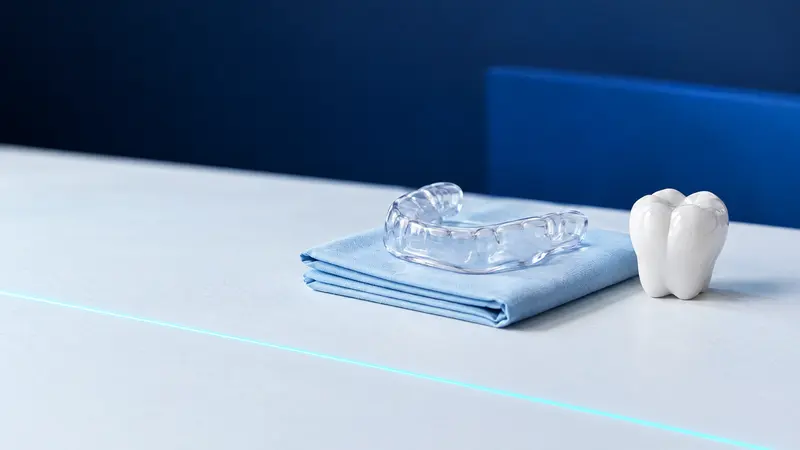
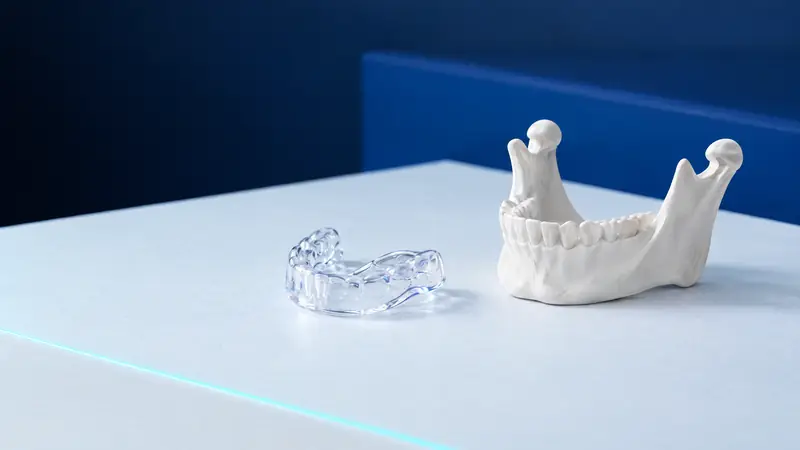
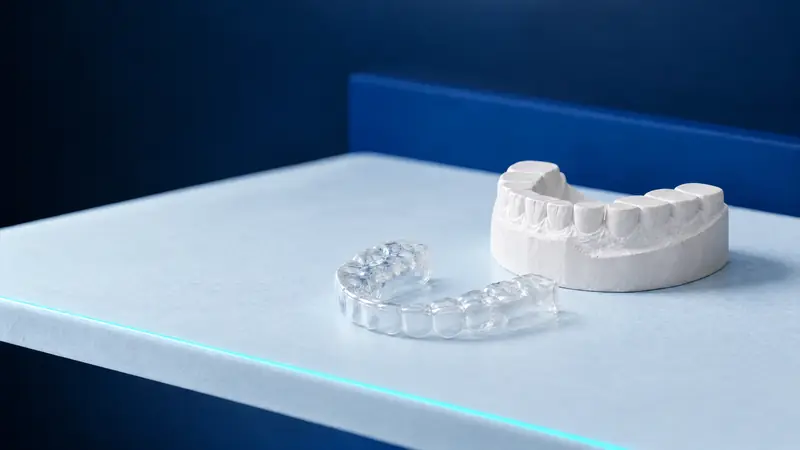
Occlusion is the way your upper and lower teeth meet, and the dentist assesses it during the examination. A relaxation splint is reversible: you put it in at night, remove it in the morning and your teeth remain unchanged.
Procedures that permanently alter teeth or the bite are different, for example grinding teeth to ‘balance the bite’. The 2023 BMJ guidelines strongly recommend against irreversible splints for chronic TMD pain, and the expert consensus does not regard bruxism in otherwise healthy people as a disorder. Before any procedure that permanently alters your teeth or bite because of grinding or jaw pain, ask for the reasoning and consider a second opinion.
Botulinum toxin for bruxism in Białystok: what does research say?
Botulinum toxin is injected into the jaw muscles to weaken their contraction. A 2025 overview of 14 systematic reviews reported reduced pain in 10, fewer bruxism episodes in 7 and lower maximum bite force in 5. All reviews were rated low or critically low quality, however, and the authors state that methodological limitations prevent firm conclusions.
The effect is temporary: in the cited studies, reduced bite force lasted up to about 3 months, and pain relief in one analysis lasted up to 24 weeks. The authors also list possible adverse effects, including temporary or partial facial muscle weakness, diffusion into neighbouring structures, and weakening of the jaw muscles with a possible effect on bone after repeated injections. They suggest considering this a last-line approach. The BMJ guidelines conditionally recommend against it for chronic TMD pain.
The overview concerned adults. Its authors emphasise that better-designed studies with accurate bruxism diagnosis and standardised methods are needed before benefits can be reliably assessed.
DentalBlue lists injections for bruxism in the aesthetic medicine category as ‘Bruxism (both cheeks)’ at 900 zł. This is a medical decision following examination and discussion of benefits, risks and uncertainty, rather than a procedure selected from a price list instead of a splint. Also ask how the effect will be assessed and what happens if symptoms return after a few months.
Relaxation splint, whitening tray or splint denture: which price-list item is which?
The Polish word ‘szyna’ appears in the price list with several different meanings, and searches for splint dentures in Białystok often lead to pages about bruxism. The table brings together DentalBlue items that are easy to confuse; the dentist determines the indications for each after an examination.
If you want a splint denture rather than a night splint, the appropriate starting point is a prosthetic consultation, listed as ‘Prosthetic consultation’ at 300 zł. A whitening tray is discussed when planning whitening, and orthodontic aligners at an orthodontic consultation. Each item has a different purpose, so their prices are not directly comparable.
| Price-list item | Category | Price | What it is |
|---|---|---|---|
| ‘Hard relaxation splint’ | Prosthetics | 1 250 zł | A dental splint usually worn at night; the dentist selects the type |
| ‘Occlusal splint’ | Hygiene and aesthetics | 600 zł | A separate dental splint item; the dentist makes the choice |
| ‘Whitening tray’ | Prosthetics | 700 zł | A tray for whitening teeth, not for bruxism |
| ‘Splint denture’ | Prosthetics | 3 500 zł | Replaces missing teeth and has a splinting function; not a night splint |
| ‘Clear Aligner tray’ | Clear Aligner | 900 zł | Part of orthodontic aligner treatment |
How do you choose where to have a relaxation splint made in Białystok?
Specific criteria give a more reliable basis for a recommendation than reviews. The decision to provide a splint should follow an examination, and the plan should clearly state what it is intended to protect and what the price includes. You can ask these questions at any practice and compare the answers.
Other patients’ reviews usually describe their appointment, rather than whether a splint was necessary for them. What matters more when choosing is whether you receive a clear explanation of why you need a splint and how you will check that it is doing its job.
- Will there be an examination of the teeth, muscles and joints and a discussion of symptoms before an impression?
- Will the dentist explain what the splint should protect and what it will not do, for example that it does not eliminate bruxism itself?
- Does the price include fitting and a follow-up appointment?
- What happens if the splint breaks, rubs or no longer fits after dental treatment?
- For chronic jaw pain, does the plan include more than a splint, such as exercises?
Relaxation splints at DentalBlue in Białystok: travel, hours and booking
DentalBlue is at ul. Kazimierza Pułaskiego 35, 15-337 Białystok, near the junction with Wspólna, south of the city centre. The nearest stop, Pułaskiego/Wspólna, is 50 m from the entrance and is served by bus routes 16, 23 and 26. The clinic is open Monday to Friday from 8:00 to 20:00 and Saturdays from 8:00 to 16:00; it is closed on Sundays.
Book by telephone on 85 748 00 50; a person answers during opening hours, and you can speak Polish, English, Ukrainian or Russian. Say that your concern is grinding or clenching, jaw pain or worn teeth, and ask about a ‘First visit without pain’. If a particular tooth hurts, a ‘First visit in pain’ at 340 zł is appropriate; it includes a panoramic X-ray, consultation, examination and pain relief. You can check the published prices before your visit, but the dentist determines your individual scope and cost after examination.
Panoramic X-rays and other images are taken in the clinic’s own radiology unit and can be supplied on CD with the Romexis viewer. Preparing the items below will help make the assessment more complete.
- A list of your medicines and information about long-term conditions.
- Your existing splint, if you have one, including a damaged or unused one.
- Previous dental images and records of joint treatment or prosthetic work.
- Notes about symptoms: when it hurts, whether household members hear grinding, and whether you wake with a headache.
Frequently asked questions
How much does a relaxation splint cost in Białystok?
DentalBlue’s published price list gives ‘Hard relaxation splint’ at 1 250 zł and ‘Occlusal splint’ at 600 zł. These are two different items, and the dentist chooses after an examination; the initial ‘First visit without pain’ costs 300 zł.
Does NFZ reimburse relaxation splints?
No. The NFZ dental benefits list includes only splints for dental injuries, certain surgical procedures and jaw fractures; relaxation and occlusal splints for bruxism are not listed (as at November 2026).
Will a relaxation splint cure bruxism?
There is no evidence that it will. The Cochrane review did not confirm that splints effectively treat sleep bruxism, while allowing for possible benefit regarding tooth wear; experts regard bruxism in otherwise healthy people as a behaviour rather than a disorder.
A splint or botulinum toxin for bruxism?
These are different tools. A splint is a reversible appliance worn over the teeth, while botulinum toxin weakens muscles for a few months and has poorly documented effectiveness, so a doctor decides on its use after examination. DentalBlue lists ‘Bruxism (both cheeks)’ at 900 zł.
Will a splint help with jaw pain?
Not always. For chronic joint and jaw muscle pain, the 2023 BMJ guidelines strongly recommend exercises, manual therapy and cognitive behavioural therapy, and conditionally recommend against reversible splints for pain treatment.
How does a relaxation splint differ from a splint denture?
A relaxation splint is an appliance worn over the teeth, usually at night. A splint denture replaces missing teeth while stabilising those remaining; DentalBlue lists ‘Splint denture’ at 3 500 zł, and the dentist assesses its indications at a prosthetic consultation.
How do I book a splint appointment in Białystok?
Call DentalBlue on 85 748 00 50, Monday to Friday from 8:00 to 20:00 or Saturday from 8:00 to 16:00. Say that you are concerned about grinding or clenching and ask about a ‘First visit without pain’.
Sources
- DentalBlue: published price list, splints, aesthetic medicine and first visit
- Cochrane: Macedo CR et al., occlusal splints for sleep bruxism, CD005514 (2007)
- Journal of Oral Rehabilitation: Lobbezoo F et al., international consensus on the assessment of bruxism (2018)
- BMJ: Busse JW et al., management of chronic pain associated with temporomandibular disorders, guideline (2023)
- Toxins: Coelho MS et al., botulinum toxin in bruxism, overview of reviews (2025)
- ELI: Rozporządzenie MZ w sprawie świadczeń gwarantowanych z zakresu leczenia stomatologicznego (Health Minister’s regulation on guaranteed dental benefits), consolidated text Dz.U. 2025 poz. 615
An informational article. It does not replace a consultation, and treatment decisions are made during a visit.