Why do implants need cleaning if they cannot decay?
An implant cannot decay because it is not made of tooth tissue, but the gum and bone around it can become inflamed. The tissues around an implant differ from those around a natural tooth because they lack the periodontal ligament that attaches a tooth to the bone. The classification adopted at the 2017 World Workshop by the American Academy of Periodontology (AAP) and the European Federation of Periodontology (EFP) distinguishes two diseases around implants (Berglundh et al., 2018).
Inflammation of the lining around an implant (peri-implant mucositis) mainly shows up as bleeding during gentle probing. There may also be redness, swelling or pus. The diagnosis means that the lining is inflamed without further bone loss after initial remodelling. Plaque causes this inflammation, which may resolve after treatment and better oral hygiene.
Peri-implantitis is plaque-related inflammation with progressive loss of the bone that supports the implant. It can develop after peri-implant mucositis and progresses differently from person to person. An early assessment helps determine whether there is also bone loss.
How do you clean dental implants every day?
Pay particular attention to where the crown or bridge emerges from the gum and to the spaces beside and beneath it. The EFP recommends personalised cleaning instructions. Ask your dentist or hygienist to show you on your own restoration which brush or floss to use and where you can insert it safely.
These instructions apply once the implant has a crown, bridge or denture. During the first few days after implant placement, follow your clinician’s separate instructions for caring for the wound, covered in another guide. Resume brushing the area when your clinician says you can. The daily routine then usually looks like this:
- Brush your teeth and implants twice a day for about 2 minutes, using a manual or electric toothbrush along the gum line around each crown.
- Once a day, clean around the implant with an interdental brush that fits the space. Use floss in tight spaces.
- Clean under the pontic with a tool that fits the space, such as bridge floss with a stiffened end or an interdental brush.
- Use a single-tuft brush for hard-to-reach areas, such as the last implant in the arch.
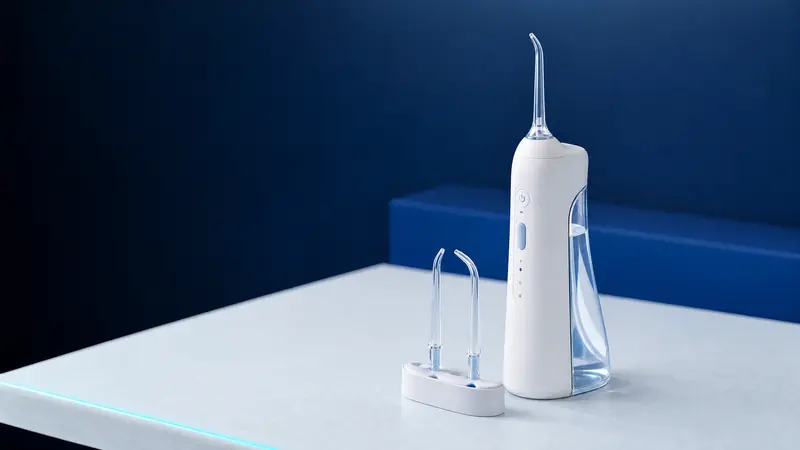
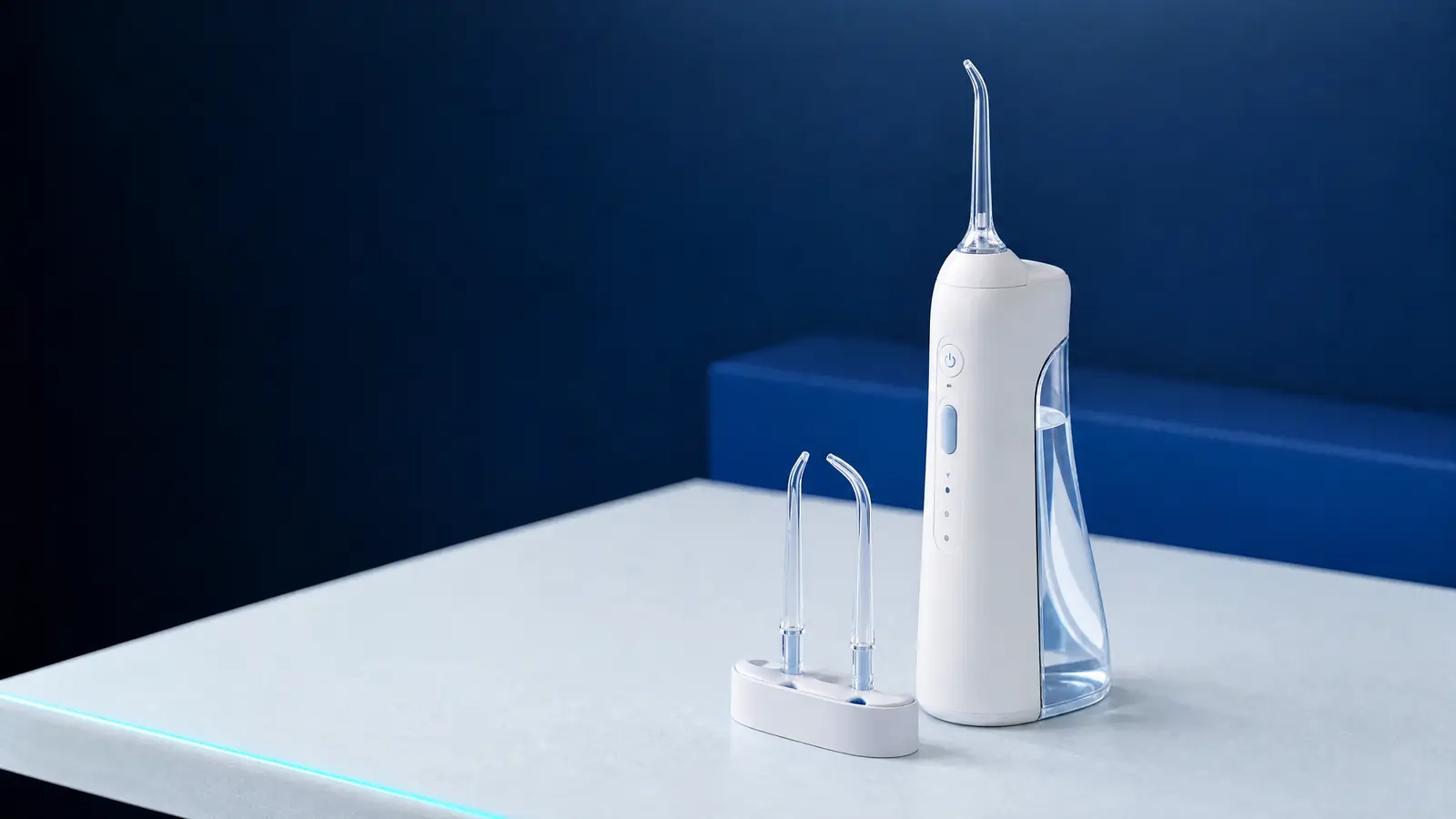
- Use a water flosser as an optional extra after brushing and cleaning between the teeth.
What should you use to clean an implant, implant bridge or implant denture?
The tools depend on the restoration. A single crown, a full-arch bridge and a denture that comes off stud attachments or a bar each need a different approach. The table shows typical tools. Your dentist or hygienist can recommend what to use after checking your restoration.
The EFP guideline recommends designing the restoration to leave enough access for home cleaning, examination and professional cleaning. If there is an area you cannot clean properly, mention it at your check-up so your tools can be reviewed.
| Restoration | Daily cleaning | Additional tools | What to pay attention to |
|---|---|---|---|
| Single implant crown | Brush along the gum line and use an interdental brush or floss on both sides of the implant | Single-tuft brush for the last tooth in the arch | The edge where the crown emerges from the gum |
| Implant bridge | Toothbrush, interdental brushes around the supports and bridge floss under the pontic | Water flosser as an extra tool under the pontic | The space under the replacement tooth suspended above the gum |
| Fixed full-arch bridge, for example All-on-4 | Toothbrush and tools suited to the bridge for cleaning beneath it, such as an interdental brush or bridge floss | Water flosser and single-tuft brush | The surfaces facing the palate and tongue. Only a clinician should remove the bridge. |
| Denture on implant-supported stud attachments | Clean the denture outside the mouth and use a soft brush on the attachments in the mouth | Single-tuft brush around the attachments | Worn inserts or a denture that fits more loosely |
| Denture on a bar connecting the implants | Clean the denture outside the mouth and brush the bar in the mouth | Bridge floss or interdental brush under the bar | The space between the bar and the gum |
What should you avoid if you have implants?
The EFP guideline recommends discussing smoking and other factors your clinician considers when planning implant care. Mention any clenching or grinding, as it can put more pressure on the restoration.
- Avoid probing around the implant with sharp or metal objects such as pins or metal toothpicks. Leave tightening and removal of a crown or bridge to your clinician.
- Avoid whitening toothpastes and abrasive products on crowns or dentures unless your clinician recommends them.
- Keep using your toothbrush and interdental brushes even if you use a rinse or water flosser. Use a mouth rinse if your clinician recommends it.
- Have bleeding checked even if nothing hurts. Bleeding is the main sign of peri-implant mucositis.
- If you smoke, talk to your clinician about quitting.
- Tell your dentist if you clench or grind your teeth, especially if the restoration has loosened.
How often should implants be checked and what happens at the visit?
The EFP guideline recommends regular maintenance care even when the tissues around an implant are healthy. The time between visits depends on your risk and the condition of the tissues. After treatment for peri-implantitis, the EFP suggests visits every 3 or 4 months for the first year, then a schedule tailored to you.
A 2016 review by Monje and colleagues included 13 studies, 10 of which could be analysed quantitatively. At the level of individual implants, the interval between visits was associated with the occurrence of peri-implantitis. The authors suggested check-ups roughly every 5 or 6 months, with the interval adjusted to the patient’s risk.
A check-up involves more than cleaning. The EFP guideline and the 2017 workshop report describe the following typical steps:
- A discussion about symptoms, health conditions, medicines, smoking and how you clean your implants at home.
- Gentle probing around the implant to check for bleeding and pus and measure pocket depth. Baseline measurements are taken within 3 months of fitting the restoration, and the examination is repeated at each check-up.
- An intraoral X-ray once bone remodelling is complete, as a baseline. Further X-rays are taken if a pocket deepens and bleeds or discharges pus.
- Professional cleaning using a method selected by the dentist or hygienist, such as implant-specific curettes, ultrasonic tips, rubber polishing cups or air polishing.
- A check of the stability of the crown, bridge or denture attachments and a review of your cleaning technique.
Who is at higher risk of inflammation around implants?
According to the report from the 2017 AAP and EFP workshop, strong evidence links a higher risk of peri-implantitis to a history of severe periodontitis, poor plaque control and a lack of regular supportive care after treatment. The evidence on smoking and diabetes as risk factors for peri-implantitis itself was inconclusive. Like radiotherapy, they may affect the course of peri-implant mucositis.
Being able to reach the gum line and the area under the restoration makes it easier to remove plaque. If you cannot clean an area properly, ask at your check-up for help choosing a tool and using it.
The EFP therefore recommends treating gingivitis and periodontitis to a stable point before implant placement and assessing factors you can influence: diabetes control, smoking, oral hygiene and regular attendance. Tell your clinician if you have been treated for periodontitis, have diabetes or smoke, as this may affect the time between check-ups.
Which symptoms around an implant need a dental visit?
Tell your dentist about bleeding or a change in the way your gums look, even if you have no pain. If you notice pus or the implant or restoration moves, contact your dental practice urgently. Do not try to tighten any parts yourself or take leftover antibiotics.
Rapidly increasing swelling of the face or neck, high fever or difficulty swallowing or breathing needs immediate help. Call 112 or go to a hospital emergency department (SOR). DentalBlue has no night duty.
- Bleeding around an implant when brushing or flossing.
- Redness, swelling or tenderness of the gum around the implant.
- Pus, an unpleasant taste or a smell from around the implant.
- Gum recession that exposes the implant or abutment.
- The crown, bridge or implant starts to move or shift suddenly, or the way your teeth meet changes.
- An implant denture that suddenly feels looser or presses on the gum.
Dental implant hygiene and check-ups at DentalBlue in Białystok
The DentalBlue price list in Białystok includes implantology, periodontology, and hygiene and aesthetics. The clinic’s team page lists roles including ‘Periodontology specialist’ and ‘Head of dental hygienists’. The clinic’s own radiology unit takes dental X-rays and CBCT scans.
The price list has no separate item for professional implant cleaning, so the scope and cost of implant care are set in the treatment plan. The table shows items from the published price list. The final scope and cost are set at the consultation, and prices may change.
The clinic is at ul. Kazimierza Pułaskiego 35 in Białystok, at the junction with Wspólna on the south side of the city centre. The nearest stop is ‘Pułaskiego/Wspólna’, 50 m from the entrance, served by bus routes 16, 23 and 26. The clinic opens from 8:00 to 20:00 Monday to Friday and from 8:00 to 16:00 on Saturdays. It is closed on Sundays.
To book, call 85 748 00 50. A receptionist answers during opening hours. Say that you are calling about implant hygiene or a check-up, how many implants you have, which type of restoration is fitted and whether anything is bleeding, swollen or loose. Bring your implant passport or the name of the implant system, previous X-rays, a list of your medicines and the tools you use for cleaning. If you have an implant denture, wear it to the appointment. You can speak Polish, English, Ukrainian or Russian at the clinic.
| Clinic price list item | Price | When it is useful |
|---|---|---|
| ‘Complete hygiene treatment (scaling, air polishing, fluoride)’ | 350 zł | Cleaning the teeth. The treatment plan specifies what is needed for implants. |
| ‘Post-implant check-up’ | 0 zł | Review after implant placement |
| ‘Implant consultation’ | 300 zł | Assessment of the implant and the restoration fitted on it |
| ‘Periodontal consultation’ | 300 zł | Bleeding, swelling or a history of periodontitis |
| ‘Intraoral radiograph’ | 60 zł | Assessment of the bone around the implant if the clinician considers it necessary |
Frequently asked questions
Do implants need to be cleaned differently from natural teeth?
The tools are the same: a toothbrush, interdental brushes and floss, with bridge floss for bridges. Home implant care advice draws on what is known about natural teeth because there is too little research to identify a better method (Louropoulou et al., 2014).
Should I use an electric or manual toothbrush for implants?
Both can work. In a review of 5 studies, electric brushes performed better around implants than manual ones, but the authors did not draw firm conclusions (Louropoulou et al., 2014). The more important thing is to brush thoroughly along the gum line without pressing hard.
How often should dental implants be checked?
Your dentist sets the interval between check-ups based on the condition of the tissues and your individual risk. After treatment for peri-implantitis, the EFP guideline suggests visits every 3 or 4 months for the first year, then a schedule tailored to you.
Is bleeding around a dental implant serious?
Bleeding may mean there is inflammation. Tell your dentist even if nothing hurts. They will check whether the lining around the implant is affected and whether there has been any bone loss.
Is a water flosser enough to clean dental implants?
No. A water flosser can supplement brushing and interdental brushes, especially under a bridge. Research on home implant care is limited, so ask your hygienist which tools suit you.
How much does professional cleaning cost if I have implants?
DentalBlue lists ‘Complete hygiene treatment (scaling, air polishing, fluoride)’ at 350 zł. There is no separate item for cleaning implants, so the scope and cost are set in the treatment plan.
Sources
- EFP: S3 guideline recommendations for preventing peri-implant diseases (Herrera D et al., 2023), infographic
- Journal of Clinical Periodontology: Berglundh T et al., peri-implant diseases, report of the 2017 AAP and EFP classification workshop (2018)
- Journal of Dental Research: Monje A et al., supportive care and peri-implant diseases, meta-analysis (2016)
- Journal of Evidence-Based Dental Practice: Louropoulou A et al., home care for implant-supported restorations, systematic review (2014)
- European Federation of Periodontology: dental implant hygiene and check-ups
- DentalBlue: published price list
An informational article. It does not replace a consultation, and treatment decisions are made during a visit.