What does dental hygiene treatment include?
Dental hygiene treatment is a set of procedures that remove plaque, tartar and deposits from teeth, rather than a single procedure. The Cochrane review defines routine scale and polish as removing plaque, calculus, debris and staining from crowns and roots, without surgery or root planing inside pockets. DentalBlue’s published price list calls the full procedure ‘Complete hygiene treatment (scaling, air polishing, fluoride)’.
Each stage has a different purpose, so the scope is agreed after examining your teeth and gums. The UK Delivering better oral health (DBOH) guidance identifies removing obstacles to cleaning, such as tartar above and below the gum and overhanging filling margins, and showing patients how to remove plaque effectively at home, as tasks for the dental team.
In studies and dental practices, the same scope of care is also called prophylaxis, professional mechanical plaque removal or simply scaling and polishing. These terms are sometimes used interchangeably, so when booking, ask about the specific stages rather than just the procedure’s name.
| Stage | What it does | What to know |
|---|---|---|
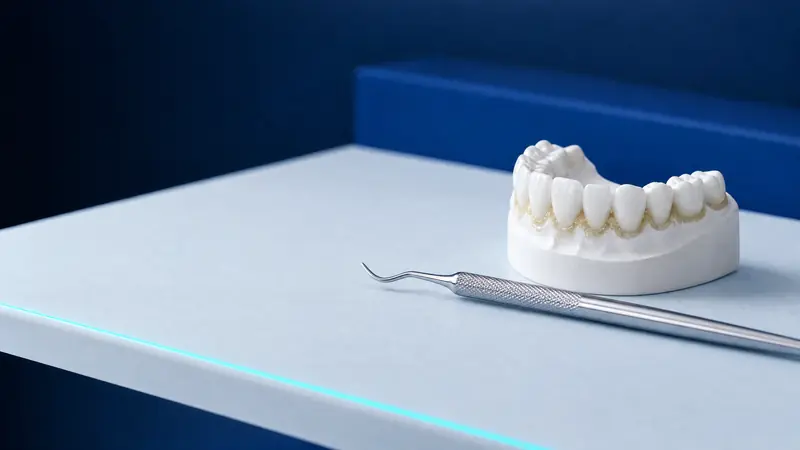
| Scaling | Removes hard tartar deposits | DBOH describes this as a procedure performed at the practice, not at home |
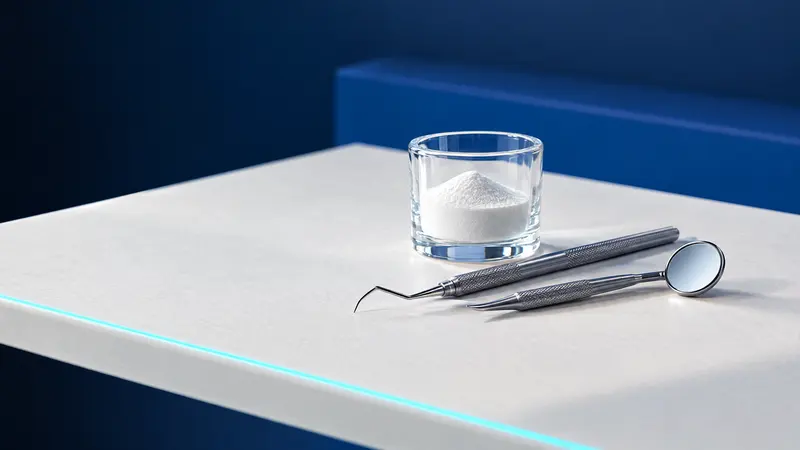
| Air polishing | A jet of fine powder propelled by air pressure removes biofilm and soft deposits | Does not replace scaling: it did not remove tartar in a 2026 study |
| Fluoride treatment | A fluoride preparation applied to the teeth, such as varnish | DBOH recommends fluoride varnish twice a year for adults at increased risk of tooth decay |
| Oral hygiene instruction | Showing where plaque remains and how to remove it | DBOH says effective daily plaque removal is essential for gum health |
Scaling and air polishing in Białystok: how do they differ, and is one enough?
Scaling removes tartar, meaning mineralised deposits, while air polishing mainly removes biofilm and soft deposits. In a laboratory study of 33 extracted teeth published in 2026, air polishing with erythritol powder for 5, 10 and 15 seconds reduced biofilm on root surfaces, but none of these durations removed tartar or the bacteria embedded in it.
The authors describe their study as a pilot and conclude that air polishing in periodontal treatment may still need to be supplemented by instrumentation. Air polishing alone therefore makes sense when deposits are present but there is no tartar. This is decided by an examination at the practice, rather than by looking at your teeth in a mirror.
The price list also allows treatment to be charged for one arch, meaning the upper or lower teeth: it lists ‘Scaling, one arch’, ‘Air polishing, one arch’ and ‘Scaling and air polishing, one arch’ separately. This can be useful when deposits mainly affect one arch or some of the work has already been done.
What happens at a dental hygiene appointment?
The appointment depends on the condition of your teeth and gums, but usually follows a set order. If you have sensitive tooth necks or bleeding gums, say so at the start. The dentist decides whether local anaesthesia is appropriate; ‘Local anaesthetic’ is listed at 60 zł.
If the examination reveals deepened pockets around teeth, hygiene treatment becomes only the first step in periodontal care. A periodontist then plans further treatment, as explained in the section on when hygiene treatment alone is not enough.
- Discussion of medicines, medical conditions and symptoms, followed by examination of the teeth and gums.
- Scaling to remove tartar.
- Air polishing to remove biofilm and deposits remaining after scaling.
- Fluoride treatment, if included in the agreed scope.
- Instruction: choosing a toothbrush, interdental aids and a cleaning technique.
- Agreeing a follow-up date; a ‘Post-hygiene check-up’ is listed at 50 zł.
How much does dental hygiene treatment cost in Białystok?
The prices in the table come from DentalBlue’s published private price list. The cost depends on whether you need the full procedure, only some stages or treatment of one arch, so the final scope is agreed after examining your teeth.
Items marked ‘one arch’ apply to a single arch, so when both arches are treated they are charged separately for each; ask which item has been selected before treatment. Prices may change, and the final scope and cost are agreed at the appointment. If this is your first visit to the clinic and you would also like your whole dentition assessed, the price list includes a ‘First visit without pain’ at 300 zł, covering a panoramic X-ray, consultation, examination and written treatment plan.
| Price-list item | Price | When it is used |
|---|---|---|
| ‘Complete hygiene treatment (scaling, air polishing, fluoride)’ | 350 zł | Full treatment with three stages |
| ‘Scaling and air polishing, one arch’ | 200 zł | Scaling and air polishing of one arch |
| ‘Scaling, one arch’ | 150 zł | Tartar removal alone in one arch |
| ‘Air polishing, one arch’ | 170 zł | Deposit removal in one arch |
| ‘Fluoride treatment’ | 100 zł | Separate application of a fluoride preparation |
| ‘Post-hygiene check-up’ | 50 zł | Follow-up appointment after treatment |
| ‘Sensitivity treatment, Duraphat, per tooth’ | 40 zł | Sensitive teeth, charged per tooth |
| ‘Sensitivity treatment, Tokuyama agent, per tooth’ | 100 zł | Sensitive teeth, charged per tooth |
| ‘Tooth cleaning with fluoride’ | 250 zł | Children |
NFZ dental hygiene treatment in Białystok: what is covered?
NFZ covers removal of dental deposits, meaning scaling, across the whole dentition once per calendar year. Women during pregnancy and the postpartum period are entitled to this no more often than once every 6 months; a pregnancy record confirms entitlement during pregnancy. Adults are also entitled to a dental examination with oral hygiene instruction once per calendar year.
Air polishing, polishing and fluoride treatment for adults are not in the benefits list, so these stages are paid for privately. Children and young people under 18 are entitled to NFZ-funded fluoride varnish on all teeth no more often than once per quarter. The legal basis is the rozporządzenie Ministra Zdrowia w sprawie świadczeń gwarantowanych z zakresu leczenia stomatologicznego (Health Minister’s regulation on guaranteed dental benefits), consolidated text Dz.U. 2025 poz. 615, legal position on 8 November 2026.
Scaling is a general dental benefit, provided by practices with an NFZ general dentistry contract. According to the Podlaskie Regional Branch of NFZ, there are 206 such service locations in the Podlaskie region (contracts from 1 July 2025, checked on 8 November 2026). Addresses in Białystok are available through the NFZ ‘Gdzie się leczyć’ (Where to get treatment) search tool by selecting the town.
- In ‘Gdzie się leczyć’ (Where to get treatment), select dental treatment, the general dentistry specialty and Białystok.
- Call your chosen practice and ask about the next available appointment and which documents to bring.
- If you are pregnant, bring your pregnancy record, which confirms entitlement to scaling every 6 months.
- If you also need air polishing or fluoride treatment, remember that adults pay privately for these.
How often should you have dental hygiene treatment?
The interval between hygiene treatments should reflect gum condition and decay risk, rather than a single rule for everyone. A 2018 Cochrane review included 1711 adults without severe periodontitis who regularly attended the dentist: over 2 to 3 years, treatment every 6 or 12 months made little or no difference to gingivitis compared with no scheduled treatment.
Regular treatment did slightly reduce tartar, with a greater reduction at 6-month intervals, although the authors considered the clinical importance of this difference uncertain. UK DBOH guidance recommends recall intervals of 3 to 24 months for adults, depending on needs and risk.
Instead of sticking to a fixed schedule, ask at the end of your visit for a specific interval and the reasons behind it: gum condition, the amount of tartar and decay risk. If your gums start bleeding during brushing between visits, do not wait for the scheduled appointment.
- Healthy gums and low risk: the dentist sets the interval; treatment every 6 and 12 months produced similar gingivitis outcomes.
- Rapid tartar build-up: a shorter interval may make sense, as treatment every 6 months reduced tartar slightly more.
- Increased decay risk: DBOH recommends fluoride varnish twice a year for adults.
- Treated periodontitis: appointments follow the supportive care plan set by the periodontist.
- Pregnancy: NFZ covers tartar removal no more often than every 6 months.
When is dental hygiene treatment alone not enough?
The routine tartar-removal studies described above involved people without severe periodontitis. If there are deepened pockets around your teeth and your gums bleed despite careful home care, you need a periodontal assessment and staged treatment, in which hygiene treatment is only the first step.
Tartar and bacteria inside pockets are removed as part of periodontal treatment, for example through closed curettage. Hygiene treatment still has a role, first as the initial step and later as part of maintenance visits, but its timing and scope follow the periodontal treatment plan. The page on seeing a periodontist in Białystok explains diagnosis and treatment stages.
- Your gums bleed during brushing despite daily interdental cleaning.
- Your gums are receding, new gaps are appearing or teeth are becoming loose.
- After hygiene treatment, you are told that some teeth have deepened pockets.
How should you care for your teeth after hygiene treatment?
Daily plaque removal at home maintains the effects of hygiene treatment, because the procedure removes deposits on one occasion while plaque continues to accumulate. UK DBOH guidance stresses that effective daily plaque removal is essential for periodontal health and gives specific recommendations.
Orthodontic appliances, bridges and implants require additional cleaning aids. DBOH recommends removing plaque around appliances and bridges with aids suggested by the orthodontist or dentist, and cleaning and monitoring implants as carefully as natural teeth, using interdental aids. If you have an appliance, bridge or implants, mention this when booking so that instruction also covers these areas.
- Brush at least twice daily, including last thing before bed, with toothpaste containing 1350 to 1500 ppm fluoride.
- Spit out toothpaste after brushing without rinsing with water, to avoid diluting the fluoride.
- Clean between your teeth daily before brushing: use an interdental brush where it fits, and floss or tape in tight spaces.
- Move the brush along the gum margin; DBOH recommends a small head with medium-textured bristles, manual or powered.
- Limit the amount and frequency of sugary foods and drinks, and avoid them before bed.
Dental hygiene treatment for children in Białystok
For children, the scope of hygiene treatment is tailored to age and decay risk. DentalBlue has a separate price-list item, ‘Tooth cleaning with fluoride’, at 250 zł for children; the final scope is agreed at the appointment.
UK DBOH guidance recommends fluoride varnish twice a year for all children from age 3, or 2 or more times a year for those at increased risk of decay, with recall visits every 3 to 12 months. NFZ covers fluoride varnish for children and young people under 18 no more often than once per quarter. The article on dental hygiene treatment for children discusses the age for a first hygiene visit, black staining and air polishing in children.
Dental hygiene treatment at DentalBlue in Białystok
DentalBlue (Dentalblue Wawrzyn) is at ul. Kazimierza Pułaskiego 35, 15-337 Białystok, near the junction with Wspólna, south of the city centre. Bus routes 16, 23 and 26 stop at ‘Pułaskiego/Wspólna’, 50 m from the entrance. Opening hours are 8:00 to 20:00 Monday to Friday and 8:00 to 16:00 on Saturdays; the clinic is closed on Sundays.
Reception takes telephone bookings on 85 748 00 50, with a person answering during opening hours. Say whether you want full hygiene treatment or one arch, when you last had treatment, and whether you have sensitive teeth or bleeding gums. If booking for a child, ask about ‘Tooth cleaning with fluoride’.
The clinic’s team page lists the roles ‘Lead dental hygienist’ and ‘Specialist in periodontology’, while any necessary dental images are taken in the clinic’s own radiology unit. Polish, English, Ukrainian and Russian are spoken at the clinic, and all amounts in this text come from the private price list.
- Bring a list of your medicines and information about long-term conditions.
- If you are pregnant, mention this when booking and at the start of the appointment.
- Prepare questions about your cleaning technique and the aids you use at home.
Frequently asked questions
How much does dental hygiene treatment cost in Białystok?
DentalBlue’s published price for ‘Complete hygiene treatment (scaling, air polishing, fluoride)’ is 350 zł. Single-arch items are ‘Scaling, one arch’ at 150 zł, ‘Air polishing, one arch’ at 170 zł and ‘Scaling and air polishing, one arch’ at 200 zł; prices may change.
How much is air polishing in Białystok?
DentalBlue lists ‘Air polishing, one arch’ at 170 zł, or 200 zł together with scaling of the same arch. Air polishing did not remove tartar in a 2026 study, so the scope is agreed after examining your teeth.
Does NFZ cover dental hygiene treatment in Białystok?
Partly. A practice with an NFZ general dentistry contract can provide tartar removal for an adult once per calendar year, but air polishing and fluoride treatment for adults are not in the benefits list.
Can I have air polishing without scaling?
Yes, if there are only soft deposits on the teeth. In a 2026 study, air polishing reduced biofilm but did not remove tartar, so scaling is needed when tartar is present.
How often should I have hygiene treatment?
Your dentist sets the interval according to gum condition and risk. The Cochrane review found no difference in gingivitis between treatment every 6 and 12 months in people without severe periodontitis, while DBOH recommends adult recall visits every 3 to 24 months.
Can I have NFZ-funded hygiene treatment during pregnancy?
Yes, women during pregnancy and the postpartum period are entitled to NFZ-funded tartar removal no more often than once every 6 months. Show your pregnancy record at the practice to confirm entitlement.
How much does dental hygiene treatment for a child cost?
DentalBlue lists ‘Tooth cleaning with fluoride’ for children at 250 zł. NFZ covers fluoride varnish for children and young people under 18 no more often than once per quarter.
What if I have sensitive teeth?
Mention this before treatment. The price list includes ‘Sensitivity treatment, Duraphat, per tooth’ at 40 zł and ‘Sensitivity treatment, Tokuyama agent, per tooth’ at 100 zł; the dentist decides whether to use them.
Sources
- DentalBlue: published price list (hygiene and aesthetics, children’s dentistry, anaesthesia, first visit)
- ELI: Rozporządzenie MZ w sprawie świadczeń gwarantowanych z zakresu leczenia stomatologicznego (Health Minister’s regulation on guaranteed dental benefits), consolidated text Dz.U. 2025 poz. 615
- Podlaskie Regional Branch of NFZ: dental treatment, service locations from 1 July 2025 (as at 8 November 2026)
- Cochrane: Lamont T et al., routine scale and polish for adults (2018)
- Dentistry Journal: Cobb CM et al., erythritol air polishing and removal of biofilm and calculus, ex vivo study (2026)
- OHID: Delivering better oral health, chapter 2, summary guidance tables (2021, updated 2025)
An informational article. It does not replace a consultation, and treatment decisions are made during a visit.