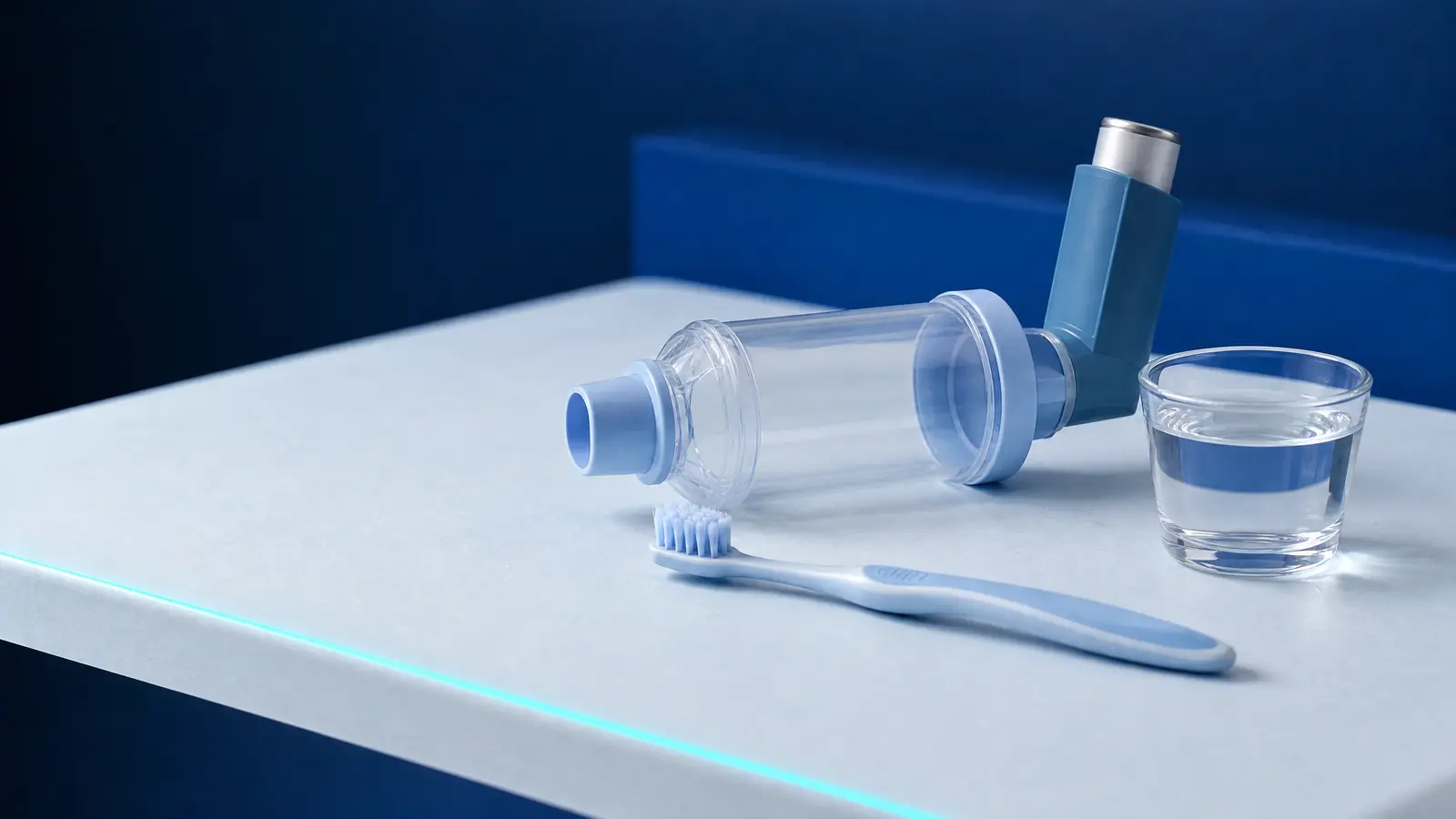
Does asthma increase the risk of tooth decay?
Asthma is associated with a slightly higher risk of tooth decay. A 2026 meta-analysis in the Journal of Global Health, covering 60 studies and 343 975 participants from 22 countries, reports an odds ratio of 1.44 (95% CI 1.17 to 1.76). People with asthma also had more decayed, filled or missing permanent teeth.
An earlier meta-analysis from 2019 (Agostini et al., 36 studies) reported similar figures: an odds ratio of 1.45 for primary teeth and 1.52 for permanent teeth. Its authors recommend that dentists and doctors work together to keep both conditions under control.
An association does not mean that everyone with asthma will develop decay. The authors of the 2026 review added a genetic analysis (Mendelian randomisation), which suggests a possible causal link, although a weaker one (odds ratio 1.09); diet, hygiene and fluoride also affect the risk. In the same meta-analysis, atopic dermatitis had a weaker association with decay (odds ratio 1.09), and allergic rhinitis had none (1.01).
Inhalers and tooth decay: what role does saliva play?
Saliva is one possible explanation for the association between asthma and tooth decay: its volume, pH and buffering capacity, meaning its ability to neutralise acids, are among the factors linked to decay. A 2022 meta-analysis in the Journal of Asthma (18 studies in the review, 14 in the quantitative analysis) found lower salivary flow in people with asthma, both at rest and when stimulated.
The same meta-analysis found a lower pH and reduced buffering capacity in resting saliva, meaning less protection against acids. This is no reason to change your asthma treatment yourself; daily preventive care reduces the risk of decay.
The Louisiana State University (LSU) School of Dentistry guide for parents of children with asthma recommends brushing morning and evening with a soft toothbrush and fluoride toothpaste, flossing in the evening and limiting juices, sugary drinks and sweet snacks between meals.
How can you prevent oral thrush from inhaled steroids?
The main oral health concern with inhaled steroids is oral thrush (candidiasis), which causes white patches, redness and soreness in the mouth, as well as a sore throat and hoarseness. NHS 111 Wales (updated in September 2026) states that inhaled steroids cause few or no side effects when used correctly and at normal doses.
The two simple habits listed below reduce the risk of thrush and hoarseness. If white patches or a burning sensation still develop, show them to your doctor or dentist; the forms of thrush and its treatment are covered in a separate article on oral thrush.
- After every use of a steroid inhaler, rinse your mouth with water and spit it out, or brush your teeth, as the NHS recommends.
- Use your inhaler with a spacer if your doctor has recommended one; the NHS lists this as a way to reduce side effects.
- Do not stop taking the medicine because of patches in your mouth; speak to the doctor who prescribed it.
Asthma and enamel erosion: what do studies show?
Data on a link between asthma and enamel erosion are inconclusive. A 2023 meta-analysis in BDJ Open covered 12 studies, 1027 people with asthma and 5617 without; the pooled result was not statistically significant (odds ratio 2.03, 95% CI 0.96 to 4.29), and neither was the result in children. In the adult subgroup an association was found (odds ratio 2.76, 95% CI 1.24 to 6.16), but the certainty of this evidence was very low.
Inconclusive findings do not rule out erosion in an individual. Erosion has many causes, from acidic drinks to reflux, which are covered in the article on enamel erosion.
Does asthma affect the gums?
People with asthma are more likely to have gum inflammation. A 2018 systematic review in the Journal of Periodontology (21 studies) found significantly higher gingival bleeding, plaque and gingival inflammation indices in this group. The authors concluded that the evidence strongly suggests an association between asthma and periodontal disease.
People with asthma also had more plaque in this review, so the same measures matter as for everyone else: thorough brushing, cleaning between the teeth and regular tartar removal. If your gums bleed when you brush, show your dentist.
Asthma and teeth: problems and prevention
The table summarises common oral problems in people with asthma, their likely causes and what helps, based on the sources cited in this article. It does not replace a discussion with the doctor managing your asthma.
| Problem | Why it occurs | What helps |
|---|---|---|
| Tooth decay | Reduced salivary flow and protection | Fluoride toothpaste twice daily, less sugar, check-ups |
| Oral thrush | Effect of the inhaled steroid on the mucosa | Rinsing or brushing after the dose, a spacer if it suits the inhaler |
| Hoarseness and sore throat | Side effects of inhaled steroids | Rinsing, a spacer suited to the inhaler, discussing it with your doctor |
| Gum inflammation | Association described in reviews, dental plaque | Brushing, flossing, tartar removal |
| Enamel erosion | Inconclusive data; association in adults, with very low certainty of evidence | Assessment at a check-up, limiting acidic drinks |
| Breathlessness in the dental chair | Stress, a reclined position, water spray | Reliever inhaler within reach, medicines taken on time |
| Asthma attack after a painkiller | Ibuprofen can worsen asthma in some people (LSU) | Telling the dentist, medicine chosen by the doctor |
What should you tell your dentist before anaesthesia or sedation if you have asthma?
Before anaesthesia or sedation, your dentist needs to know how well controlled your asthma is, which medicines you take and what triggers attacks. The LSU guide lists questions the dentist may ask and notes that, with severe uncontrolled asthma, treatment may have to wait until it is controlled.
The ingredients of the anaesthetic also matter. The US prescribing information for one articaine preparation with adrenaline warns that its sodium metabisulphite (a sulphite) can cause an allergic reaction, including an asthma attack, in some sensitive people. Tell your dentist about any previous reaction to an anaesthetic or to sulphites.
According to the LSU guide, nitrous oxide (laughing gas) is safe for most children with mild or moderate asthma. The dentist may decide on other forms of sedation after speaking to the child’s doctor.
- How often attacks occur and when the last one happened.
- Whether you have been admitted to hospital or attended a hospital emergency department because of asthma.
- All medicines: inhaled and oral, including steroids, and their doses.
- Known triggers, including painkillers; the LSU guide states that ibuprofen can increase the risk of an attack.
- Drug and food allergies, and previous reactions to dental anaesthesia.
How do you prepare a child with asthma for a dental visit?
A child with asthma prepares for a dental visit like any other child, with a few extra steps. The LSU School of Dentistry guide notes that the visit itself can trigger an asthma attack, for example if the child is frightened, is lying back in the chair or is exposed to water spray from dental instruments.
The same guide reminds parents that children with asthma can avoid decay just like their peers: through a low-sugar diet and regular toothbrushing. The dentist decides whether prescription fluoride products are needed after an examination and X-rays.
- Give your child their asthma medicines as scheduled, including on the day of the visit.
- Make sure your child has had enough sleep before the visit.
- Bring the reliever inhaler and a list of medicines with their doses.
- Have the contact details of the paediatrician or respiratory specialist managing the asthma ready.
- Ask the paediatrician whether your child needs any particular precautions during dental treatment.
How it works at DentalBlue
At the first visit to DentalBlue in Białystok, the dentist examines the teeth and gums, and the clinic’s own radiology unit takes a panoramic X-ray. In the clinic’s price list, “Wizyta bez bólu” (visit without pain, including a panoramic X-ray, consultation, examination and written treatment plan) costs 300 zł, and “Kompleksowa higienizacja (skaling, piaskowanie, fluoryzacja)” (comprehensive dental hygiene treatment: scaling, air polishing and fluoride application) costs 350 zł.
The clinic provides inhalation sedation with nitrous oxide. Treatment under general anaesthesia, intended for specific patient groups, is always preceded by a joint dental and anaesthesiology consultation with a full medical history and medication list. Bring your reliever inhaler to the visit. The final scope and cost are agreed at the consultation, and prices may change.
Frequently asked questions
Can a child with asthma have laughing gas at the dentist?
Usually, yes. The LSU School of Dentistry guide states that nitrous oxide is safe for most children with mild or moderate asthma. The dentist decides after taking a medical history and may consult the child’s doctor if the asthma is more severe.
Can you brush your teeth straight after using a steroid inhaler?
Yes. NHS 111 Wales recommends rinsing your mouth with water and spitting it out, or brushing your teeth, after a steroid inhaler. It lists both methods as protection against side effects such as oral thrush and hoarseness.
How often should a child with asthma see a dentist?
Usually every 6 months, and more often if the risk of decay is high. The LSU guide states that the dentist may then recommend visits every 3 to 4 months. The dentist sets the interval after an examination and X-rays, considering diet, hygiene and the condition of the teeth.
Do children with asthma have more decay in their primary teeth?
According to the 2019 meta-analysis by Agostini et al., yes: the odds ratio for decay in primary teeth was 1.45. In the newer 2026 meta-analysis, which analysed allergic conditions together, the result for primary teeth depended on how it was measured (surfaces or whole teeth), so this is described as an association rather than a definite cause.
Must people with asthma avoid dental anaesthetics containing adrenaline?
There is no general rule. The prescribing information for one articaine preparation with adrenaline warns that its sulphite can trigger an asthma attack in some sensitive people, which is why the dentist asks about previous reactions. The anaesthetic is chosen by the doctor who knows the course of your asthma.
Does hoarseness after an inhaler mean you should see a dentist?
Hoarseness and a sore throat are typical side effects of inhaled steroids described by NHS 111 Wales. Rinsing after the dose helps, and so does a spacer if your inhaler is a suitable type. If hoarseness persists, speak to the doctor managing your asthma, and show a dentist any white patches or sores in your mouth.
Sources
- Journal of Global Health: Yu Q et al., Association between asthma, allergic rhinitis, atopic dermatitis, and dental caries, meta-analysis (2026)
- Journal of Asthma: Agostini BA et al., The role of asthma in caries occurrence, meta-analysis (2019)
- Journal of Asthma: Hatipoğlu Ö, Pertek Hatipoğlu F, Association between asthma and caries-related salivary factors, meta-analysis (2022)
- BDJ Open: Sivaramakrishnan G et al., The association between erosive toothwear and asthma, meta-analysis (2023)
- Journal of Periodontology: Moraschini V et al., Association between asthma and periodontal disease, systematic review (2018)
- NHS 111 Wales: Steroid inhalers (2026)
- DailyMed: Septocaine (articaine with adrenaline), prescribing information, section 5.5 (2024)
- LSU Health School of Dentistry: A Parent's Guide to Dental Care for Children with Asthma (undated)
An informational article. It does not replace a consultation, and treatment decisions are made during a visit.