What are teeth, gums and enamel called in Polish?
Knowing the Polish names for teeth and their parts helps when you need to point out where it hurts or read an X-ray report. The English column gives British usage first and marks American variants ‘US’ where they differ. It also distinguishes clinical terms used in records from everyday words. The definitions draw on the American Dental Association (ADA) glossary and the Medical Subject Headings (MeSH) database.
| Polish | English | What it means |
|---|---|---|
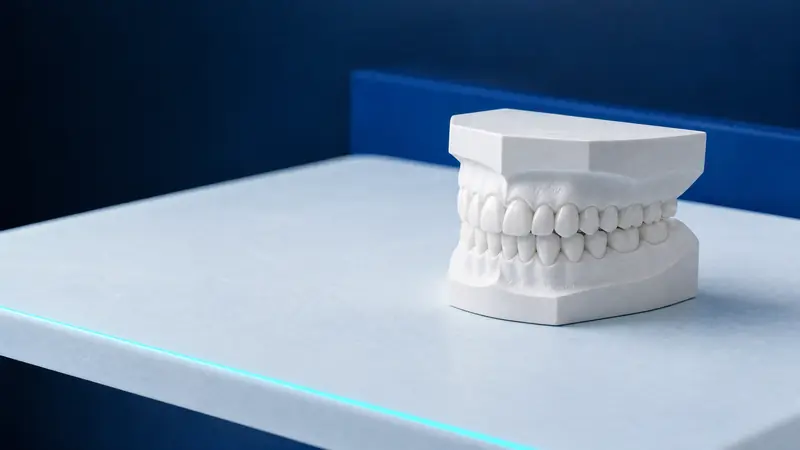
| ząb | tooth (plural teeth) | An organ set in bone that helps you bite and chew |
| ząb mleczny | milk tooth, baby tooth (clinically, primary tooth) | A tooth from the first set of teeth, later replaced by a permanent tooth |
| siekacz | incisor | A front tooth with a flat edge, in position one or two from the midline |
| kieł | canine (also US cuspid) | The third tooth from the midline of the arch |
| przedtrzonowiec | premolar (also US bicuspid) | The fourth or fifth tooth from the midline, between the canine and the molars |
| trzonowiec | molar | A large back tooth used to grind food |
| ósemka, ząb mądrości | wisdom tooth (clinically, third molar) | The last molar in the arch, which erupts last or may never come through |
| dziąsło | gum (clinically, gingiva) | Tissue that surrounds the teeth and covers the bone |
| szkliwo | enamel | The hard tissue covering the crown of the tooth |
| zębina | dentine (US dentin) | The tissue beneath the enamel that makes up most of the tooth |
| miazga | pulp, dental pulp | Tissue inside the tooth containing nerves and blood vessels |
| korzeń | root | The part of the tooth set in bone and hidden from view in the mouth |
How do you describe toothache, swelling or an abscess in Polish?
Tell the dentist what hurts, when it started, what makes it worse and whether there is any swelling. If you suspect a dental abscess, seek urgent dental care. Go straight to a hospital emergency department (SOR) if swelling spreads quickly or reaches the area around your eye or your neck, or if you have toothache with both a high fever and facial swelling. Call 112 if you have difficulty breathing, speaking or swallowing.
| Polish | English | What it means |
|---|---|---|
| ból zęba | toothache | Pain in or around a tooth |
| ból przy nagryzaniu | pain on biting | Pain when you close your teeth together or bite down |
| nadwrażliwość zębów | sensitive teeth (clinically, dentine hypersensitivity) | A short, sharp pain triggered by cold or brushing |
| krwawienie dziąseł | bleeding gums | Blood on your toothbrush or floss when you clean your teeth |
| obrzęk | swelling | Puffiness of the gum, cheek or face |
| ropień | abscess, dental abscess | A build-up of pus around a tooth or in the gum |
What are tooth decay, gum disease and bruxism called in Polish?
Your dentist may use everyday words when speaking to you and clinical terms in your records or X-ray report. The table gives both. The NHS calls bruxism ‘teeth grinding (bruxism)’, which covers grinding or clenching your teeth. A separate article explains what bruxism is and how it is treated.
| Polish | English | What it means |
|---|---|---|
| próchnica | tooth decay (clinically, dental caries) | A disease that damages enamel and dentine |
| ubytek, dziura w zębie | cavity | An area where decay has destroyed some of the tooth |
| zapalenie miazgi | pulpitis | Inflammation of the tissue inside a tooth, often with severe pain |
| zapalenie dziąseł | gingivitis | Inflammation of the gums without loss of the tissues that support the tooth |
| paradontoza (zapalenie przyzębia) | periodontitis | Gum disease involving loss of the tissues that support the tooth. ‘Gum disease’ is a broader term. |
| bruksizm | bruxism (commonly teeth grinding). Clenching means pressing the teeth together. | Grinding or clenching your teeth during sleep or while awake |
Polish words for bite, malocclusion and braces
Angle’s classification mainly describes how the first permanent molars meet. In Class II, the lower molars sit further back relative to the upper molars. In Class III, they sit further forward. The clinician assesses the positions of the upper and lower jaw bones separately.
The Polish terms ‘tyłozgryz’ and ‘przodozgryz’ also cover partial forms. If you need to explain your diagnosis in English, give the class shown in your records and describe how your teeth are aligned.
| Polish | English | What it means |
|---|---|---|
| zgryz | bite (clinically, occlusion) | How your upper and lower teeth meet when you close your mouth |
| wada zgryzu | malocclusion | Misalignment of the teeth or jaws in relation to each other |
| tyłozgryz | Class II malocclusion (distoclusion), if Class II has been diagnosed | A bite in which the lower teeth sit further back relative to the upper teeth. A partial form can affect the front teeth while the molars have a different classification. |
| przodozgryz | Class III malocclusion (mesioclusion), if Class III has been diagnosed. Commonly ‘underbite’ when the lower incisors sit in front of the upper ones. | A bite in which the lower teeth sit further forward relative to the upper teeth. A partial form can affect the front teeth while the molars have a different classification. |
| zgryz otwarty | open bite | Some teeth do not meet when you close your teeth together |
| zgryz głęboki | deep bite, increased overbite | The upper incisors cover too much of the lower ones |
| zgryz krzyżowy | crossbite | The upper teeth bite inside the lower teeth |
| stłoczenia | crowding, crowded teeth | Teeth overlap because there is too little room for them |
| nagryz poziomy | overjet | The horizontal distance from the biting edge of the upper incisors to the front surface of the lower incisors |
| nagryz pionowy | overbite | How far the upper incisors overlap the lower ones vertically |
| aparat stały | fixed brace (US braces) | Brackets bonded to the teeth and connected by a wire |
| nakładki ortodontyczne | clear aligners | Clear, removable trays that move the teeth in stages |
| retainer | retainer (fixed or removable) | A fixed wire or removable tray that holds teeth in position after treatment |
Polish terms for fillings, root canal treatment and splints
These terms appear in treatment plans and estimates. If you want to ask for a splint to protect your teeth from grinding, use ‘szyna relaksacyjna’ (occlusal splint) or explain that you mean a guard to wear at night.
| Polish | English | What it means |
|---|---|---|
| plomba, wypełnienie | filling | Material such as composite used to fill a cavity |
| leczenie kanałowe | root canal treatment (US root canal therapy, commonly root canal) | Removal of the pulp, followed by cleaning and filling the root canals |
| ekstrakcja, usunięcie zęba | extraction, tooth removal | Removal of a tooth or part of a tooth from its socket |
| implant | dental implant | A screw placed in bone to replace a tooth root |
| korona protetyczna | crown (commonly cap) | A restoration that covers the visible part of a tooth or replaces it on an implant |
| most protetyczny | dental bridge, bridge | A fixed replacement for missing teeth, supported by one or more teeth or by implants |
| proteza | denture (commonly false teeth) | A removable replacement for some or all teeth |
| licówka | veneer | A thin covering placed on the front surface of a tooth |
| wybielanie | teeth whitening (clinically, bleaching) | Lightening the teeth with an oxidising agent |
| higienizacja | professional cleaning (UK scale and polish, US prophylaxis) | Removal of tartar, plaque and other deposits at a dental practice |
| skaling | scaling | Removal of tartar from the surfaces of teeth |
| piaskowanie | air polishing | Removal of deposits using a jet of air, water and powder |
| szyna relaksacyjna | occlusal splint (also UK mouth splint, US night guard or occlusal guard) | A guard usually worn at night to protect the teeth from grinding or clenching |
How do you say local anaesthesia, sedation and general anaesthesia in Polish?
Local anaesthesia numbs the area being treated while you stay awake. With nitrous oxide inhalation sedation, you usually stay awake and can respond to the dentist. General anaesthesia is a controlled loss of consciousness brought on by medicines. Before treatment, tell the dentist if you are afraid of injections or have previously had a reaction to anaesthesia.
| Polish | English | What it means |
|---|---|---|
| znieczulenie | anaesthesia (US anesthesia). The medicine is an anaesthetic (US anesthetic). | Medicines reduce or block sensation during a procedure |
| znieczulenie miejscowe | local anaesthesia (US local anesthesia). The medicine is a local anaesthetic (US local anesthetic). | Numbing a specific area while you stay awake |
| drętwienie | numbness (adjective ‘numb’) | Loss of feeling in the lip, cheek or tongue after anaesthesia |
| sedacja | sedation | Medicines or gas help you relax. The depth of sedation depends on the method. |
| podtlenek azotu, gaz rozweselający | nitrous oxide (commonly laughing gas) | Inhaled with oxygen through a nose mask to help reduce anxiety |
| znieczulenie ogólne, narkoza | general anaesthesia (US general anesthesia) | A controlled loss of consciousness brought on by medicines |
Polish terms for booking, X-rays and prescriptions
The words used at reception and in dental records help you book an appointment, request copies of X-rays and deal with your insurer. The guide for foreign patients explains eligibility for treatment through Poland’s National Health Fund (NFZ) and which documents to bring. The table gives the Polish terms you may hear or see.
| Polish | English | What it means |
|---|---|---|
| rejestracja | reception (US front desk) | Where you book an appointment, in person or by phone |
| wizyta, umówić wizytę | appointment, book an appointment (also US make an appointment) | A scheduled dental visit and the act of arranging it |
| wizyta kontrolna, przegląd | check-up | An examination of your teeth and gums when you have no specific complaint |
| skierowanie | referral, referral letter | A written request for you to see a specialist or have a test |
| dokumentacja, karta pacjenta | dental records, patient records | The practice’s record of your medical history, examinations and treatment |
| pantomogram | panoramic X-ray, OPG (US panoramic radiograph) | A single image showing all the teeth and both jaw bones |
| RTG zęba, zdjęcie punktowe | dental X-ray. A periapical X-ray is one type. | A periapical X-ray shows the tooth, its root and the area around the root tip |
| tomografia CBCT | CBCT scan, cone beam CT | A three-dimensional image of the teeth and bones |
| recepta | prescription | An order for medicine, usually electronic in Poland |
| zwolnienie lekarskie (e-ZLA) | sick note (US doctor’s note) | A certificate stating that you are unable to work, which a dentist can also issue |
Useful Polish phrases to describe symptoms at the dentist
A few simple sentences can help you describe pain and share information the dentist needs to treat you safely. Always mention allergies, pregnancy and medicines you take regularly, even if they seem unrelated to your teeth. List the active ingredients in your medicines, as brand names vary between countries.
| Polish | English | When to use it |
|---|---|---|
| Boli mnie ząb. | I’ve got toothache. In US English, ‘I have a toothache.’ | When booking and at the start of the appointment |
| Boli, kiedy gryzę. | It hurts when I bite. | When you have pain on biting |
| Mam spuchnięty policzek. | My cheek is swollen. | Contact a dentist urgently. Go to a hospital emergency department (SOR) for rapidly spreading swelling or swelling near the eye or on the neck. Call 112 if you have difficulty breathing, speaking or swallowing. |
| Wypadła mi plomba. | My filling has fallen out. | When you have lost a filling |
| Jestem uczulony (uczulona) na… | I’m allergic to… | If you are allergic to medicines, latex or anaesthetics |
| Jestem w ciąży. | I’m pregnant. | Before examination or any treatment |
| Przyjmuję leki przeciwzakrzepowe. | I take blood thinners (anticoagulants). | Before a procedure, especially a tooth extraction |
| Boję się zastrzyków. | I’m nervous about injections. | At the start of the appointment so the dentist can take it into account |
| Ile to będzie kosztować? | How much will it cost? | Before treatment starts |
| Czy mogę dostać kopię zdjęcia? | Can I have a copy of my X-ray? | If you will continue treatment elsewhere |
An appointment in English at DentalBlue in Białystok
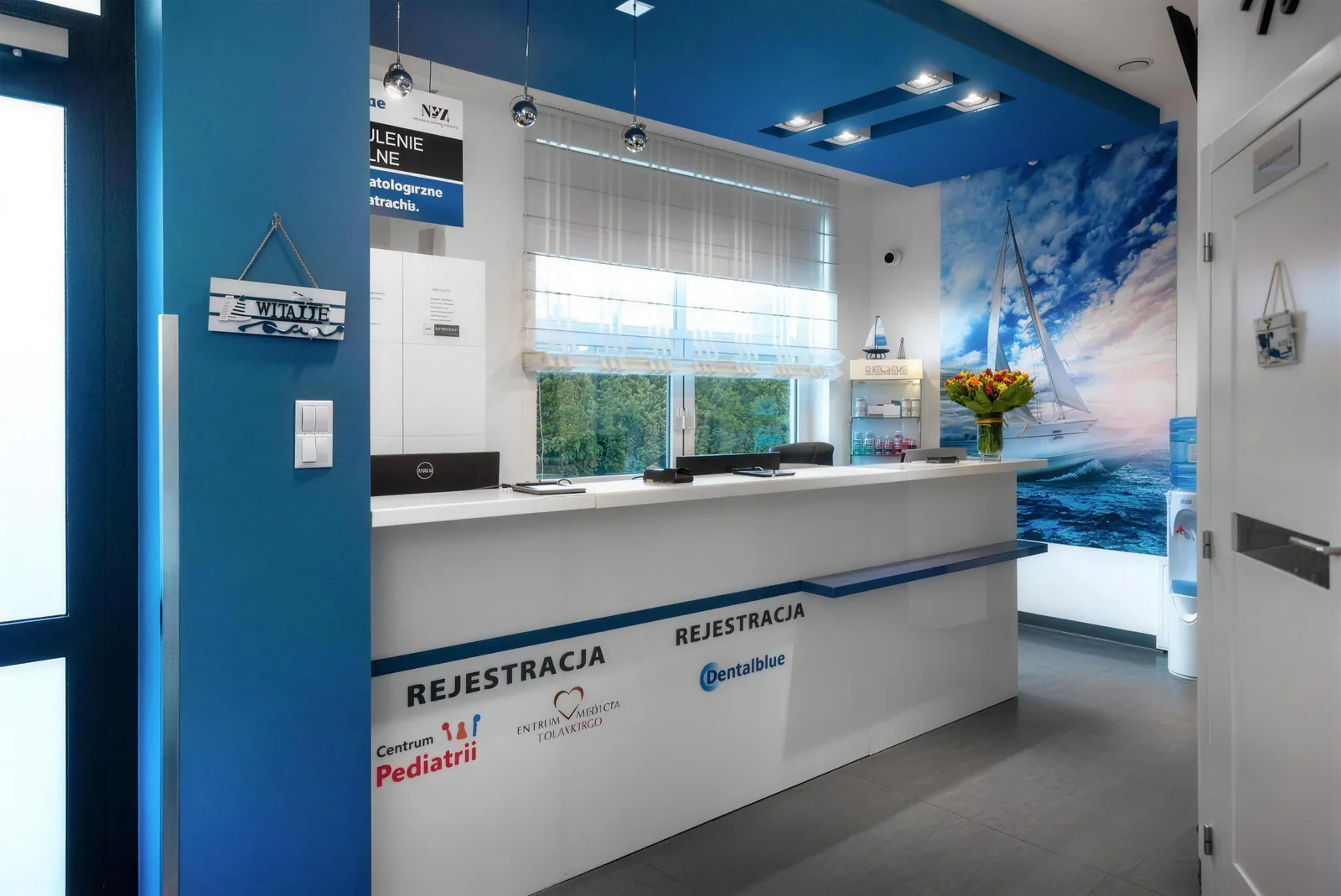
DentalBlue is at ul. Kazimierza Pułaskiego 35 in Białystok, at the junction with Wspólna. The clinic speaks Polish, English, Ukrainian and Russian. The nearest bus stop is ‘Pułaskiego/Wspólna’, 50 m from the entrance, served by routes 16, 23 and 26. The clinic is open Monday to Friday from 8:00 to 20:00 and Saturday from 8:00 to 16:00. It is closed on Sundays.
Call 85 748 00 50 to book. A receptionist answers during opening hours. The price list shows ‘First visit in pain’ at 340 zł (a panoramic X-ray, consultation, examination and pain relief) and ‘First visit without pain’ at 300 zł (a panoramic X-ray, consultation, examination and a written treatment plan). The clinic’s own radiology unit takes panoramic X-rays and CBCT scans, and you can get the images on CD. Prices may change. The final scope and cost are set at the consultation.
- When booking, say which language you would like to speak and whether you have pain or swelling.
- Bring any previous X-rays or scans on your phone or a storage device, along with a record of your previous treatment.
- List the active ingredients in your medicines and note any allergies, long-term conditions or pregnancy.
Frequently asked questions
What does ‘bruksizm’ mean?
‘Bruksizm’ means bruxism, commonly called teeth grinding. Clenching means pressing your teeth together. The NHS uses the term ‘teeth grinding (bruxism)’.
How do you ask for a local anaesthetic at a Polish dentist?
‘Znieczulenie miejscowe’ means local anaesthesia (US local anesthesia). The medicine is a local anaesthetic (US local anesthetic). To ask ‘Could I have a local anaesthetic, please?’ in Polish, say ‘Czy mogę prosić o znieczulenie miejscowe?’
What do ‘wada zgryzu’ and ‘tyłozgryz’ mean?
‘Wada zgryzu’ means malocclusion. If your diagnosis of ‘tyłozgryz’ specifies Angle Class II, use ‘Class II malocclusion’. ‘Overbite’ is the vertical overlap of the upper and lower incisors.
What does ‘szyna relaksacyjna’ mean?
‘Szyna relaksacyjna’ means occlusal splint. When discussing grinding during sleep, you can also say ‘night guard’. The word ‘mouthguard’ on its own can refer to a sports mouthguard.
Can I speak English at DentalBlue?
Yes. The clinic speaks Polish, English, Ukrainian and Russian. When you call 85 748 00 50 to book, say which language you would like to speak.
Sources
An informational article. It does not replace a consultation, and treatment decisions are made during a visit.