What are the four types of teeth?
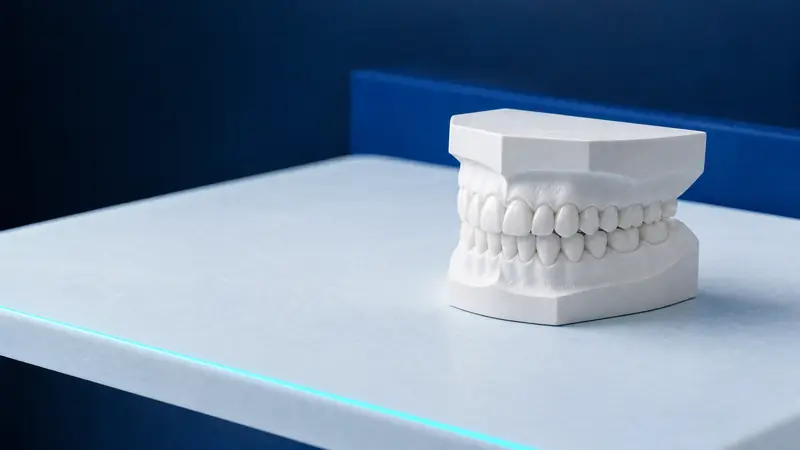
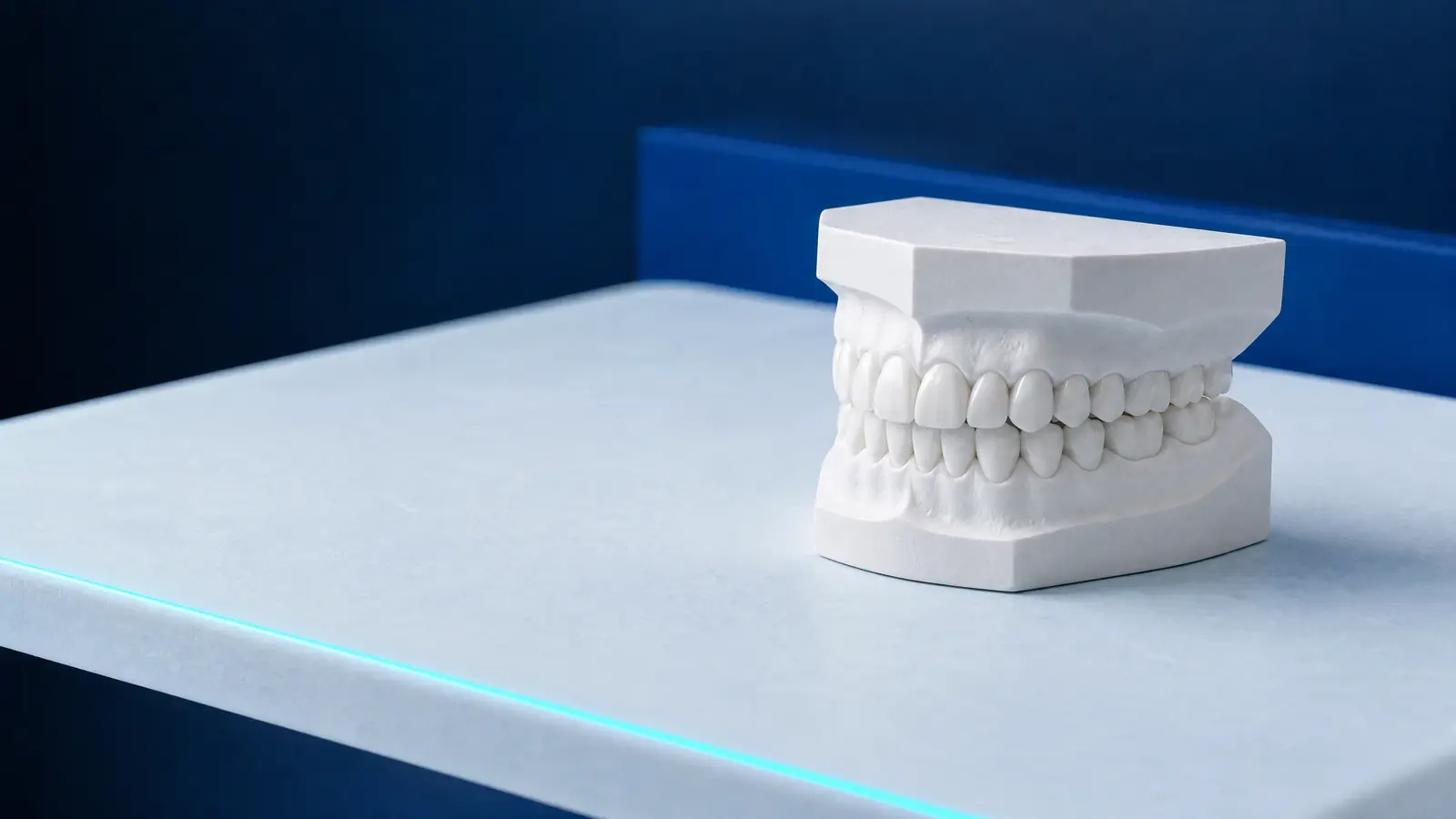
The four groups of human teeth are incisors, canines, premolars and molars. From the centre outwards, each quadrant of a full permanent set has a central incisor, a lateral incisor, a canine, a first and second premolar, and a first, second and third molar.
According to Better Health Channel, the Australian state of Victoria’s health information service, the average person has 32 permanent teeth by about age 21, with 16 in the upper arch and 16 in the lower arch, although some people have fewer or more. The American Dental Association (ADA) glossary classifies incisors and canines as front teeth and premolars and molars as back teeth. The table gives each tooth’s anatomical name, everyday Polish name, count in a full permanent set and main function.
| Anatomical name | Everyday Polish name | Number in a full permanent set | Main function |
|---|---|---|---|
| Central incisor | Jedynka (one) | 4 | Biting off pieces of food |
| Lateral incisor | Dwójka (two) | 4 | Biting off pieces of food |
| Canine | Trójka (three). The upper canine is the eyetooth (ząb oczny). | 4 | Tearing food |
| First premolar | Czwórka (four) | 4 | Crushing food |
| Second premolar | Piątka (five) | 4 | Crushing food |
| First molar | Szóstka (six) | 4 | Grinding food |
| Second molar | Siódemka (seven) | 4 | Grinding food |
| Third molar | Ósemka (eight), ząb mądrości (wisdom tooth) | 4 | Grinding food |
What do incisors, canines, premolars and molars do?
Each type is shaped for its job as you bite, tear, crush and grind food before swallowing. Better Health Channel notes that teeth also help you speak clearly and are an important part of your smile. The ADA adds that teeth help shape your face. The tooth numbering guide explains how many roots and canals each tooth group has. Here is how the groups differ in shape and function.
- Incisors sit at the front of the mouth. The upper and lower incisors meet like scissor blades to cut off a bite of food. The ADA glossary describes an incisor as a cutting tooth.
- Canines are pointed teeth just behind the incisors. Each has a single cusp and helps tear food.
- Premolars sit between the canines and molars and crush food. They usually have two cusps, hence the name ‘bicuspid’, meaning a tooth with two cusps.
- Molars are the large teeth at the back of the arch. They are bigger than premolars and have large crowns and broad, flat chewing surfaces. The ADA glossary describes them as grinding teeth.
Why are teeth called ones, twos and sixes in Polish?
Everyday Polish tooth names follow their order from the centre of the arch. The first tooth, ‘jedynka’, sits next to the midline, and the eighth, ‘ósemka’, is at the very back if it is present. To identify a tooth you could say ‘górna lewa szóstka’, meaning the upper left sixth tooth.
The eighth tooth, or third molar, is also called the wisdom tooth. According to the ADA eruption chart, it comes through last, usually between ages 17 and 21, when the other permanent teeth are already in place. Its Latin name ‘dens serotinus’ comes from a word meaning ‘late’. The article on wisdom tooth removal explains when removal is needed and when the tooth can stay.
The everyday number corresponds to the second digit of the tooth’s code. In Poland, dental records, X-ray reports and dental charts, which show both arches, identify teeth with a two-digit code under ISO 3950. The first digit gives the quadrant and the second the position from the centre, so the upper right sixth tooth is tooth 16. The tooth numbering guide explains how to read the codes for adults and children.
Which tooth is the eyetooth, or ‘ząb oczny’ in Polish?
‘Ząb oczny’ is an everyday Polish name for the upper canine, the third tooth from the centre of the upper jaw. Its number in dental records is 13 on the right and 23 on the left. The English word ‘eyetooth’ works the same way. Merriam-Webster defines it as an upper canine, and Better Health Channel gives ‘eye teeth’ as an everyday name for canines.
The origin of the Polish name ‘ząb oczny’ is uncertain. It may refer to the position of the upper canine below the eye. The dentist records it as a canine or uses its tooth number.
The upper canine erupts relatively late. The ADA chart puts its eruption at ages 11 to 12, and that of the lower canine at ages 9 to 10. If the upper canine fails to come through at this age, the article on impacted canines explains possible causes and what happens next.
What are the Latin names for teeth?
The International Federation of Associations of Anatomists (IFAA) publishes Terminologia Anatomica, the international nomenclature that sets out the Latin names for teeth. Permanent teeth are ‘dentes permanentes’, milk teeth are ‘dentes decidui’ and a single tooth is ‘dens’.
The terms ‘superior’ and ‘inferior’, or ‘maxillaris’ and ‘mandibularis’, distinguish upper and lower teeth. ‘Dens caninus superior’ is the upper canine, or eyetooth. Here are the names for each type of tooth.
- An incisor is ‘dens incisivus’. The central incisor is ‘dens incisivus centralis’ or ‘dens incisivus primus’, and the lateral incisor is ‘dens incisivus lateralis’ or ‘dens incisivus secundus’.
- A canine is ‘dens caninus’, from the Latin ‘canis’, meaning ‘dog’.
- A premolar is ‘dens premolaris’. Older textbooks also use the spelling ‘praemolaris’.
- A molar is ‘dens molaris’. The third molar, or wisdom tooth, is ‘dens molaris tertius’ or ‘dens serotinus’.
- Milk teeth have ‘deciduus’ in their name. A milk canine is ‘dens caninus deciduus’ and a milk molar is ‘dens molaris deciduus’.
What are the milk teeth called and when do premolars appear?
A child has 20 milk teeth. Each quadrant has a central incisor, a lateral incisor, a canine and a first and second milk molar. According to the ADA, the first milk teeth erupt at about 6 months. Better Health Channel says a child usually has all 20 by age 3.
There are no premolars in the milk dentition. The ADA charts show that milk molars are shed between ages 9 and 12, and permanent premolars erupt in their place. The ADA glossary calls a permanent tooth that replaces a milk tooth a ‘succedaneous tooth’. This is why positions four and five from the centre are occupied by molars in the milk set and by premolars in the permanent set.
Permanent molars have no milk predecessors because they erupt behind the last milk teeth. According to the ADA, the first permanent molar, the sixth tooth from the centre, appears between ages 6 and 7. The article on losing milk teeth explains the order in which teeth are replaced.
| Milk tooth | Latin name | Number in a full set | Permanent successor |
|---|---|---|---|
| Milk central incisor | dens incisivus deciduus centralis | 4 | Central incisor |
| Milk lateral incisor | dens incisivus deciduus lateralis | 4 | Lateral incisor |
| Milk canine | dens caninus deciduus | 4 | Canine |
| First milk molar | dens molaris deciduus primus | 4 | First premolar |
| Second milk molar | dens molaris deciduus secundus | 4 | Second premolar |
What names might you see in English-language dental records?
Knowing the English terms helps when you read records from abroad or speak to a dentist in English. The ADA eruption chart uses ‘central incisor’ and ‘lateral incisor’, ‘canine’ or ‘cuspid’, ‘premolar’ or ‘bicuspid’, and ‘molar’. The upper canine is also called an ‘eyetooth’ in everyday English. A wisdom tooth is a third molar.
Milk teeth are also called ‘baby teeth’, ‘primary teeth’ or ‘deciduous teeth’. Permanent teeth are also called ‘adult teeth’. Check the numbering in US dental records. The ADA glossary says the ISO system is rarely used there, and the tooth numbering guide explains the US system.
Identifying your teeth at DentalBlue in Białystok
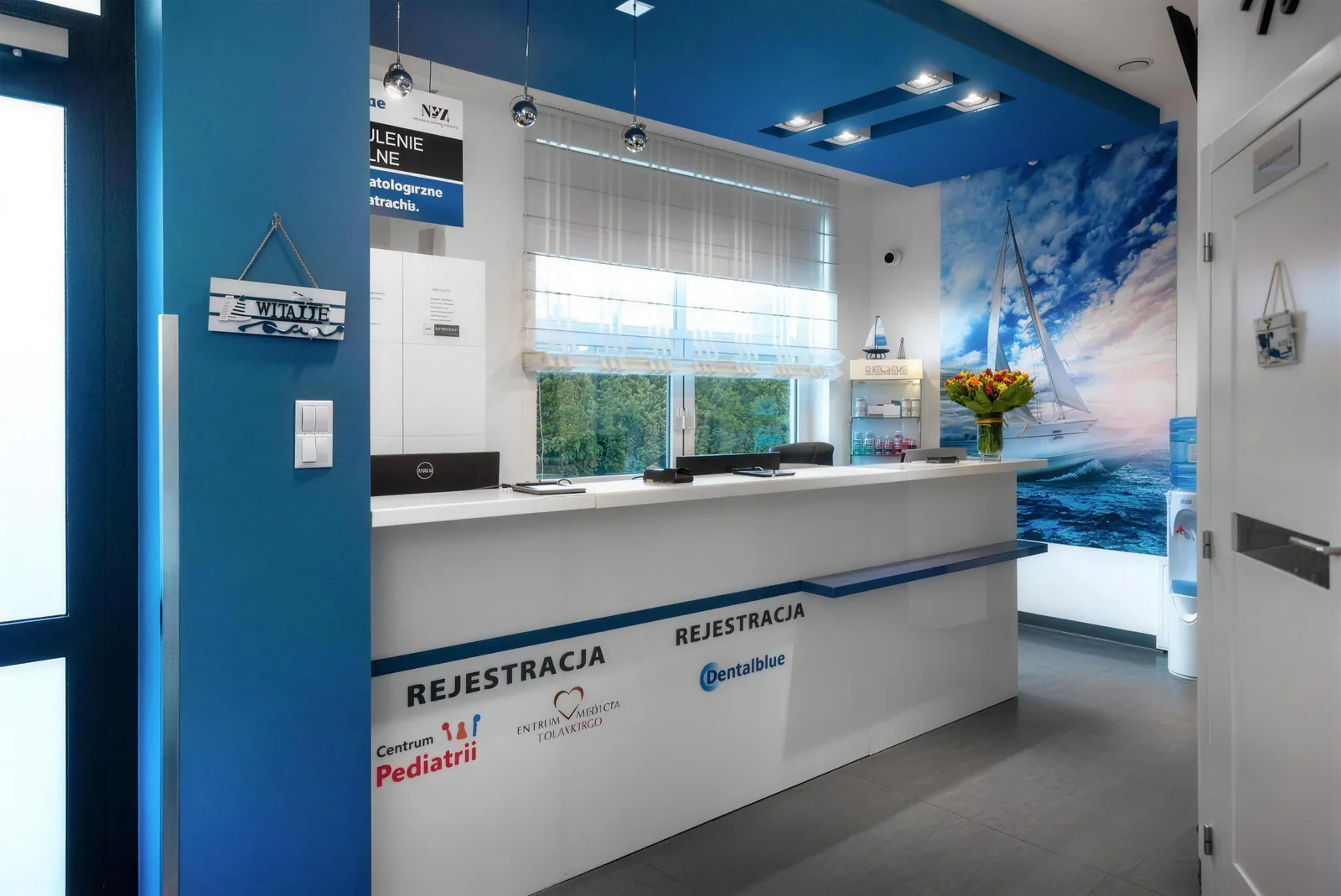
If you want the dentist to assess all your teeth and show you which is which, ask DentalBlue in Białystok about a first visit without pain. The published price for ‘First visit without pain’ is 300 zł and includes a panoramic X-ray, consultation, examination and a written treatment plan. If you see a tooth number in your plan, ask the dentist to point out that tooth on your X-ray.
The clinic’s own radiology unit takes intraoral X-rays, panoramic X-rays and CBCT scans. The price list shows ‘Panoramic radiograph’ at 120 zł, and you can get your images on CD with the Romexis viewer. For children, the price list shows ‘Acclimatisation visit’ at 250 zł. Prices may change, and the final scope and cost are set at the consultation.
The clinic is at ul. Kazimierza Pułaskiego 35, at the junction with Wspólna on the south side of the city centre. The ‘Pułaskiego/Wspólna’ stop is 50 m from the entrance and is served by bus routes 16, 23 and 26. The clinic is open Monday to Friday from 8:00 to 20:00 and Saturday from 8:00 to 16:00. It is closed on Sundays.
Call 85 748 00 50 to book. You can speak Polish, English, Ukrainian or Russian. Say you would like a first visit without pain to have all your teeth assessed. If you are booking for a child, ask about an acclimatisation visit.
- Bring previous dental X-rays and treatment records, including any from abroad, as they may use a different tooth numbering system.
- Bring a list of your medicines and details of any long-term conditions.
Frequently asked questions
Which tooth is the eyetooth?
The eyetooth is the upper canine, the third tooth from the centre of the upper jaw, known in everyday Polish as ‘górna trójka’. It is numbered 13 or 23 in Polish dental records. Merriam-Webster defines ‘eyetooth’ as a canine of the upper jaw.
How many molars does an adult have?
An adult with a full set of teeth has 12 molars, 6 in each arch, including 4 wisdom teeth. If all four wisdom teeth failed to develop or were removed, 8 molars remain.
Do children have premolars in their milk teeth?
A full set of milk teeth has 8 incisors, 4 canines and 8 molars. Permanent premolars erupt during childhood in place of the milk molars, which the ADA says are usually shed between ages 9 and 12.
What is the difference between a premolar and a molar?
Premolars sit between the canines and molars. They are smaller than molars, usually have two cusps and crush food. Molars are larger, with broad, flat chewing surfaces for grinding food. An adult has 8 premolars and up to 12 molars.
What is the Latin name for a wisdom tooth?
In anatomical nomenclature, a wisdom tooth is ‘dens molaris tertius’, meaning third molar, or ‘dens serotinus’. An upper wisdom tooth is ‘dens molaris superior tertius’ and a lower one is ‘dens molaris inferior tertius’.
How much does a visit to have all my teeth assessed cost?
DentalBlue lists ‘First visit without pain’ at 300 zł, including a panoramic X-ray, consultation, examination and a written treatment plan. Prices may change, and the final scope and cost are set at the consultation.
Sources
- Better Health Channel (Victoria Department of Health): Teeth, types and functions (reviewed 2025)
- ADA MouthHealthy: Eruption Charts for milk and permanent teeth with their English names
- ADA: Glossary of Dental Clinical Terms (CDT)
- IFAA: Terminologia Anatomica, terms for the dentition (dentitio) in Latin and English
- Merriam-Webster: Eyetooth, dictionary and medical definitions
- DentalBlue: Price list
An informational article. It does not replace a consultation, and treatment decisions are made during a visit.