Why does my tooth hurt when I bite down?
Biting puts pressure on the tissues around the tooth, including the periodontal ligament, which connects the root to the bone. Tenderness when the tooth is tapped may suggest irritation or inflammation in the tissues around the root. The dentist considers it alongside the results of other tests.
The table lists common patterns. The same pain can have different causes, so you still need an examination.
| What you notice | Likely cause | What the dentist checks | Usual treatment |
|---|---|---|---|
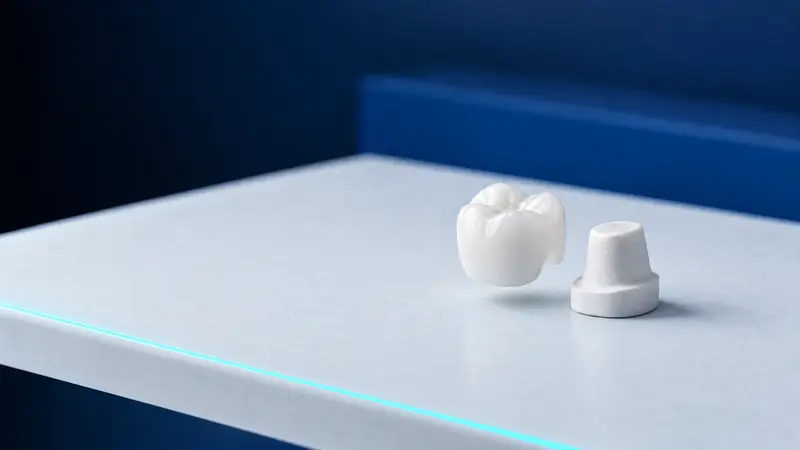
| Pain from the first meals after a new filling or crown | A filling or crown that is too high | How your teeth meet, using articulating paper | Adjustment to remove excess material |
| Constant or throbbing pain, tenderness when tapped and no response to cold | Possible inflammation around the root and pulp necrosis | Tapping, cold test and X-ray | Root canal treatment or extraction |
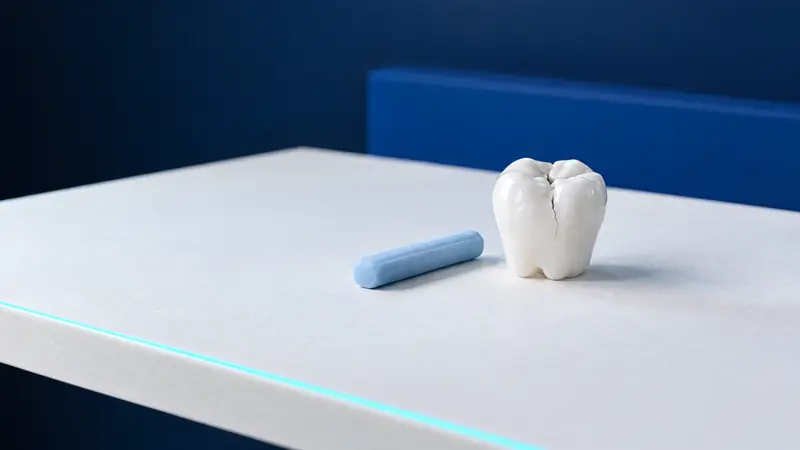
| Brief, sharp pain when biting something hard or releasing pressure | Cracked tooth | Bite test, light shone through the tooth and magnification | A restoration covering the cusps, sometimes with root canal treatment |
| Tenderness in the first few days after root canal treatment | Irritation around the root or a contact that is too high | The bite and how symptoms have changed | Usually settles on its own, sometimes needs bite adjustment |
| Painful, swollen gum around one tooth, with pus | Periodontal abscess | Gum pocket, tooth mobility and X-ray | Draining the pus and cleaning the pocket |
| Several upper back teeth hurt at once, with a runny nose | Maxillary sinusitis | Dental examination and assessment of sinus symptoms, with imaging if indicated | Treat the sinus, and treat the teeth only if they are the cause |
| Clenching or grinding, with worn teeth | Excessive forces that make cracks more likely | Tooth wear and contacts that interfere with the bite | Tooth protection and a night splint |
Does pain when biting after a new filling or crown mean it is too high?
If pain when biting starts as soon as a filling or crown is fitted, a high spot in the bite is the first thing to suspect. Renton describes it as a consequence of treatment: the tooth takes pressure first and the tissues at the root tip become inflamed. The pain is sharp at first and later feels duller. The bite is hard to judge while you are numb, so the problem usually becomes noticeable a few hours later or the next day.
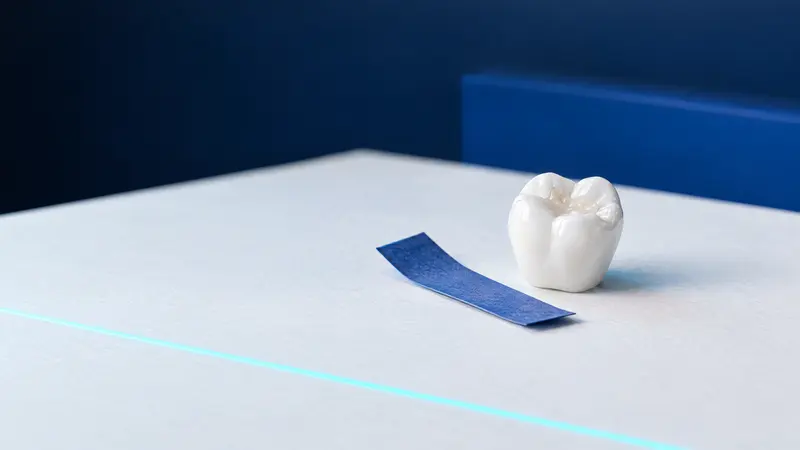
The dentist checks your bite with articulating paper, which marks where the tooth touches too soon, and removes excess material. This is a mechanical problem, so there is little point waiting weeks. Slight tenderness after extensive treatment can also come from pulp irritation, which Renton says can be reversible. If your tooth hurts mainly in response to cold after a filling, sensitivity is more likely, as explained in a separate guide. Pain under a crown that starts only years later usually has another cause.
Pain when biting and tapping: root inflammation and pain after root canal treatment
When the pulp dies, infection can spread through the root tip to the surrounding tissues and cause inflammation or an abscess. The tooth may stop responding to cold while still hurting when you bite or when it is tapped. Once the dentist confirms that an infection inside the tooth is the cause, they consider root canal treatment or extraction.
A tooth can be tender on biting after root canal treatment, and in most patients the discomfort gradually eases. Renton also lists a high bite contact after treatment as a cause of pain at the root tip. The dentist can adjust this contact. A separate guide explains how long pain after root canal treatment usually lasts.
A root-filled tooth that starts to hurt when you chew months or years later needs an X-ray. Possible causes include inflammation at the root tip or a vertical root fracture. According to the European Society of Endodontology (ESE) 2025 position statement, vertical root fractures are more common in root-filled teeth and, at an advanced stage, can cause an isolated, deep pocket or several sinus tracts on the gum.
Why does my tooth hurt when I bite and release?
The ESE position statement describes brief, sharp pain when biting hard foods as a typical early symptom of a cracked tooth. Pain when releasing pressure is one possible symptom, and the tooth may also respond to cold. Cracks most often affect the upper premolars and molars and the lower molars, especially after the age of 40.
A crack can be hard to see on an X-ray. In a study cited by the ESE, it was visible in only 2% of cracked teeth with living pulp. Diagnosis therefore relies on a bite test, shining light through the tooth and examination under magnification, which the statement describes as essential. Our guide to cracked teeth explains treatment.
Heavy biting forces make cracks more likely. The ESE lists contacts that interfere with the bite, hard foods and clenching or grinding among the causes. It recommends considering a stabilisation splint for people with these habits. Our guide to bruxism explains more.
Can pain when chewing come from the gums, sinuses or a loose tooth?
Pain on biting can come from outside the tooth. Scottish SDCEP guidance describes a periodontal abscess as a collection of pus in the wall of a gum pocket, usually in someone with periodontitis. It causes gum pain and swelling, pus, increased tooth mobility and sometimes fever. The dentist drains the pus and cleans the pocket.
Trapped food can also cause local gum pain. Renton explains that where neighbouring teeth make poor contact, trapped food can cause local inflammation of the gum. SDCEP lists trapped food among the causes of periodontal abscesses.
If several upper back teeth hurt at once, the maxillary sinus may be the cause. According to Renton, inflammation in this sinus causes a dull, constant, diffuse pain, usually on one side, that gets worse when you bend over or lie down. A separate guide covers sinusitis and tooth pain.
A tooth that has become loose can hurt when you chew. It may be loose because it has lost bone support, but mobility can also occur with an abscess or a fractured tooth. The dentist identifies the cause.
How does a dentist find the cause of pain when biting?
The dentist asks about your symptoms, performs several tests and takes an X-ray, since no single test is sufficient. Renton describes tests for tooth pain, and the ESE position statement covers tests that help detect cracks.
The ESE notes that in selected cases a dentist may order a CBCT scan if the examination and intraoral X-ray do not explain the symptoms. The scan may show bone loss associated with a crack, although the crack itself is not always visible.
- History: when the pain started, whether the tooth was recently treated and what brings on the pain.
- Percussion: tenderness when a tooth is tapped may indicate irritation of the tissues around the root.
- A bite test, cusp by cusp, using a device to reproduce the pain caused by a crack.
- Cold test: no response may mean the pulp has died.
- Probing and checking for mobility: the dentist checks pocket depth, bleeding and tooth support.
- A bite check with articulating paper, especially after a new filling or crown.
- Light shone through the tooth, staining, and a microscope or magnifying loupes if a crack is suspected.
- An intraoral X-ray, with small-field CBCT only in selected cases.
When is pain on biting urgent and what can you do until your appointment?
Swelling of the gum or cheek, a fever or constant, throbbing pain needs assessment the same day. Swelling and fever may indicate a spreading infection that could require a procedure.
Call 112 or go to SOR if you have difficulty breathing, speaking or swallowing, marked trismus with suspected infection, marked swelling inside the mouth, swelling under the jaw, in the neck or around the eye, or a sudden deterioration in vision. If the pain is mild and you have no swelling or fever, book an appointment in the next few days. Until then, you can try the measures below.
- Chew on the other side and avoid anything that makes the pain worse, including very cold or hot foods.
- Use a painkiller that has helped you before, such as ibuprofen or paracetamol. Follow the instructions and warnings in the leaflet and stay within the daily dose.
- Follow the instructions in the leaflet. Do not put aspirin or other painkiller tablets on your gum.
- If you have bleeding, avoid choosing aspirin or ibuprofen for tooth pain. If you take aspirin regularly as prescribed, do not stop it on your own.
- If lying down makes the pain worse, sleep with your head raised.
- Keep your appointment even if a painkiller relieves the pain, because the cause still needs attention.
What does treatment for tooth pain on biting cost and what does the NFZ cover?
The cost depends on the cause. The table lists items from DentalBlue’s published price list. The final scope and cost are set at the consultation, and prices may change.
At a dentist contracted with Poland’s National Health Fund (NFZ), a patient in pain is entitled to care on the day they present (§ 6 of the ‘Rozporządzenie w sprawie świadczeń gwarantowanych z zakresu leczenia stomatologicznego’, the regulation on guaranteed dental treatment services). For adults, covered services include fillings, abscess incision, extraction and root canal treatment except on premolars and molars. Children and adolescents under 18, and women during pregnancy and the postpartum period, have coverage for root canal treatment on all teeth (as of November 2026).
Crowns and onlays used to protect cracked teeth are outside the scope of coverage. The NFZ ‘Gdzie się leczyć’ search (‘Where to get treatment’) lists contracted practices and emergency dental care locations.
| Price list item | Price | When it applies |
|---|---|---|
| ‘First visit in pain’ | 340 zł | Panoramic X-ray, consultation, examination and pain relief |
| ‘Filling adjustment’ | 100 zł | A high or uneven filling |
| ‘Intraoral radiograph’ | 60 zł | Assessment of the root and surrounding bone |
| ‘Endodontic consultation’ | 300 zł | Assessment before root canal treatment or retreatment |
| ‘Consultation under the microscope’ | 300 zł | Suspected crack |
A visit for tooth pain when biting at DentalBlue in Białystok
If you have none of the warning signs, you can ask DentalBlue in Białystok about a ‘First visit in pain’ (340 zł). It includes a panoramic X-ray, consultation, examination and pain relief. The clinic’s own radiology unit takes intraoral and panoramic X-rays and CBCT scans. The team page lists a ‘Restorative dentistry and endodontics specialist’, and the price list includes ‘Consultation under the microscope’ (300 zł) if a crack is suspected.
The clinic is at ul. Kazimierza Pułaskiego 35 in Białystok, at the junction with Wspólna. The ‘Pułaskiego/Wspólna’ stop is 50 m from the entrance and is served by bus routes 16, 23 and 26. The clinic opens from 8:00 to 20:00 Monday to Friday and from 8:00 to 16:00 on Saturdays. It is closed on Sundays and has no night duty. Call 85 748 00 50 to book in Polish, English, Ukrainian or Russian.
When you call, say which tooth hurts, when it started and whether the tooth recently had a filling, root canal treatment or a new crown. Mention swelling or fever, as this affects how soon you need an appointment.
- A list of the medicines you take, especially anticoagulants.
- Previous dental X-rays and records if the tooth was treated elsewhere.
- The name of the painkiller you last took and the time you took it.
Frequently asked questions
Can tooth pain when biting go away on its own?
Sometimes. Mild tenderness after extensive treatment may ease because pulp irritation can be reversible. A high filling, a crack or infection around the root needs treatment, so see a dentist if the pain persists or gets worse.
Why does my tooth hurt when I bite but not react to cold?
This can happen when the pulp has died and the tissues around the root are tender when you bite. A tooth that has had root canal treatment may also fail to respond to cold. The dentist compares the result with other tests and chooses treatment after identifying the cause.
How much does it cost to adjust a filling that is too high?
DentalBlue lists ‘Filling adjustment’ at 100 zł and a ‘First visit in pain’, including a full assessment of the tooth, at 340 zł. The dentist determines the final scope and cost after examination, and prices may change.
Can sinus problems cause tooth pain when chewing?
It can. Maxillary sinusitis can cause diffuse pain in several upper back teeth, usually on one side. See a dentist if the pain is concentrated in one tooth or persists after the sinus symptoms clear.
Will antibiotics alone stop tooth pain when biting?
Antibiotics alone do not remove the cause of pain when biting. If you have an abscess, the dentist decides how to drain the pus and treat the source of infection. They may consider antibiotics if the infection is spreading, there are systemic symptoms or your immunity is weakened, among other reasons.
Can I get same-day NFZ care for tooth pain when biting?
Yes. A patient in pain is entitled to same-day care at a dentist with an NFZ contract under § 6 of the ‘Rozporządzenie w sprawie świadczeń gwarantowanych z zakresu leczenia stomatologicznego’ (regulation on guaranteed dental treatment services, as of November 2026). The NFZ ‘Gdzie się leczyć’ search lists contracted practices.
Sources
- Reviews in Pain: Renton T, dental (odontogenic) pain, review (2011)
- International Endodontic Journal: Patel S et al., ESE position statement on longitudinal cracks and fractures of teeth (2025)
- SDCEP: Management of Acute Dental Problems, acute periodontal conditions including periodontal abscess (2026)
- SDCEP: Management of Acute Dental Problems, painkillers and self-care for toothache (2026)
- Sejm of the Republic of Poland, ELI: Rozporządzenie Ministra Zdrowia w sprawie świadczeń gwarantowanych z zakresu leczenia stomatologicznego (Minister of Health regulation on guaranteed dental treatment services), consolidated text, Journal of Laws 2025, item 615
- DentalBlue: published price list (as of 22 November 2026)
An informational article. It does not replace a consultation, and treatment decisions are made during a visit.