When should you book a first orthodontist appointment?
A child should see an orthodontist by the age of 7 at the latest, and can come for a check-up much earlier, even while teething. This is the advice of the government patient website run by the Ministry of Health and the NFZ, which also stresses that you do not need a referral to see an orthodontist. Prices, NFZ waiting lists and practices with an NFZ contract are covered in the article on orthodontists in Białystok.
A first appointment does not mean treatment starts straight away. The British Orthodontic Society (BOS) says most children start treatment at around 12 or 13, once their permanent teeth have come through, and that in some situations it is better to start earlier. Age is no barrier either: teeth can be moved at any age if the teeth and gums are healthy. Signs for which pacjent.gov.pl advises booking an orthodontist appointment:
- Asymmetrical facial features.
- Crowded teeth, or teeth spaced too widely, with gaps.
- A speech impediment.
- Breathing through the mouth, or a mouth that is always open.
- A chin that sticks out or is set back too far.
- Abnormal tongue function.
- Habits such as thumb-sucking, biting nails and pencils, or grinding teeth.
- Early loss of baby teeth.
What happens at the first orthodontist appointment?
The first orthodontist appointment starts with a conversation and an examination. According to BOS, the orthodontist looks in the mouth, assesses the teeth and gums, takes X-rays or photographs if needed, and then discusses the treatment options with the patient and agrees the next steps. If treatment is to start, impressions of the teeth may be taken. Having braces fitted at the first appointment is very unlikely.
A written estimate can usually only be prepared after this assessment. How long the appointment takes depends, among other things, on whether X-rays, photographs and scans are taken on the same day. Ask about this when you book. A typical orthodontic consultation follows this order:
- Conversation: what bothers you, since when, what you expect and whether your bite has been treated before.
- Medical history: long-term conditions, medicines and habits, and for a child, breathing and swallowing pattern as well.
- Examination of the teeth, gums, bite and facial features.
- A decision on whether X-rays, photographs and impressions or scans are needed.
- Discussion of the treatment options and, once the records are complete, a plan and an estimate.
Which X-rays and scans are taken before orthodontic treatment?
X-rays are not a compulsory part of every first appointment. The BOS guidelines on radiographs in orthodontics state that every radiograph must be clinically justified, and that the clinician assesses whether the information needed can be obtained less invasively, for example from models of the teeth or an examination. The guidelines regard taking panoramic radiographs of all new patients, and screening children without symptoms, as unjustified (Isaacson et al., 2015).
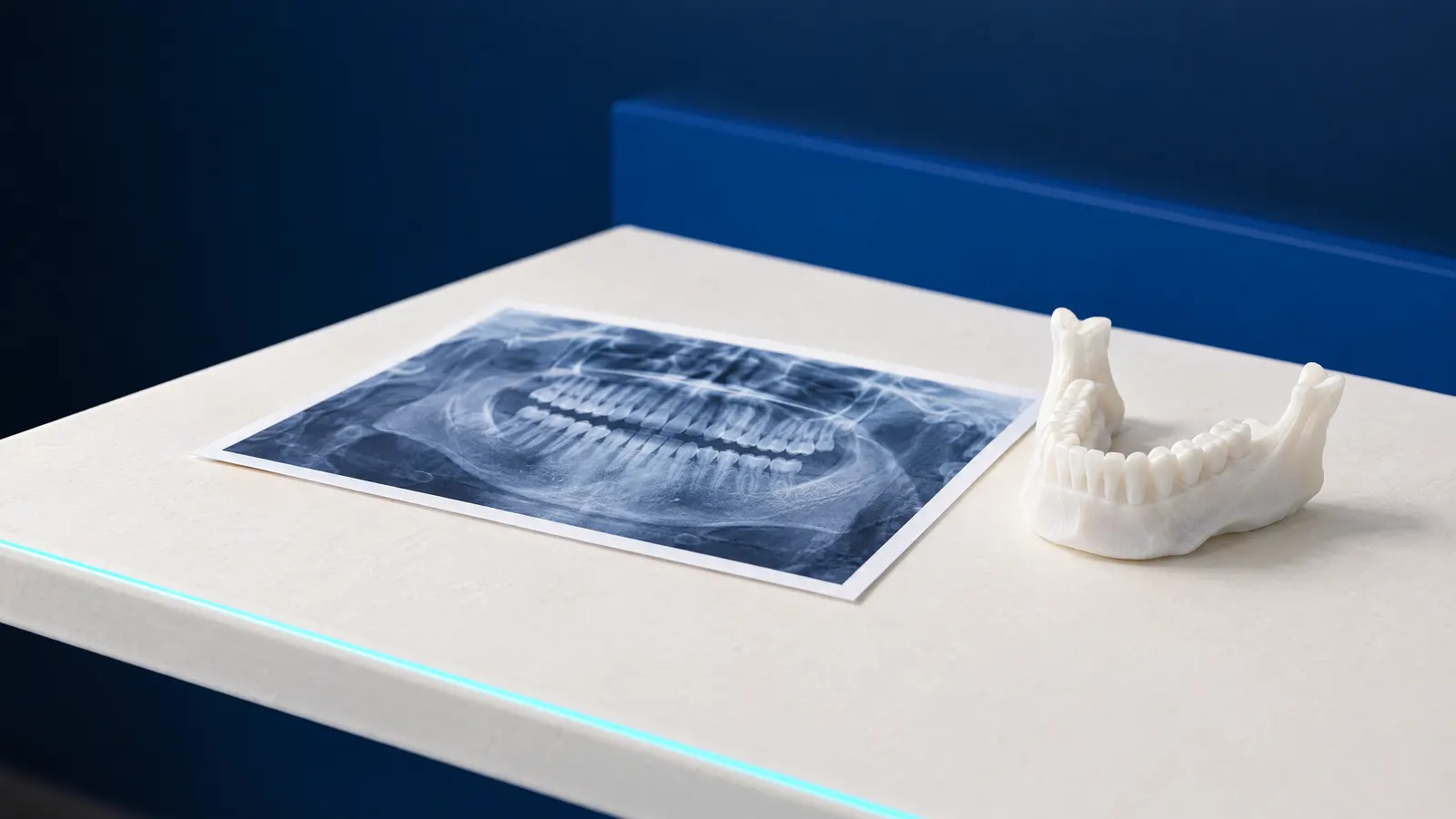
When orthodontic treatment is being considered, a panoramic radiograph, which shows all the teeth, including those that have not yet come through, is often appropriate. A lateral cephalometric radiograph, a side-view X-ray of the head used to measure the positions of the jaws and teeth, helps with diagnosis and planning, but when the position of the incisors does not need to change much, it is usually not needed (Isaacson et al., 2015).
At DentalBlue, panoramic radiographs, cephalometric radiographs and CBCT scans are taken in the clinic’s own radiology unit, and orthodontic treatment is planned digitally, using cephalometric analysis. The records also include photographs and models or scans of the teeth. The orthodontist decides which examinations are needed, and recent images from another practice may make some of them unnecessary.
A child’s first orthodontist appointment: consent, habits and the NFZ
A parent or another legal representative attends the consultation with a child, because they give consent to the child’s examination and treatment; a de facto carer, meaning a person who provides ongoing care for the child without a statutory duty (art. 3 of the Patient Rights Act), can consent only to the examination itself. Simply bringing the child to an appointment does not make someone a de facto carer. A teenager aged 16 or over must also give their own consent (art. 32(2), (3) and (5) of the Act on the Professions of Physician and Dentist). The article about a 16-year-old at the dentist without a parent explains the consent rules and when a parent can give consent by phone.
Before the appointment, note whether your child sucks their thumb, bites their nails, breathes through their mouth or snores. Pacjent.gov.pl points out that an ENT consultation is sometimes needed before orthodontic treatment, for example because of enlarged tonsils, and that you need a referral to see an ENT specialist.
Through the NFZ, removable appliance treatment is available until the 12th birthday. Children treated under the NFZ also have follow-up checks of the results after completed treatment and repairs of an appliance made under the NFZ until their 13th birthday, unless the appliance was damaged through improper use. An orthodontist’s examination and specialist consultation are available through the NFZ until the 18th birthday, and during treatment provided under the NFZ, where clinically justified, up to 2 panoramic radiographs, taken on referral from the orthodontist, and up to 2 cephalometric radiographs (Annex 6 to the regulation, consolidated text Dz.U. 2025 poz. 615; pacjent.gov.pl). A separate NFZ programme covers orthodontic treatment for children with congenital defects of the facial skeleton, such as cleft palate.
A first orthodontist appointment for adults: how is it different?
An orthodontic consultation for an adult follows the same pattern: a conversation, an examination, a decision about X-rays and a discussion of the options. BOS says teeth can be moved at any age if the teeth and gums are healthy, and that adults’ expectations of the result may differ from children’s, which the orthodontist should discuss when presenting the treatment options.
Through the NFZ, appliance treatment is available to children up to 12 and an orthodontic consultation up to 18, so adults pay privately, except in a separate programme for people with congenital defects of the facial skeleton, in which adult patients can continue treatment if they document that it began in this programme or in one of the two earlier programmes for children with cleft palate. If you have bleeding gums, loose teeth or untreated cavities, the orthodontist may recommend treating them before braces are fitted. During orthodontic treatment you still attend check-ups with your own dentist, because the orthodontist looks after the brace, and the risk to your teeth increases during this time (BOS).
What should you ask the orthodontist at the first appointment?
BOS lists six questions worth asking before treatment starts, and advises that at the consultation the orthodontist should present all the treatment options with their risks and benefits, discuss the types of brace, estimate the treatment time, explain from the outset the need to wear a retainer, probably for life, give you time to think it over and provide a written plan and cost estimate. Treatment often takes between a year and 2 years, and check-ups usually take place every 4 to 10 weeks (BOS).
- How long will my treatment take?
- Will the result be stable?
- Will I need a retainer after treatment, and how long will I have to wear it?
- What are the risks of treatment?
- What will the total cost of treatment be, and does it include brace repairs and retainers?
- Who will carry out my treatment?
How much does a first orthodontist appointment cost in Białystok?
In DentalBlue’s published price list, an ‘Orthodontic consultation’ costs 300 zł. If the orthodontist considers them necessary, examinations and records are added and priced separately; the table lists the items as they appear in the price list.
The total of the items in the table is not a treatment estimate: the dentist may consider some examinations unnecessary, for example if you bring recent images, and the cost of the brace is set only after the consultation and treatment planning. Prices may change. At a practice with an NFZ contract, the orthodontic treatment a child is entitled to under the insurance is free.
| Price-list item | What it is | Price |
|---|---|---|
| ‘Orthodontic consultation’ | First appointment and examination | 300 zł |
| ‘Panoramic radiograph’ | Image of all the teeth and jawbones | 120 zł |
| ‘Cephalometric radiograph’ | Side-view head X-ray for measurements | 120 zł |
| ‘Diagnostic scans’ | Digital image of the dental arches | 300 zł |
| ‘Diagnostic model’ | Model of the teeth for planning | 260 zł |
| ‘Treatment plan with cephalometric analysis’ | Measurements and a plan before choosing a brace | 380 zł |
| ‘Clear Aligner visualisation’ | Preview of the aligner treatment plan | 350 zł |
How to prepare for your first orthodontist appointment at DentalBlue
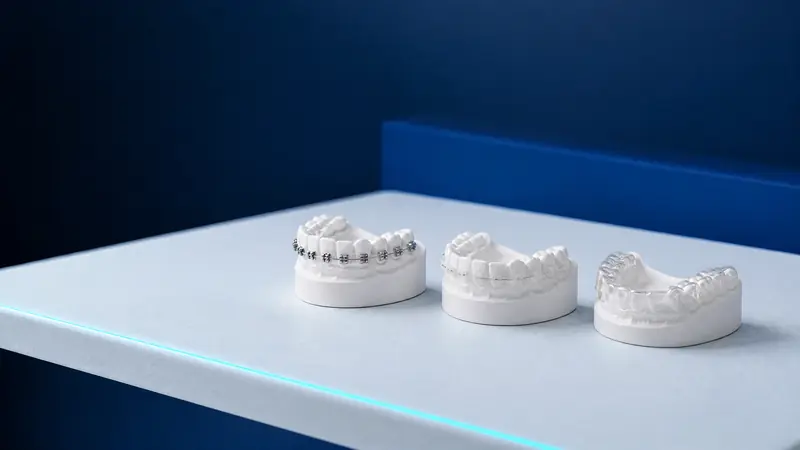
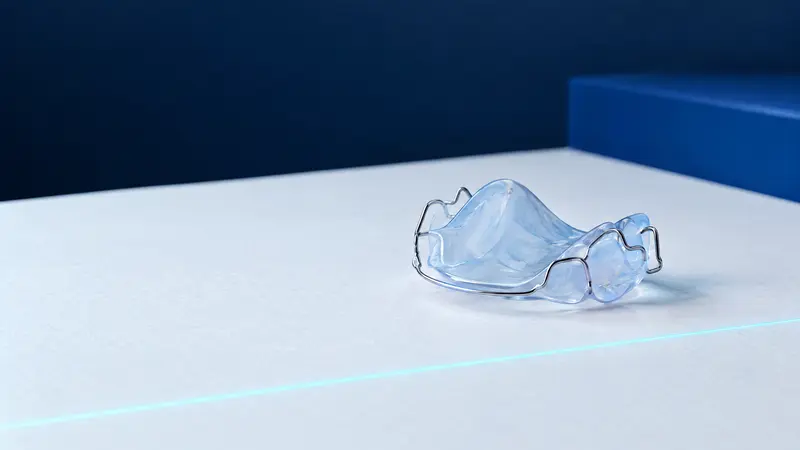
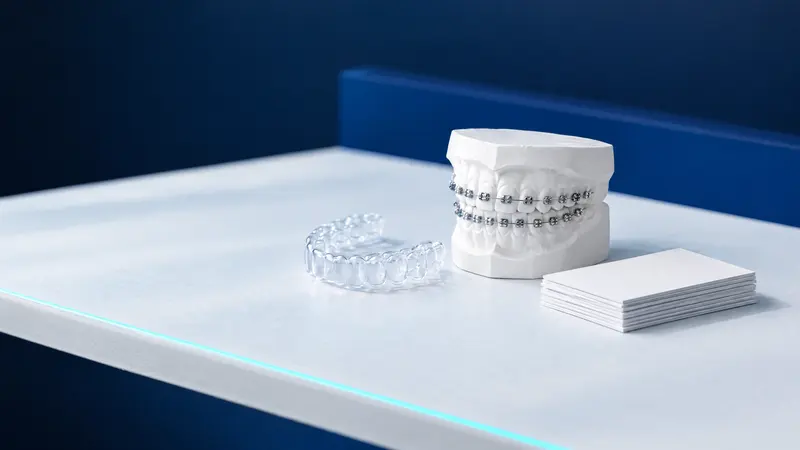
At DentalBlue in Białystok, orthodontic treatment includes fixed braces, removable appliances and Clear Aligner trays, and X-rays are taken in the clinic’s own radiology unit. Call 85 748 00 50 to book an ‘Orthodontic consultation’ (300 zł). A member of the reception team answers during opening hours.
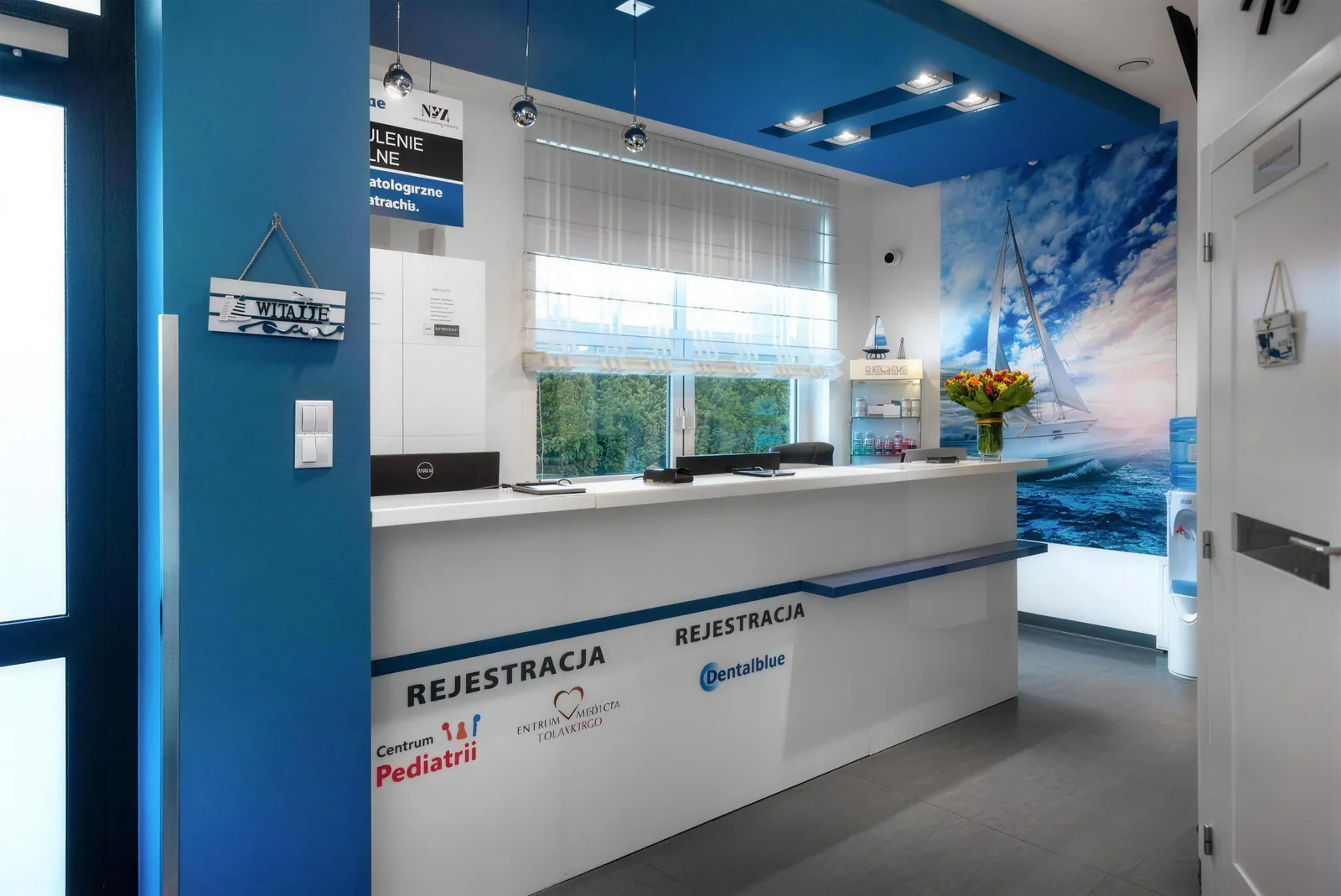
The clinic is at ul. Kazimierza Pułaskiego 35, 15-337 Białystok, and the nearest bus stop, Pułaskiego/Wspólna, is 50 m from the entrance. DentalBlue is open Monday to Friday from 8:00 to 20:00 and Saturday from 8:00 to 16:00. The team speaks Polish, English, Ukrainian and Russian. Before your first appointment, brush your teeth and prepare the following:
- Previous dental images, preferably as files or on disc, with reports.
- A list of the medicines you take and details of any long-term health conditions.
- For a child: a parent or another legal representative present if consent to treatment is needed (a de facto carer can also consent to the examination alone), the teenager’s own consent from age 16, and a note about habits, breathing and snoring.
- Information about any previous orthodontic treatment and retainer.
- Your own questions about treatment time, retention and the total cost.
Frequently asked questions
Are braces fitted at the first orthodontist appointment?
Very rarely. The British Orthodontic Society says that at the first appointment the orthodontist examines the teeth and gums, arranges X-rays if needed and discusses the treatment options, and that fitting braces at that point is very unlikely. Braces are fitted once the records have been collected and a plan agreed.
Do I need a referral to see an orthodontist?
No. The government website pacjent.gov.pl, run by the Ministry of Health and the NFZ, states plainly that you do not need a referral to see an orthodontist. A referral from the orthodontist is, however, needed for a panoramic radiograph as part of NFZ-funded orthodontic treatment.
How much does a first orthodontist appointment cost in Białystok?
In DentalBlue’s price list, an ‘Orthodontic consultation’ costs 300 zł. If the orthodontist considers them necessary, examinations are added, for example ‘Panoramic radiograph’ and ‘Cephalometric radiograph’ at 120 zł each, ‘Diagnostic scans’ at 300 zł and ‘Treatment plan with cephalometric analysis’ at 380 zł.
Do I need an X-ray before my first orthodontist appointment?
No. The orthodontist decides after the examination whether an X-ray is needed, because every radiograph must be clinically justified (Isaacson et al., 2015). If you have recent dental images from another practice, bring them to the consultation.
At what age should a child have a first orthodontist appointment?
A child should see an orthodontist by the age of 7 at the latest, and can come for a check-up earlier (pacjent.gov.pl). Adults can come at any age: according to BOS, teeth can be moved if the teeth and gums are healthy.
Can an adult have an NFZ-funded orthodontic consultation?
Usually not. Through the NFZ, an orthodontic consultation and examinations are available until the 18th birthday, and removable appliance treatment until the 12th (consolidated text Dz.U. 2025 poz. 615). The exception is the programme for people with congenital defects of the facial skeleton, in which adults can continue treatment documented as having begun in this programme or in one of the two earlier programmes for children with cleft palate. At DentalBlue, an ‘Orthodontic consultation’ costs 300 zł.
Sources
- British Orthodontic Society: FAQs, the first appointment and questions to ask your orthodontist (2026)
- Isaacson KG et al., British Orthodontic Society: Guidelines for the Use of Radiographs in Clinical Orthodontics, 4th edition (2015)
- Pacjent.gov.pl (Ministry of Health and NFZ): orthodontics for children, referrals and NFZ benefits (updated 2024)
- ELI: Rozporządzenie Ministra Zdrowia w sprawie świadczeń gwarantowanych z zakresu leczenia stomatologicznego (Minister of Health regulation on guaranteed dental services), consolidated text, Dz.U. 2025 poz. 615, Annex 6 (orthodontics)
- Ministry of Health (Poland): orthodontic care programme for children with congenital defects of the facial skeleton (2025)
- Sejm: Ustawa o zawodach lekarza i lekarza dentysty, t.j. Dz.U. 2026 poz. 37 (art. 32)
- Sejm: Ustawa o prawach pacjenta i Rzeczniku Praw Pacjenta (Patient Rights and Patient Ombudsman Act), t.j. Dz.U. 2024 poz. 581 (art. 3)
- DentalBlue: published price list, orthodontics, Clear Aligner and X-rays
An informational article. It does not replace a consultation, and treatment decisions are made during a visit.