How high is the risk of infection at the dentist?
The risk of infection at the dentist is low if the practice follows basic hygiene rules. The CDC’s 2016 document on infection prevention in dental settings states that transmission of infectious agents between patients and dental staff is rare.
The same document acknowledges that transmission in dental practices, including between patients, was documented from 2003 to 2015. Usually no single specific failure could be identified, but reported shortcomings included unsafe injection practices, failure to heat-sterilise dental handpieces between patients and failure to monitor autoclaves using spore tests.
Examples in the literature cited by the CDC include patient-to-patient hepatitis B transmission after oral surgery (a 2007 report), at a portable dental clinic in West Virginia (2009), and hepatitis C transmission at an Oklahoma practice (a 2013 investigation). These events are rare, but show why the procedures below matter.
Which infections can be transmitted in a dental practice?
The main focus is on blood-borne viruses: hepatitis B and C viruses and HIV. Hepatitis is sometimes referred to colloquially in Polish as jaundice. The vaccination website szczepienia.pzh.gov.pl of Poland’s National Institute of Public Health PZH states that hepatitis B can be transmitted through contact with infected blood or non-sterile sharp medical equipment, such as needles and surgical instruments contaminated with an infected person’s blood.
A second group comprises respiratory infections transmitted through droplets or the air, for example during coughing and sneezing. CDC guidance also covers dental unit water because bacteria can multiply and form biofilm in long, narrow waterlines. The table summarises the main risks and how they are reduced.
| Risk | How transmission can occur | How the practice reduces it |
|---|---|---|
| Hepatitis B, hepatitis C, HIV | Blood on non-sterile needles or instruments | Instrument sterilisation; needle and cartridge for one patient only |
| Surgical and periodontal instruments | Contact with blood, soft tissues and bone | Always heat-sterilised |
| Dental handpieces | Contamination inside the handpiece during use | Heat sterilisation after every patient |
| Injections, including anaesthesia | Reuse of a needle, syringe or vial | Sterile technique; single-dose medicines for one patient |
| Dental unit water | Bacteria and biofilm in waterlines | Treatment to drinking-water quality; sterile fluids for surgery |
| Surfaces near the chair | Contact with contaminated surfaces | Barriers changed after each patient, or cleaning and disinfection |
| Respiratory infections | Coughing, sneezing, nasal secretions | Cough hygiene, masks, postponing non-urgent treatment |
| Practice staff | Contact with blood and secretions | Gloves, masks, eye protection, staff vaccinations including hepatitis B |
How are dental instruments sterilised?
After each patient, reusable dental instruments are first cleaned; how they are then reprocessed depends on their use and the manufacturer’s instructions, and surgical instruments and dental handpieces are always sterilised. According to the CDC, instruments that penetrate soft tissue or bone, such as surgical and periodontal instruments, must always be heat-sterilised, as must most instruments touching mucous membranes, such as dental mirrors.
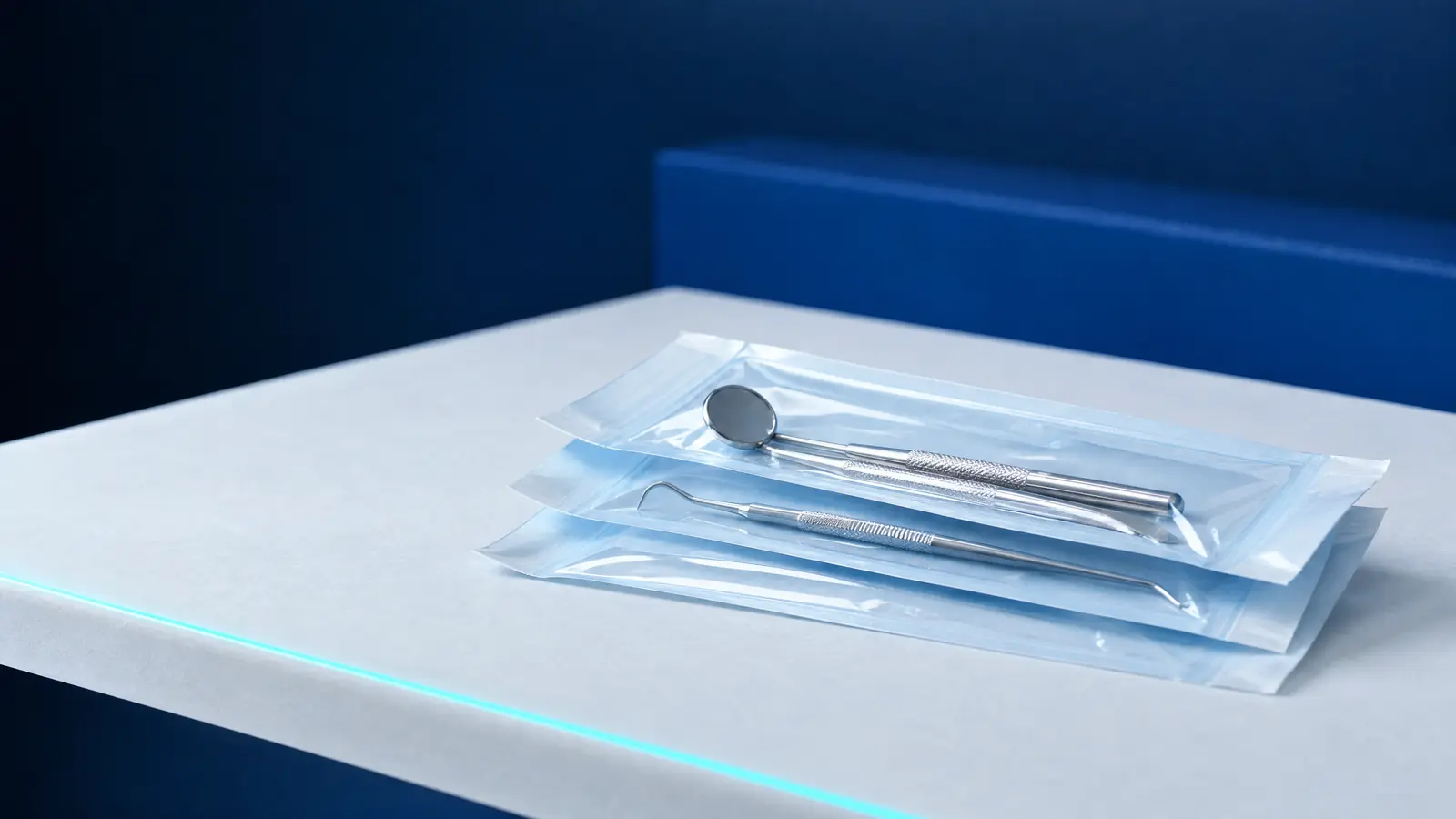
Once cleaned, instruments are packaged for sterilisation. Each pack is labelled with the cycle number, date and steriliser used. A chemical indicator inside shows whether the sterilising agent, such as steam, reached the instruments; if the colour has not changed, the instruments are not used. Packaging is checked for damage before opening.
The CDC recommends three types of indicator for monitoring sterilisation: mechanical (pressure, temperature and time records), chemical and biological. Biological indicators, or spore tests containing highly resistant bacterial spores, are the most widely accepted method and should be used at least weekly. Results and equipment servicing are documented.
In Poland, these duties derive from the Act on Preventing and Combating Infections and Infectious Diseases in Humans (t.j. Dz.U. 2025 poz. 1675; legal status as of 24 October 2026). Its art. 11 requires providers to develop, implement and supervise infection prevention procedures, including decontamination of medical devices, surfaces and equipment, use personal protective equipment and conduct internal checks. Its art. 12 requires these activities to be documented.
Which items are single-use and which are reusable?
Single-use products are those labelled by the manufacturer for one use. According to the CDC, they are used for one patient and then discarded. This includes needles and syringes and, for dental anaesthesia, the needle and anaesthetic cartridge, which must not be used for another patient.
Reusable items include hand instruments and dental handpieces, often called drills. The CDC stresses that handpieces, including low-speed motors and reusable prophylaxis angles, must be heat-sterilised after every patient, rather than just surface-disinfected, because their interiors can become contaminated with material from the patient.
The cartridge syringe is also cleaned and sterilised before use for another patient. Digital intraoral X-ray sensors are covered with a disposable barrier and reprocessed between patients according to the manufacturer’s instructions: the CDC provides for cleaning followed by sterilisation or high-level disinfection. If a sensor cannot tolerate these methods, the CDC recommends at a minimum a barrier plus cleaning and disinfection with an intermediate-level disinfectant.
How are water, surfaces and personal protection managed?
According to the CDC, dental unit water used to cool the drill and rinse the mouth should meet drinking-water standards: no more than 500 colony-forming units (CFU) of heterotrophic bacteria per millilitre. Water reservoirs alone are not enough; treatment systems and monitoring in accordance with the manufacturer’s instructions are needed. Sterile saline or sterile water is used during surgery.
Surfaces near the dental chair are covered with barriers changed after every patient, or cleaned and disinfected between patients. Standard precautions are fundamental and, according to the CDC, apply to every patient, whether or not an infection is known about. They include:
- Hand hygiene, which the CDC calls the most important way to prevent the spread of infection.
- Personal protective equipment, such as gloves, masks and protective eyewear.
- Respiratory hygiene: covering the mouth and nose when coughing, and masks for people who are coughing.
- Safe handling of sharp instruments and safe injections.
- Sterile instruments and devices, and clean, disinfected surfaces.
Is hepatitis B vaccination worth considering?
Hepatitis B vaccination protects against infection regardless of where exposure might occur. The szczepienia.pzh.gov.pl website states that in Poland vaccination against hepatitis B is compulsory for infants and for specified previously unvaccinated risk groups, including people infected with hepatitis C virus (HCV) and healthcare workers exposed to infection. It is recommended for other non-immune people; a doctor decides the appropriate schedule.
For healthy people, 3 doses at 0, 1 and 6 months are sufficient, and a full course provides long-term immunity (page updated 5 January 2026). If you do not know whether you were vaccinated, ask your GP. The CDC also recommends that practices have a staff vaccination programme including hepatitis B.
What can you ask at the practice?
You have a right to care in conditions meeting professional and sanitary requirements (art. 8 of the Patient Rights Act), so asking about hygiene is a normal part of talking to your dentist. For example, you can ask:
- Are the instruments for my procedure in labelled sterilised packs, and will they be opened in front of me?
- Are dental handpieces sterilised after every patient?
- How does the practice monitor sterilisation effectiveness, for example with spore tests?
- Are the needle, cartridge and other single-use products opened only for me?
- How is water in the dental unit treated?
Should you tell your dentist about HIV or hepatitis?
Yes, it is worth telling your dentist about HIV, hepatitis B or hepatitis C. This information helps make your treatment safe, rather than changing hygiene rules. Standard precautions apply to all patients, so the practice protects others in the same way regardless of what you disclose.
Liver, kidney and blood disorders can increase bleeding, as the Scottish SDCEP programme’s patient leaflet (2022) notes. The dentist takes these into account when planning procedures and, if necessary, contacts the doctor treating you.
Information about your health is confidential (art. 13 i 14 of the Patient Rights Act, art. 40 of the Act on the Professions of Doctor and Dentist). When delay could endanger life or cause serious bodily injury or a serious health disturbance, the doctor must provide help (art. 30).
Hygiene questions at DentalBlue
At DentalBlue in Białystok, the clinical team includes dentists, dental assistants and hygienists. You can ask about instrument and workstation preparation before the procedure starts. Before your appointment, mention conditions, medicines and infections, including those that seem unrelated to your teeth. Consultations can be arranged on 85 748 00 50, Monday to Friday from 8:00 to 20:00 and Saturdays from 8:00 to 16:00, in Polish, English, Ukrainian or Russian.
Frequently asked questions
Can you catch HIV at the dentist?
In theory yes, because HIV is blood-borne, but the CDC describes infection transmission in dental settings as rare and associated with procedural failures. Sterilisation, needles and cartridges used for one patient only, and standard precautions applied to every patient provide protection.
Can dental unit water transmit infection?
Water treatment reduces the risk. For routine treatment, the CDC recommends dental unit water with no more than 500 colony-forming units (CFU) of heterotrophic bacteria per millilitre. Sterile fluids are used for surgery. Without treatment, bacteria can multiply and form biofilm in dental unit waterlines.
Are disinfected instruments as safe as sterilised ones?
Not always. The CDC requires instruments that penetrate tissue or bone to be heat-sterilised, and dental handpieces to be sterilised after every patient. Surface disinfection of handpieces alone is insufficient because their interiors can be contaminated. For items touching only intact skin, cleaning is usually sufficient, with disinfection if soiled.
Can a patient with a cold infect others in the waiting room?
Yes. The CDC therefore recommends cough hygiene, masks for coughing patients, sitting away from others and, where possible, postponing non-urgent treatment until the patient is no longer infectious. If you have an infection, call the practice before attending and ask about rescheduling.
Are children vaccinated against hepatitis B?
Yes. According to szczepienia.pzh.gov.pl, hepatitis B vaccination is compulsory for all infants in Poland. Children with a birth weight below 2 000 g receive 4 doses at 0, 1, 2 and 12 months, while healthy people receive 3 doses. A doctor confirms the schedule for each child.
Sources
- CDC: Summary of Infection Prevention Practices in Dental Settings, Basic Expectations for Safe Care (2016)
- CDC: Summary of Infection Prevention Practices in Dental Settings, website (2024)
- Sejm: Ustawa o zapobieganiu oraz zwalczaniu zakażeń i chorób zakaźnych u ludzi, t.j. Dz.U. 2025 poz. 1675 (art. 11, 12)
- NIZP PZH: Szczepienia.info, hepatitis B (2026)
- Sejm: Ustawa o prawach pacjenta i Rzeczniku Praw Pacjenta, t.j. Dz.U. 2024 poz. 581 (art. 8, 13, 14)
- Sejm: Ustawa o zawodach lekarza i lekarza dentysty, t.j. Dz.U. 2026 poz. 37 (art. 30, 40)
- SDCEP: Anticoagulant or Antiplatelet Medication and Your Dental Treatment, patient leaflet (2022)
An informational article. It does not replace a consultation, and treatment decisions are made during a visit.